📌 Key Takeaways
- Keep your highest tile in a corner — this is the most important rule
- Build a descending chain of values from your corner tile
- Plan 3-4 moves ahead to anticipate tile placement
- Use the undo button to learn from mistakes, not as a crutch
- Patience and consistency matter more than speed
2048 is one of the most addictive and elegant puzzle games ever created. Created by Italian developer Gabriele Cirulli in 2014, the game has captivated millions of players worldwide with its simple premise and deep strategic complexity. The goal is straightforward: merge matching numbered tiles on a 4×4 grid to reach the elusive 2048 tile. But achieving that goal requires strategy, patience, and careful planning.
At MIA Games, we've seen thousands of players take on the 2048 challenge. Some reach 2048 in their first few attempts; others struggle to break the 512 barrier. This guide will equip you with proven strategies to not only reach 2048 but to go beyond — achieving high scores and maybe even reaching the 4096 tile.
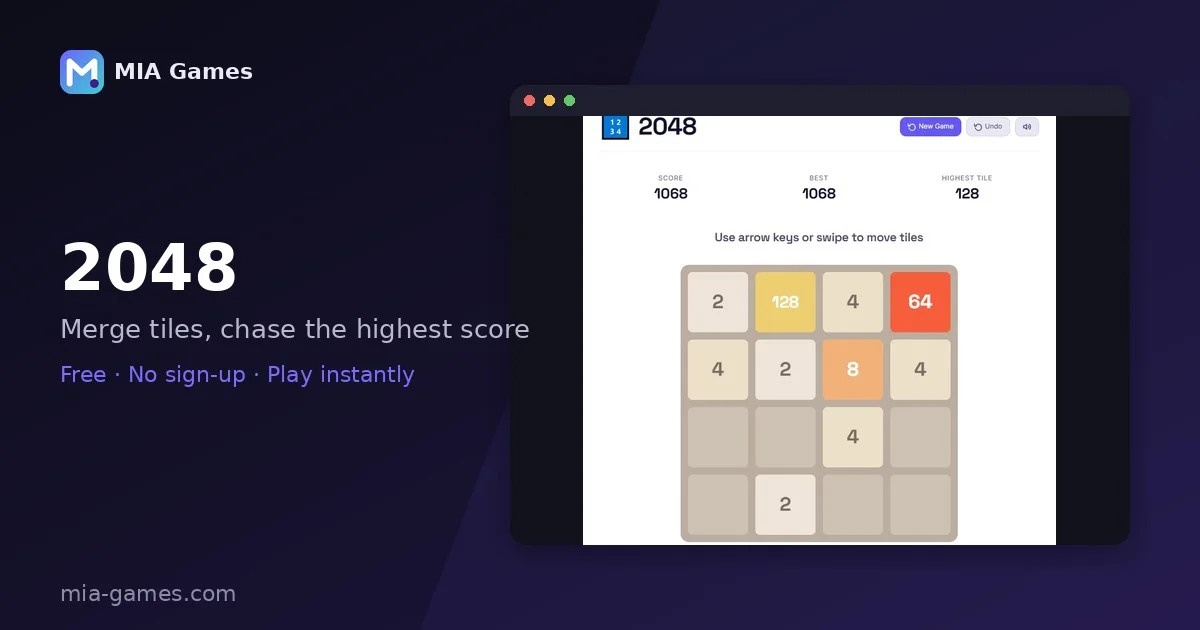
Understanding the Basics
Before diving into advanced strategies, let's recap the core mechanics. You control the movement of all tiles on the grid by pressing arrow keys (or swiping on mobile). Each move shifts all tiles in the chosen direction as far as possible. When two tiles with the same number collide, they merge into one tile with the combined value, and you earn points equal to the new tile's value.
After each move, a new tile (either 2 or 4) appears in a random empty cell. The game continues until you create a 2048 tile (you win!) or there are no empty cells and no adjacent tiles can be merged (game over). The random element — where new tiles appear — is what makes 2048 challenging. You can't control where tiles spawn, but you can control how you arrange the board to minimise disruption.
💡 Key Insight: Every move matters. A single poor move can create a "snowball effect" that fills your board with unmergeable tiles. Patience and planning are your greatest tools.
The Corner Strategy: The #1 Rule
The most important strategy in 2048 is to keep your highest tile in a corner. This is the single most effective technique for consistent success. Here's why:
- A corner tile only needs to be protected from two directions instead of three, making it much easier to maintain your arrangement
- It provides a stable anchor for building a descending chain of values — a structure that makes merges predictable and efficient
- It's much harder for random new tiles to disrupt your arrangement when your highest tile is in a corner
- It simplifies decision-making — you know exactly where your highest tile will always be, reducing cognitive load
Pro Tip: Most experienced players choose the bottom-left or bottom-right corner as their "home base." Stick with one corner and never move your highest tile from it unless absolutely forced to.
Build a Descending Chain
Once your highest tile is securely in a corner, your next goal is to build a descending chain of values extending from that corner. The chain should be arranged so that values decrease as you move away from the corner.
Here's an example with the bottom-left corner as your anchor:
- Bottom-left: 1024 (your highest tile)
- Next to it: 512, then 256, then 128
- Above them: 64, 32, 16, 8
This chain structure makes merges predictable and efficient. When you merge two tiles, the resulting tile will naturally fill the correct position in the chain, maintaining your organisation. Think of it like a well-organised filing system — everything has its place, and you can find what you need instantly.
Don't Move Your Highest Tile
This cannot be overstated: never move your highest tile from its corner. If you're forced to, it's often better to restart the game than to try to recover. Once your highest tile leaves the corner, you lose your anchor, and the board becomes chaotic.
To avoid moving your corner tile, use these guidelines:
- If your highest tile is in the bottom-left, avoid pressing ⬆ Up or ➡ Right unless absolutely necessary
- Focus on moves that keep the tile locked in place (⬅ Left and ⬇ Down in the example above)
- If you must move it, try to return it to the same corner as quickly as possible — and learn from the mistake
Plan Your Merges Ahead
Successful 2048 players think several moves ahead. Before making a move, visualise where each tile will end up and how new tiles will appear. Consider:
- What tiles will merge? Look for pairs that are close to each other — the closer they are, the easier they are to merge
- Where will new tiles appear? Empty cells are valuable — avoid moving tiles into positions that create chaotic patterns
- What's the backup plan? If your move doesn't work as intended, have a strategy to recover
🎯 Strategy Check: Before every move, ask yourself: "Does this move bring me closer to the 2048 tile, or does it just shuffle pieces around?" If you can't answer with confidence, pause and reassess.
Use the Undo Feature Wisely
In the MIA Games 2048, you have an Undo button. Use it! Professional players often use undo to:
- Recover from obvious mistakes — we all make them
- Test different strategies without penalty — "what if we moved up instead of left?"
- Learn from your errors by comparing what happened with what you expected
However, avoid relying on undo as a crutch. The best way to improve is to understand why a move was good or bad. Use undo as a learning tool, not a safety net.
Advanced Patterns: The "Snake" Method
Once you've mastered the basics, try the "Snake" method, named for its winding pattern. The idea is to keep your tiles in a continuous chain from the highest value to the lowest, like a snake winding across the grid.
Here's the pattern for a bottom-left anchor:
- Row 4 (bottom): 1024 < 512 < 256 < 128
- Row 3: 64 < 32 < 16 < 8
- Row 2: 4 < 2 < 4 < 2 (or similar low values)
- Row 1 (top): 8 < 16 < 32 < 64
This "snake" pattern allows you to merge tiles efficiently when you move upwards. If you maintain this structure, every upward move will create powerful merges that keep your chain strong. It's called the "snake" method because the chain snakes back and forth across the rows, maintaining a continuous flow of values.
What to Do When You Get Stuck
Even with perfect strategy, you'll sometimes find yourself with no good moves. Here's how to handle it:
- Look for opportunities: Sometimes a move that seems bad can create a new merge opportunity
- Clear smaller tiles first: Focus on merging low-value tiles (2s and 4s) to free up space
- Consider a "sacrifice" move: If you're truly stuck, a strategic move that disrupts your chain but creates new opportunities might be your only option
- Use the undo button: If a move made things worse, undo and try something different
Common Mistakes to Avoid
- Moving your highest tile: This is the most common and most damaging mistake. Protect your corner tile at all costs.
- Filling the board too quickly: Slow down. Sometimes the best move is to wait (by making a safe, non-disruptive move) rather than rushing.
- Ignoring the bottom row: If you're building from the bottom-left, never move the bottom row unless absolutely necessary. Keep it stable.
- Panicking when a new tile appears: Remember that new tiles are random. Adapt your strategy rather than abandoning it.
How to Score Higher Points
Your final score in 2048 is the sum of all merged tiles. If you want high scores, focus on:
- Keeping your board organised: A clean board creates more merge opportunities
- Avoiding early merges: Sometimes it's better to delay a merge to set up a larger chain
- Maximising each move: Every move should have a purpose — don't waste moves on meaningless shuffling
- Playing patiently: Rushing leads to mistakes. Take your time and think each move through
Practice Plan for Improvement
Here's a simple plan to build your 2048 skills:
- Week 1: Focus on the corner strategy. Play without using undo. Aim to reach 512 consistently.
- Week 2: Practice building a descending chain. Try to reach 1024.
- Week 3: Learn the snake pattern. Aim to reach 2048 at least once.
- Week 4: Focus on efficiency. Reduce your move count and aim for higher scores (not just reaching 2048, but getting a high score when you do).
Key Strategies Summary
Corner Anchor
Keep your highest tile in a corner. Never move it!
Descending Chain
Build a chain of decreasing values from your corner
Plan Ahead
Think 3-4 moves in advance. Visualise outcomes
Use Undo
Learn from mistakes by undoing and trying again
Snake Pattern
Arrange tiles in a winding chain for efficiency
Stay Patient
Rushing leads to mistakes. Take your time
Frequently Asked Questions
What's the best starting move in 2048?
There's no single best starting move, but most experienced players recommend moving in a way that establishes a corner strategy early. Some players prefer moving down and left, others down and right. The key is to pick a direction and stick with it.
Is 2048 a game of luck?
Not really. While new tiles appear randomly, the game is fundamentally about strategy. Skilled players can consistently reach 2048 because they manage the board effectively regardless of where new tiles appear. Luck plays a small role, but strategy is the deciding factor.
How do I get a higher score in 2048?
Higher scores come from merging larger tiles. Focus on keeping your board organised and building a descending chain. The more efficient your merges, the higher your score. Don't rush — take time to plan each move.
What's the highest possible score in 2048?
The theoretical maximum score is around 3.9 million points, achieved by reaching the 131,072 tile — the highest tile mathematically possible on a 4×4 grid. In practice, most players never reach that level, but scores in the hundreds of thousands are achievable with practice.
Can I play 2048 on my phone?
Yes. MIA Games 2048 is fully responsive and works on any device with a browser. You can swipe on touchscreens or use arrow keys on desktop.
Why do I keep losing at 2048?
Most losses come from moving the highest tile out of its corner, filling the board too quickly, or not planning ahead. Review your games and look for patterns — you'll likely spot one of these mistakes.
Ready to Play?
Now that you have these strategies, it's time to put them into practice. Remember: reaching 2048 isn't about luck — it's about consistent, disciplined play. Every move counts, and every game is a learning opportunity.
Ready to test your skills? Play 2048 on MIA Games and apply these strategies. Keep track of your progress using the high score system, and don't forget to use the undo button when you need to learn from a mistake.
Good luck, and happy merging!