📌 Key Takeaways
- Browser gaming began in the early 1990s with simple text-based adventures
- Java and Flash (1995-2000) revolutionised browser gaming and enabled the indie game movement
- HTML5 (2010+) made browser games faster, more secure, and cross-platform
- Classic games like Pong, Snake, and Tetris laid the foundation for modern gaming
- Browser games remain popular because they're accessible, private, and nostalgic
Long before Fortnite and Among Us dominated screens, before gaming consoles became household staples, and before smartphones put games in every pocket — there was the humble browser game. The history of browser gaming is a story of innovation, accessibility, and the democratisation of play. It's a journey that began in the early days of the World Wide Web and continues to this day, with classic games like Snake, Pong, and 2048 still captivating players around the globe.
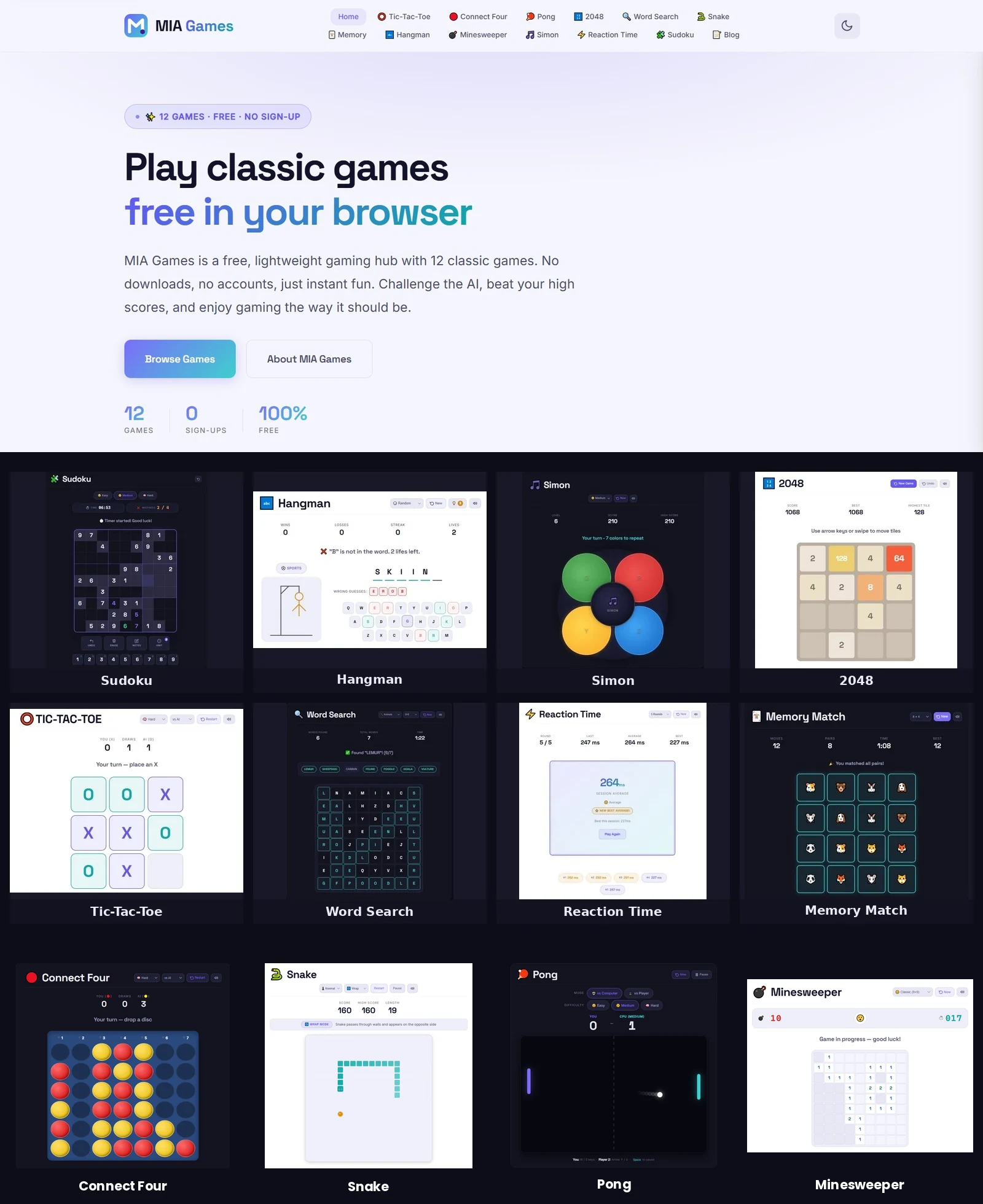
At MIA Games, we're proud to carry on this tradition. Our collection of 13 classic browser games is a tribute to the games that shaped the internet — and the millions of developers and players who made it all possible.
The Dawn of Browser Gaming (1990s)
The story of browser gaming begins with the invention of the World Wide Web itself. In the early 1990s, websites were simple, text-heavy pages. But as web browsers became more sophisticated, developers began to experiment with interactivity.
The first browser games were simple, often text-based adventures. They relied on basic HTML and sometimes a bit of JavaScript — which was itself a fledgling technology. These early games were primitive by today's standards, but they proved a crucial point: the web could be more than just a repository of information; it could be a platform for entertainment.
One of the earliest documented web-based games was "World Wide Web Worm," a text-based adventure created in 1993 by Martijn Koster. It allowed players to explore a virtual world by clicking hyperlinks. The game is long gone, but its legacy lives on in every browser game you play today. Another early example was "The Adventures of Captain Gamma" — a simple point-and-click adventure — demonstrating that the web had real potential for interactive storytelling.
💡 Did You Know? The first-ever web-based game is widely considered to be "World Wide Web Worm", a text-based adventure created in 1993. It allowed players to explore a virtual world by clicking hyperlinks. The game is long gone, but its legacy lives on in every browser game you play today.
The Arrival of Java and Flash (1995-2000)
Two technologies transformed browser gaming in the late 1990s: Java applets and Macromedia Flash. Java applets, introduced in 1995, allowed developers to embed interactive applications directly into web pages. They could run complex code, display graphics, and even play sounds. For the first time, browser games could rival the quality of desktop games.
But it was Flash, introduced in 1996, that truly democratised browser gaming. Flash brought animation, sound, and interactivity to the browser in a way that was both lightweight and accessible. Its vector graphics scaled beautifully, and its ActionScript programming language was approachable for beginners. Suddenly, anyone with a creative idea and some Flash knowledge could create a game and share it with the world.
Flash games became a phenomenon. Sites like Newgrounds (launched in 1995), Armor Games (2003), and Kongregate (2006) became hubs for independent game developers. This was the birth of the indie game movement — years before Steam or mobile app stores made indie development mainstream. The "Flash era" produced countless classics, from Alien Hominid and Line Rider to The Impossible Game and Fancy Pants Adventure. These games weren't just time-wasters; they were cultural touchstones, shaping the tastes and interests of an entire generation.
The Rise of HTML5 and the Modern Era (2010-Present)
By the late 2000s, Flash's dominance began to wane. Security concerns, performance issues, and the rise of mobile devices — which didn't support Flash — led to a search for alternatives. The answer came in the form of HTML5.
HTML5 introduced a range of new features that made browser gaming more powerful than ever. The <canvas> element allowed for dynamic, pixel-level drawing. The Web Audio API enabled sophisticated sound design. WebGL brought 3D graphics to the browser. And with the advent of modern JavaScript engines, performance skyrocketed. Games that once required a plugin now ran natively in the browser, with no downloads, no permissions, and no security risks.
The 2048 phenomenon of 2014 is a perfect example of the HTML5 revolution. Created in a single weekend by Italian developer Gabriele Cirulli, the game reached over 100 million players within months. It was simple, addictive, and worked flawlessly on any device. It proved that HTML5 was the future of browser gaming — and that the best games don't need complex graphics to be compelling.
🎮 2048 — A Modern Classic: Created in 2014 by Gabriele Cirulli, 2048 is a perfect example of HTML5's capabilities. The game is simple, addictive, and works flawlessly on any device. Today, 2048 remains one of the most played browser games worldwide.
Iconic Browser Games That Shaped the Internet
Throughout browser gaming history, certain games have stood out as milestones — games that not only entertained millions but also pushed the medium forward.
Pong (1972) — The Beginning of Everything
While Pong wasn't a browser game — it was an arcade game — its legacy is inseparable from browser gaming. Pong was the first video game to achieve mainstream success. It established the template for competitive, two-player gaming. Countless browser games have drawn inspiration from Pong's simple, elegant design. Even today, Pong remains a benchmark for game developers: if you can build a Pong clone, you can build almost anything. Its enduring influence can be seen in games like Reaction Time and countless other browser-based challenges.
Snake (1997) — The Mobile Revolution
Before there were smartphones, there was the Nokia 6110. The 1997 version of Snake introduced millions of people to mobile gaming. It was simple — you guided a snake to eat food while avoiding its own tail — but it was also addictive. Snake proved that small, simple games could be just as compelling as complex, console-quality experiences. It paved the way for the casual gaming revolution, demonstrating that gaming didn't require expensive hardware or dedicated consoles. Today, Snake remains one of the most recognisable and beloved games in history.
Tetris (1984) — The Perfect Puzzle
Tetris is one of the most influential video games ever created. Its simple block-stacking mechanics have been adapted into countless browser games, including 2048 and Minesweeper. Tetris taught the world that puzzle games could be both accessible and deeply strategic. Its "easy to learn, hard to master" philosophy became the gold standard for game design, influencing everything from casual mobile games to competitive esports.
Minesweeper (1990) — The Brain Teaser
First introduced in Microsoft Windows 3.1, Minesweeper became a staple of office productivity — or, more accurately, office procrastination. Its combination of logic, memory, and calculated risk made it endlessly replayable. Minesweeper also served as a subtle teacher: it taught a generation of users how to use a mouse, demonstrating the difference between left-click, right-click, and the dreaded "chord-click." For many, Minesweeper was their first introduction to logic puzzles — and it remains a beloved classic to this day.
Word Search — The Word Lover's Delight
While word puzzles have existed for centuries, the digital Word Search became a browser phenomenon in the 2000s. Its combination of vocabulary, pattern recognition, and timed challenges appealed to casual players and word enthusiasts alike. Word Search demonstrated that browser games could be both educational and entertaining — a balance that many developers continue to strive for today.
Why Browser Games Are Still Popular
In an age of photorealistic 3D graphics and massive multiplayer online worlds, why do simple browser games still captivate millions?
- Accessibility: You don't need a powerful computer or a console to play browser games. Any device with a web browser — from a budget smartphone to a work laptop — can run them. This lowers the barrier to entry for players around the world.
- No Downloads: There's no waiting for downloads or updates. Click and play. This low-friction experience is especially important for casual gamers who want instant gratification.
- Cross-Platform: A browser game works on Windows, Mac, Linux, iOS, Android, and everything in between. This universal compatibility is a huge advantage over platform-specific apps.
- Privacy-First: Unlike mobile apps that require permissions and access to your personal data, most browser games are self-contained. Hangman, for example, runs entirely in your browser without collecting any personal information.
- Nostalgia: For many players, browser games evoke a sense of nostalgia. They remind us of simpler times — late nights in the computer lab, lazy afternoons at school, and the early days of the internet.
- Quick Play Sessions: Browser games are designed for short bursts of play. They fit perfectly into busy schedules, offering a quick mental reset without the time commitment of console or PC games.
The Future of Browser Gaming
The future of browser gaming is bright. Advances in WebGL and WebAssembly are making it possible to create console-quality games that run entirely in the browser. Streaming services like Google Stadia and Xbox Cloud Gaming are also using the browser as a delivery mechanism, bringing AAA games to anyone with a decent internet connection.
But even as technology advances, the appeal of classic browser games remains strong. At MIA Games, we believe that the best games are timeless. They don't need complex graphics or elaborate storylines to be fun. They just need great mechanics — and the classic games of the past provide exactly that.
That's why we've built a collection of 13 classic games that have stood the test of time. From Tic-Tac-Toe to Sudoku, each game is a piece of gaming history, reimagined for the modern browser.
Frequently Asked Questions
What was the first browser game?
The first widely recognised web-based game was "World Wide Web Worm", a text-based adventure created in 1993. It allowed players to explore a virtual world by clicking hyperlinks.
Why did Flash games disappear?
Flash was discontinued by Adobe in 2020 due to security concerns, performance issues, and the rise of mobile devices that didn't support it. HTML5 replaced Flash as the standard for browser games, offering better security, performance, and cross-platform compatibility.
Are browser games still popular?
Yes. Browser games remain incredibly popular because they're accessible, private, and require no downloads. Millions of people play browser games daily, from casual puzzle games to competitive multiplayer experiences.
What makes a classic browser game?
A classic browser game is one that has stood the test of time — it's simple, addictive, and replayable. Games like Pong, Snake, Minesweeper, and Tetris are considered classics because they've been enjoyed by multiple generations of players.
Can I play browser games on my phone?
Yes. Most modern browser games are built with HTML5 and are responsive, meaning they adapt to any screen size. You can play them on your phone, tablet, or desktop without any downloads.
Are browser games free?
Many browser games are free, supported by ads or donations. At MIA Games, all of our 13 classic games are completely free to play — no subscriptions, no in-app purchases, no hidden costs.
Ready to Play?
The history of browser gaming is a story of innovation, accessibility, and timeless fun. Now, it's your turn to be part of that story. Explore our collection of classic games, challenge your friends, beat your high scores, and discover why browser games have captivated players for over three decades.
Start your journey today — browse our full collection and find your new favourite classic game.