📌 Key Takeaways
- Memory is trainable — just like a muscle, it responds to regular exercise
- Different games target different types of memory (visual, auditory, spatial)
- Techniques like chunking and the Method of Loci significantly boost recall
- Consistency (daily practice) matters more than long sessions
- Variety is key — rotating games prevents diminishing returns
Memory is one of the most essential cognitive functions we possess. It shapes our identity, helps us learn, and guides our daily decisions. But like any other skill, memory can be trained and improved — and one of the most enjoyable ways to do that is through games.
At MIA Games, we've built a collection of games that aren't just fun — they're powerful tools for cognitive enhancement. From Memory Match to Simon, Sudoku to 2048, each game challenges different aspects of your memory and cognitive function.
In this article, we'll explore 10 science-backed tips to improve your memory using games — and how you can incorporate them into your daily routine.
Play Memory Match Games Daily
Memory Match is the quintessential memory game. By flipping cards and finding pairs, you're exercising your short-term memory and spatial recall. Regular practice with memory matching games genuinely exercises working memory — and the tip about "chunking" 4-5 cards at a time is based on real, foundational psychology. In his famous 1956 paper "The Magical Number Seven, Plus or Minus Two," psychologist George Miller showed that human short-term memory holds roughly 4-7 items at once, and that grouping information into chunks is one of the most effective ways to work around that limit. Practicing this chunking strategy through games like Memory Match is a legitimate, well-grounded way to strengthen how efficiently you use your short-term memory.
Challenge Your Pattern Recognition with Simon
Simon is more than just a colourful game — it's a powerful tool for improving auditory and visual memory. The game requires you to remember and repeat increasingly complex sequences of colours and sounds. Pattern recognition games like Simon strengthen the neural pathways in the hippocampus, the brain's memory centre. The progressive difficulty means you're constantly pushing your memory limits, which is exactly what drives improvement.
Solve Puzzles with Sudoku
Sudoku is a logic puzzle that engages multiple cognitive functions simultaneously. You need to remember numbers, track possibilities, and hold complex patterns in your mind. Sudoku engages the same kind of structured, working-memory-heavy reasoning that's consistently linked to cognitive engagement in aging research more broadly. Puzzles that require holding multiple possibilities in mind while systematically testing them are a recognised category of "cognitively stimulating activity" that researchers in healthy-aging studies often point to — even without one game being singled out by name.
Practice Strategic Thinking with 2048
2048 requires you to plan several moves ahead while remembering the positions of your tiles. This combination of working memory and strategic planning is excellent for cognitive health. The game trains your brain to hold information in mind while simultaneously making decisions — a skill that translates directly to real-world problem-solving, from project planning to navigating complex social situations.
Use the "Method of Loci" Technique
The Method of Loci, also known as the "memory palace" technique, is one of the oldest and most effective memory strategies. It involves associating information with specific locations in a familiar place. You can practice this by creating a "map" of the game board in your mind and assigning each card or tile to a specific location on that map. The Method of Loci isn't just old — it's one of the most rigorously validated memory techniques in existence. It's the core strategy used by virtually every competitor in the World Memory Championships, and it's been studied extensively in cognitive science, including brain-imaging research showing it measurably changes how the brain encodes information. It's genuinely one of the most well-supported memory techniques humans have ever developed.
Take Regular Breaks Between Sessions
Memory consolidation — the process of transferring information from short-term to long-term memory — occurs during rest. This lines up with one of the oldest and most replicated findings in memory research: the "spacing effect," first documented by psychologist Hermann Ebbinghaus in 1885 and confirmed by countless studies since. Spreading learning out with rest in between consistently beats cramming everything into one continuous session, because your brain needs downtime to consolidate what it just processed into longer-term memory. After a challenging round of Simon or Memory Match, take a 5-minute break to let your brain process what you've learned.
Vary the Games You Play
Your brain thrives on novelty. Playing the same game repeatedly can lead to diminishing returns. By rotating through different types of games — from Sudoku to 2048 to Simon — you engage different neural pathways and prevent adaptation. This variety is essential for long-term cognitive improvement. Think of it like a balanced diet: different foods provide different nutrients, and different games provide different cognitive benefits.
Practice Mindful Observation
Before making a move, take a moment to observe the entire game board. In 2048, this means scanning all tiles and planning your next three moves. In Memory Match, it means paying attention to the positions of multiple cards. This mindful observation trains your brain to absorb more information from your environment — a skill that translates directly to better memory in daily life, from remembering where you parked your car to recalling a shopping list.
Use Associations to Remember Patterns
Associating new information with something you already know is a powerful memory technique. In Simon, you can associate each colour with a word or image (e.g., Green = Grass, Red = Fire). This technique, known as elaborative rehearsal, has been shown to improve retention rates significantly because it creates multiple mental "hooks" for the same piece of information, making it easier to retrieve later.
Make Memory Training a Daily Habit
Consistency is the secret to any cognitive improvement. Just 15 minutes of memory training each day can produce noticeable results within two weeks. At MIA Games, we've made it easy: our games are designed to be played in short, focused sessions that fit seamlessly into your daily routine. Whether you're playing Memory Match during your lunch break or Sudoku while commuting, every session counts. The key is to make it a habit — and to enjoy the process.
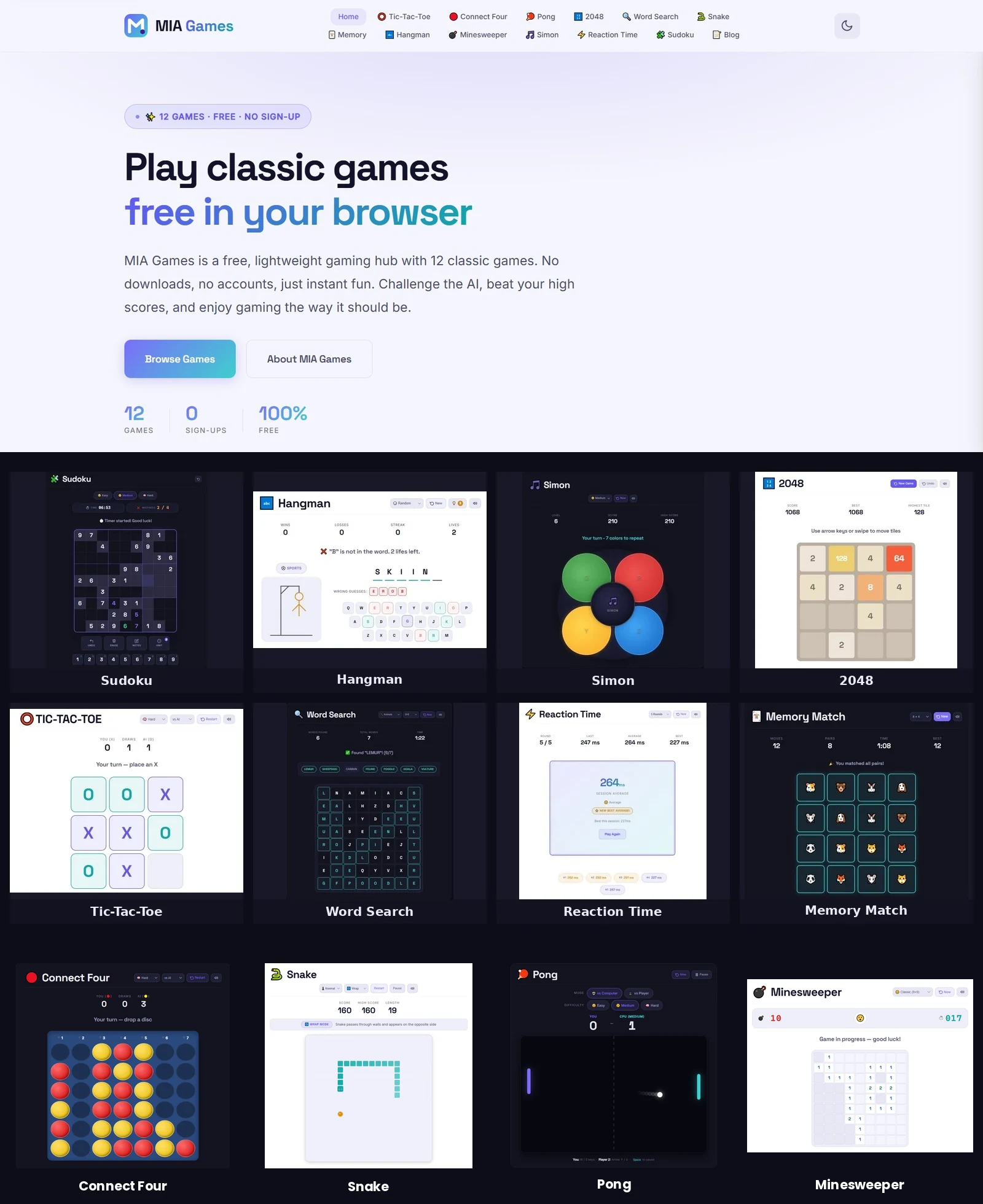
Which Games Are Best for Memory Training?
Different games target different aspects of memory. Here's a quick guide to help you choose:
- Memory Match — Improves short-term memory and spatial recall
- Simon — Enhances pattern recognition and auditory memory
- Sudoku — Boosts working memory and logical thinking
- 2048 — Develops strategic planning and forward-thinking memory
- Connect Four — Builds foresight and memory of opponent patterns
- Word Search — Enhances visual scanning and word recall
Suggested Training Schedule
Here's a simple weekly schedule to get the most out of your memory training:
- Monday: Memory Match (4×6 grid) — 10 minutes
- Tuesday: Simon (Medium difficulty) — 10 minutes
- Wednesday: Sudoku (Easy to Medium) — 15 minutes
- Thursday: 2048 — 10 minutes (focus on the corner strategy)
- Friday: Memory Match (6×6 grid) — 10 minutes
- Saturday: Any game of your choice — 15 minutes
- Sunday: Rest (or light play without pressure)
Frequently Asked Questions
Can memory games really improve my memory?
Yes — but with an important nuance. Research shows that memory games improve the specific skills they train (like short-term recall or pattern recognition). While the evidence for broad transfer to unrelated tasks is mixed, regular practice is a healthy form of mental exercise that supports cognitive health.
How long should I play memory games each day?
Most experts recommend 10-15 minutes of focused memory training daily. Consistency matters more than session length.
What is the Method of Loci, and does it really work?
The Method of Loci (Memory Palace) is a technique where you associate information with specific locations in a familiar place. It's one of the most rigorously validated memory techniques — used by World Memory Champions and backed by brain-imaging research showing it changes how the brain encodes information.
Are memory games suitable for older adults?
Yes. Research, including the ACTIVE study, has shown that older adults can benefit significantly from cognitive training. Games that challenge memory, reasoning, and processing speed are particularly beneficial for maintaining cognitive health in later life.
What's the best game for improving short-term memory?
Memory Match is specifically designed to challenge short-term and spatial memory. Simon is also excellent for short-term memory, especially with its auditory component.
Can I train my memory too much?
Like anything else, moderation is key. Overdoing cognitive training can lead to mental fatigue. It's important to balance memory training with rest, physical activity, and social engagement.
Start Your Memory Training Today
Your memory is like a muscle — it grows stronger with regular exercise. And the best part? You can train it while having fun. At MIA Games, we've created a collection of 13 classic games that are perfect for cognitive enhancement.
Ready to improve your memory? Browse our full collection and start your brain training journey today. Whether you're a beginner or a seasoned player, there's a game for every skill level.