📌 Key Takeaways
- Memory Match is a powerful brain-training exercise for short-term memory
- The Method of Loci (Memory Palace) is one of the most effective memory techniques
- Chunking information reduces cognitive load and improves recall
- Spatial memory strategies leverage the brain's natural strength
- Consistent practice with progressive difficulty leads to measurable improvement
Memory Match — it looks like a simple children's game, but don't let those colourful cards fool you. Beneath the surface, this classic matching game is one of the most effective brain-training exercises you can find. It challenges your short-term memory, spatial awareness, pattern recognition, and concentration — all at the same time.
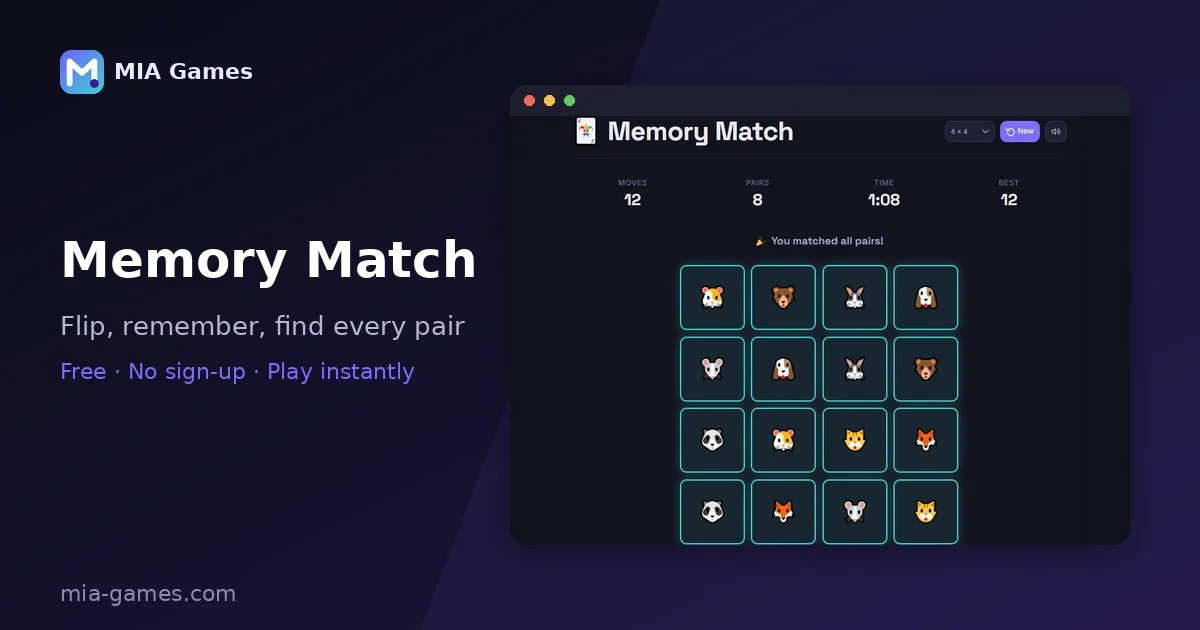
At MIA Games, we've built our Memory Match game with smooth 3D flip animations and a timer to track your progress. Over the years, we've watched players go from struggling with the 4×4 grid to breezing through the 6×6 board in under 60 seconds. The difference? They learned the techniques we're about to share with you.
💡 Key Insight: Memory Match isn't about having a "good memory" — it's about using the right strategies. Anyone can improve their card-flipping skills with the right techniques and consistent practice.
A Brief History of Memory Match
Memory Match — also known as Concentration or Pelmanism — has a surprisingly rich history. The game's origins can be traced back to the 19th century, where it was used as a teaching tool to develop children's memory skills. The name "Pelmanism" comes from the Pelman Institute, a British educational organisation founded in the early 1900s that promoted memory training techniques.
In its traditional form, Memory Match was played with physical cards laid face-down on a table. Players would take turns flipping two cards at a time, trying to find matching pairs. The game's simplicity made it accessible, while its cognitive demands made it effective. Today, Memory Match has found a new home in digital formats — including our MIA Games version — where it continues to challenge and delight players of all ages.
Understanding the Game
Before we dive into advanced strategies, let's make sure we're on the same page. Memory Match (also known as Concentration or Pelmanism) is played with a set of cards laid face-down in a grid. Each card has a matching pair somewhere on the board. Your goal is to flip two cards at a time and find all the pairs.
In our MIA Games version, you have the option to play on different grid sizes (4×4 and 6×6) and the game tracks your time and flip count. The fewer flips you make, the better your score.
Technique 1: The Method of Loci (Memory Palace)
The Method of Loci, also known as the "Memory Palace" technique, is one of the oldest and most effective memory strategies in existence. It was used by ancient Greek and Roman orators to memorise speeches, and it works beautifully for Memory Match.
Here's how to apply it: mentally assign each card in the grid to a specific location in a familiar place — like your home. For example:
- Row 1, Column 1 = Your front door
- Row 1, Column 2 = The coat rack
- Row 1, Column 3 = The living room sofa
- Row 2, Column 1 = The kitchen table
- And so on...
When you flip a card and see the image, mentally place that image at the corresponding location in your memory palace. When you find a match, you'll remember exactly where the other card is because you've anchored it to a location.
🧠 Science Says: The Method of Loci works because the brain is naturally better at remembering spatial information than abstract data. It's the core strategy used by virtually every competitor in the World Memory Championships.
Technique 2: Chunking
Chunking is the process of grouping information into smaller, more manageable units. Instead of trying to remember every card individually, group them by theme, colour, or pattern.
For example, if you see a card with a red pattern, mentally note all the red cards you've seen and their positions. If you see an animal card, group it with other animal cards. This reduces the cognitive load and makes it easier to recall where cards are located.
- Colour grouping: Group cards by colour (red, blue, green, yellow).
- Category grouping: Group by type (animals, objects, shapes, patterns).
- Positional grouping: Group cards by grid quadrant (top-left, top-right, bottom-left, bottom-right).
Chunking works because it leverages the brain's natural ability to recognise patterns. When you see a group of related items, you're not remembering them individually — you're remembering the relationship between them, which is much easier for your brain to process.
Technique 3: Spatial Memory Strategies
Your brain has a dedicated system for spatial memory — the ability to remember the location of objects in space. You can train this system by using a few key techniques:
- Scan systematically: Don't flip cards randomly. Scan the grid in a consistent pattern — left to right, top to bottom. This creates a mental map of where cards are located.
- Use landmark cards: If you find a particularly distinctive card, use it as a "landmark" to anchor surrounding cards in your memory.
- Create a mental grid: Before you start, visualise the grid and assign each square a mental coordinate (A1, A2, B1, B2, etc.).
Technique 4: Progressive Tracking
Progressive tracking is the skill of remembering more than one card at a time. Instead of flipping one card, remembering it, and moving on, try to hold 3-4 cards in your working memory at once.
Here's how to practice:
- Start small: Try to remember the positions of 2 cards at a time.
- Increase gradually: As you improve, work up to 3 cards, then 4.
- Use verbal repetition: Say the card's location out loud or in your head: "Red card at top-left, blue card at middle-right."
🎯 Pro Tip: In our MIA Games Memory Match, try playing on the 4×4 grid first and practice holding 4 cards in your memory. Once you can do that consistently, move up to the 6×6 grid.
Advanced Techniques
1. The "Two-Pass" Method
Instead of trying to memorise everything in one go, use a two-pass approach. On the first pass, focus on learning the positions of as many cards as possible. On the second pass, aim to match them efficiently. This reduces the cognitive load per pass.
2. The "Association" Technique
Create mental associations between cards. For example, if you see a card with a cat and a card with a dog, remember them together as "pets." This creates a mental hook that makes both cards easier to recall.
3. The "Pattern Break" Technique
If you're stuck, intentionally flip a card in a completely different area of the grid. This can break your mental fixation and help you see the board from a fresh perspective.
Key Techniques Summary
Method of Loci
Associate cards with locations in a familiar place.
Chunking
Group cards by colour, category, or position.
Spatial Memory
Create a mental map of the grid.
Progressive Tracking
Hold multiple card positions in memory.
Systematic Scanning
Flip cards in a consistent pattern.
Pace Yourself
Balance speed and accuracy.
Common Mistakes to Avoid
- Rushing: Speed is important, but accuracy is more important. One wrong pair costs you time and mental energy.
- Random flipping: Don't flip cards randomly. Every flip should have a purpose — either to confirm a suspected match or to gather new information.
- Ignoring the timer: The timer is your friend. Use it to track your progress, not to stress you out. Focus on improvement, not just speed.
- Not reviewing failed pairs: When you flip two cards that don't match, take a moment to memorise both positions. This is a crucial learning opportunity.
- Sticking to one grid size: Playing the same grid size repeatedly leads to diminishing returns. Vary the grid size to keep your brain challenged.
How to Practice and Improve
Here's a training plan to build your Memory Match skills:
- Week 1: Play the 4×4 grid and focus on accuracy. Aim to complete the game with 0-2 wrong flips.
- Week 2: Start tracking your time. Can you complete the 4×4 grid in under 30 seconds?
- Week 3: Move to the 6×6 grid. Use the Method of Loci and chunking techniques.
- Week 4: While playing 6x6, start practicing progressive tracking — aim to remember 3-4 cards at a time.
- Week 5: Alternate between grid sizes. Focus on consistency and efficiency.
Beyond Memory Match: Other Brain Training Games
Memory Match is just one of the many brain-training games we offer at MIA Games. If you're looking to improve other cognitive skills, try:
- Simon — Test your pattern recognition and auditory memory.
- Sudoku — Improve logical reasoning and working memory.
- 2048 — Develop strategic planning and forward-thinking memory.
- Minesweeper — Enhance logic, deduction, and spatial memory.
Each game targets different cognitive functions, so rotating through them gives you a well-rounded brain workout.
Frequently Asked Questions
What is the best strategy for Memory Match?
The most effective strategy is a combination of the Method of Loci (Memory Palace), chunking, and systematic scanning. Start by scanning the grid systematically, use chunking to group cards, and apply the Memory Palace technique to anchor card positions in your mind.
How can I improve my Memory Match score?
Focus on accuracy first, then speed. Use the techniques in this guide — especially chunking and progressive tracking. Practice regularly on different grid sizes, and always review your mistakes.
Is Memory Match good for brain training?
Yes. Memory Match challenges short-term memory, spatial awareness, and concentration — all key cognitive functions. Regular practice can lead to measurable improvements in these areas.
What is the Method of Loci?
The Method of Loci, also known as the Memory Palace technique, is a memory strategy where you associate information with specific locations in a familiar place. It's one of the most effective and well-researched memory techniques in existence.
Can I play Memory Match on my phone?
Yes. MIA Games Memory Match is fully responsive and works on any device with a browser. You can tap on touchscreens or use mouse controls on desktop.
What grid size should I start with?
Start with the 4×4 grid. It's small enough to be manageable but challenging enough to be effective. Once you can complete it consistently with few mistakes, move up to the 6×6 grid.
Ready to Play?
Now that you have these techniques, it's time to put them into practice. Play Memory Match on MIA Games and start applying these strategies. Challenge yourself to beat your best time and flip count — and don't be discouraged if you don't master it immediately. Every game is a step toward better memory.
Good luck, and happy matching!