📌 Key Takeaways
- Minesweeper is a game of perfect logic — every move should be based on deduction
- Start by identifying cells that are guaranteed safe or guaranteed mines
- Learn pattern recognition: 1-2-1, 1-2-2-1, and 1-1 patterns are essential
- Use chord-clicking to reveal multiple cells at once and save time
- When forced to guess, use probability to make the safest choice
Minesweeper — the game that defined a generation of office workers and computer lab sessions. On the surface, it looks like a simple grid of squares hiding invisible mines. But beneath that modest exterior lies a game of pure logic, deduction, and strategic thinking that rewards patience and careful analysis.
At MIA Games, we've seen thousands of players take on our Minesweeper challenge. Some breeze through Expert level in under 60 seconds. Others struggle to clear Beginner without stepping on a mine. The difference? It's not luck — it's strategy. In this guide, we'll share the exact techniques our team has used to solve thousands of boards and help you think like a Minesweeper pro.
💡 Key Insight: Minesweeper is a game of perfect logic. Every mine is placed before you start, and the numbers give you all the information you need. If you're guessing, you're missing a logical step.
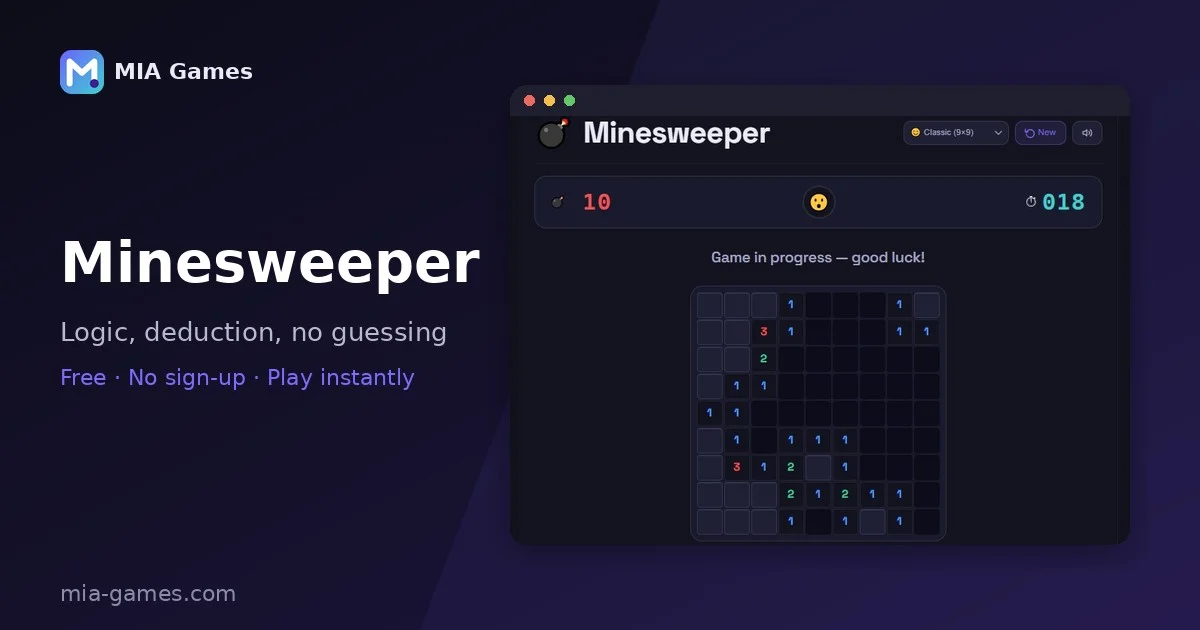
A Brief History of Minesweeper
Minesweeper has a surprisingly practical origin. It was first developed in the 1960s by a programmer named Robert Donner, who created a version called "Mine" for the PLATO computer system. The game was simple: a grid with hidden mines, and players had to flag them without clicking on them.
However, Minesweeper became truly famous when it was bundled with Microsoft Windows 3.1 in 1990. Microsoft had a specific goal: they wanted to teach users how to use a mouse. Minesweeper was perfect because it required left-clicking, right-clicking, and precise cursor control. It also encouraged double-clicking (chord-clicking) — a skill that was new to many users.
The game was designed by Curt Johnson, a Microsoft engineer, who based it on the earlier PLATO game. Johnson's version introduced the three difficulty levels we still use today: Beginner (9×9, 10 mines), Intermediate (16×16, 40 mines), and Expert (30×16, 99 mines). Minesweeper remained a Windows staple until Windows 8, and it's still available today through the Microsoft Store and countless browser versions — including ours at MIA Games.
Understanding the Basics
Before diving into advanced strategies, let's make sure we're on the same page about the rules. Minesweeper is played on a grid where some cells contain hidden mines. Your goal is to reveal all cells that don't contain mines — without clicking on a mine.
- Left-click: Reveals a cell. If it's a mine — game over.
- Right-click: Places a flag on a cell you believe contains a mine.
- Numbered cells: Tell you exactly how many mines are adjacent to that cell (including diagonals).
- First click: In our MIA Games version, your first click is always safe — no mine there.
The Golden Rule: Start with the Obvious
When you open a fresh board, your first move is safe. After that, look for cells with a number that already has all its mines flagged. If a "1" has a flag next to it, all other adjacent cells are safe to click. This is the most basic and important rule in Minesweeper.
For example, if a "1" is in a corner and has one adjacent flagged cell, the other adjacent cells (if any) are safe. If a "2" already has two flags adjacent to it, all other adjacent cells are safe. This pattern repeats for any number.
Pattern Recognition: The Key to Speed
The secret to fast Minesweeper play is pattern recognition. Instead of solving each cell individually, you learn to recognise common patterns that tell you exactly where the mines are. Here are the four most important patterns:
1-2-1 Pattern
Mines are always above/below the "1"s, not the "2".
💣 1 2 1 💣1-2-2-1 Pattern
Mines are above/below the "1"s and the outer edges of the "2"s.
💣 1 2 2 1 💣1-2-2-2-1 Pattern
Similar to 1-2-2-1 but with a safe middle cell.
💣 1 2 2 2 1 💣1-1 Pattern
If two "1"s are adjacent, the cells beyond them are safe.
1 1 → ✅ ✅The 1-2-1 Pattern in Detail
The 1-2-1 pattern is the most famous pattern in Minesweeper. When you see a sequence of numbers 1-2-1 in a row (or column), with the "2" in the middle, the mines are always directly above and below the "1"s — not above the "2".
Here's how it works: In a 1-2-1 pattern, the middle "2" has two mines adjacent to it. The "1"s on either side each have one mine adjacent. The only configuration that satisfies all three numbers is having mines adjacent to the "1"s, leaving the cells above/below the "2" safe.
The 1-2-2-1 Pattern in Detail
This pattern is an extension of the 1-2-1 pattern. When you see 1-2-2-1 in a row, the mines are located above/below the "1"s and above/below the outer cells of the "2"s.
This pattern is less common but incredibly useful on Expert difficulty. Once you've identified it, you can clear large sections of the board quickly.
Chord-Clicking: The Speed Technique
Chord-clicking is a speed technique used by advanced players. Here's how it works: when you have a number that already has all its adjacent mines flagged, you can middle-click (or left-click + right-click simultaneously) on that number. This reveals all unflagged adjacent cells instantly.
For example, if a "3" has three flags adjacent to it, chord-clicking on the "3" will automatically reveal all remaining adjacent cells. This is much faster than clicking each cell individually and is essential for speedrunning.
⚡ Speed Tip: In our MIA Games Minesweeper, you can use chord-clicking (middle-click or dual-click) to reveal cells faster. Practice this technique to cut your solving time in half.
When to Guess — and How to Guess Smart
Let's be honest: even with perfect logic, there are times when you have to guess. Some boards are not solvable through logic alone. But when you do have to guess, there are smart ways to do it.
- Look for the highest probability: If you have a 50/50 choice, pick the cell that gives you the most information if it's safe.
- Wait until the end: Often, a guess early in the game can be avoided by solving other parts of the board first.
- Use the "corner strategy": If you have a choice between a corner cell and a middle cell, the corner cell is statistically safer.
- Count remaining mines: On our MIA Games version, you can see how many mines are left. Use this to guide your guesses.
That said, a well-played game of Minesweeper should require minimal guessing. The more you practice, the fewer guesses you'll need to make.
Difficulty Levels Explained
At MIA Games Minesweeper, we offer three difficulty levels. Here's what you should expect:
- 😊 Beginner (9×9, 10 mines): Perfect for learning the basics. Most boards are solvable with the techniques above.
- 🤔 Intermediate (12×12, 30 mines): Requires pattern recognition and careful planning. Most boards require some guesswork.
- 🧠 Expert (14×14, 50 mines): The ultimate test. Requires all patterns, chord-clicking, and smart guessing.
Advanced Techniques for Experts
1. Boundary Tracking
Track the boundaries between solved and unsolved areas. Often, the numbers at the boundary give you enough information to extend your solved territory. Work your way from the edges inward.
2. Multiple-Cell Reduction
Sometimes, a number alone doesn't give enough information, but two numbers together do. For example, if a "2" and a "3" are adjacent, the difference between them can tell you something about the cells they share.
3. The "50-50" Trap
Some boards end with a 50-50 guess — you have two cells, one is a mine, one is safe. There's no way to know which is which. In these cases, just click quickly and don't overthink it. Even the best players lose to these sometimes.
Common Mistakes to Avoid
- Flagging too quickly: Don't flag a cell unless you're certain it's a mine. A wrong flag can mislead you for the rest of the game.
- Ignoring the counter: The mine counter tells you how many mines are left. Use it to double-check your flags.
- Rushing: Speed is important, but accuracy is more important. One mistake costs you the entire game.
- Forgetting about diagonals: Remember that "adjacent" includes diagonals. Many beginners forget this.
- Guessing when you don't have to: If you can make a logical deduction, do it. Guessing should be a last resort.
How to Practice and Improve
The best way to improve at Minesweeper is to play consistently. Here's a training plan:
- Week 1: Play Beginner difficulty until you can solve 9 out of 10 boards without guessing.
- Week 2: Move to Intermediate and focus on pattern recognition. Can you spot 1-2-1 patterns consistently?
- Week 3: Start timing yourself. Can you solve Beginner in under 30 seconds? Intermediate in under 2 minutes?
- Week 4: Try Expert. Don't worry about speed — just try to solve it. Focus on logic and deduction.
- Week 5: Combine all skills. Work on speed while maintaining accuracy. Aim for consistent Expert solves.
Remember: every loss is a learning opportunity. When you lose, review the board and try to understand why you made the wrong move. With enough practice, you'll start to see the patterns instead of thinking about them.
Frequently Asked Questions
Is Minesweeper a game of luck?
Mostly skill. While some boards require guessing, the majority of Expert-level boards can be solved purely through logic. The best players can consistently solve over 90% of Expert boards.
What's the best first move in Minesweeper?
The best first move is often a corner cell or an edge cell because they give you the most information with the least risk. In our MIA Games version, the first click is always safe, so you can start anywhere.
What is chord-clicking?
Chord-clicking is when you middle-click (or left-click + right-click simultaneously) on a number that already has all its adjacent mines flagged. This reveals all remaining adjacent cells instantly and is essential for speedrunning.
What's the highest possible score in Minesweeper?
The score is based on time and difficulty. On Expert, the fastest times are under 30 seconds. The world record is under 20 seconds — a truly incredible feat of pattern recognition and clicking speed.
Can I play Minesweeper on my phone?
Yes. MIA Games Minesweeper is fully responsive and works on any device with a browser. You can tap on touchscreens or use mouse controls on desktop.
How do you solve a 50-50 guess?
You can't — that's why it's called a 50-50 guess. The best approach is to make the guess as late as possible, after you've solved everything else. If it's a true 50-50, just click and hope for the best.
Ready to Play?
Now that you have these strategies, it's time to put them into practice. Play Minesweeper on MIA Games and start applying these techniques. Challenge yourself to beat your best time, and don't be discouraged by losses — every game is a step toward mastery.
And remember: at MIA Games, we believe that the best games are timeless. Minesweeper has been challenging players for over three decades, and it's not going anywhere. Explore our full collection of classic games and keep your brain sharp.
Good luck, and happy sweeping!