📌 Key Takeaways
- Control the centre columns (3, 4, and 5) for maximum flexibility
- Build double threats — they're almost impossible to block
- Balance offence and defence — don't neglect either
- Force your opponent to react to your threats
- Think 3-5 moves ahead to outmanoeuvre your opponent
Connect Four is one of the most beloved two-player strategy games in the world. The rules are simple: drop your coloured discs into a 7-column, 6-row grid, and be the first to connect four of your discs in a row — horizontally, vertically, or diagonally. But beneath its simple exterior lies a game of deep strategy, psychology, and foresight.
At MIA Games, we've seen thousands of players battle it out in our Connect Four game. Some players seem to win every time; others struggle to break through. In this guide, we'll share five proven strategies that will elevate your game and help you dominate your opponents.
💡 Key Insight: Connect Four is a game of forcing moves. The best players don't just react — they create situations where their opponent has no good choices. Every move should build toward a forced win.
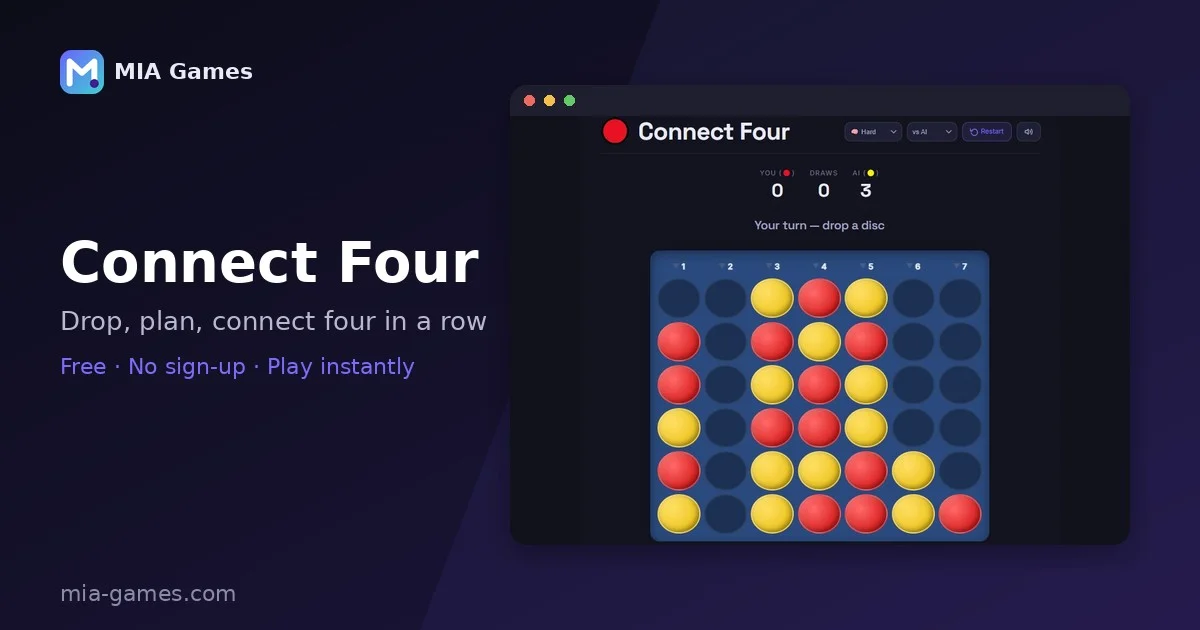
1. Control the Centre
The most important strategic principle in Connect Four is controlling the centre columns — specifically columns 3, 4, and 5. Why? Because the centre offers the most opportunities to create winning lines. From the centre, you can build threats in multiple directions simultaneously.
A disc placed in the centre column (column 4) can be part of a horizontal, vertical, or diagonal line. A disc near the edge (columns 1 or 7) can only contribute to a limited number of lines. By controlling the centre, you give yourself more options and restrict your opponent's opportunities.
Practical tip: On your first move, always aim for one of the centre columns. Column 4 is the most powerful, but columns 3 and 5 are also excellent. Avoid the edge columns (1 and 7) unless you have a specific reason to play there.
2. Build Double Threats
A double threat is a move that creates two winning lines at the same time. Your opponent can block one, but not both. This is the most powerful attacking strategy in Connect Four.
For example, if you place a disc that gives you three in a row in two different directions, your opponent is forced to choose which threat to block. You then play the other to win. Double threats are the foundation of almost every winning strategy.
How to create them: Look for opportunities where you have two separate lines of three with an open space at the end. If you can place a disc that completes both lines simultaneously, you've created a double threat that your opponent can't stop.
🎯 Pro Tip: Always look for opportunities to create a double threat. A single threat is easy to block; a double threat is almost impossible to stop. This is how you force wins.
3. Play Defensively — But Not Too Defensively
It's tempting to focus entirely on your own attack, but strong defence is equally important. Whenever your opponent has three in a row with an open space at the end, you must block them. If you don't, they'll win on their next move.
However, playing too defensively can be a trap. If you spend all your moves blocking your opponent, you never build your own attack. The key is to balance offence and defence. Every defensive move should also contribute to your own attacking plans.
Practical tip: When you block your opponent, try to place your blocking disc in a position that also creates a threat for you. This way, you're not just reacting — you're building your own game while disrupting theirs.
4. Force Your Opponent to React
The best players don't react to their opponent — they force their opponent to react to them. This is done by creating immediate threats that must be blocked. Each time you create a threat, your opponent loses a move they could have used to build their own attack.
For example, if you play a disc that gives you three in a row, your opponent must block you. This gives you the initiative and allows you to control the pace of the game. Keep creating threats, and your opponent will spend all their moves defending.
Practical tip: Don't just create threats randomly. Aim to create threats that also set up future double threats. This layered approach is what separates good players from great players.
5. Think Several Moves Ahead
Connect Four is a game of foresight. The best players think 3, 4, or even 5 moves ahead. Before you make a move, ask yourself: "What will the board look like after this move? What will my opponent's best response be? How can we set up a win on the next turn?"
This kind of forward planning is what separates good players from great players. It's also a skill that translates to other strategy games — including Tic-Tac-Toe, 2048, and even Sudoku.
Practical tip: When planning ahead, always consider your opponent's best response. If you can anticipate their move, you can stay one step ahead. This is the essence of strategic thinking in Connect Four.
Advanced Traps and Tactics
Once you've mastered the five core strategies, you can start using advanced traps:
- The "7" trap: If you control columns 3, 4, and 5, you can often force a win by creating threats that your opponent can't block simultaneously.
- The "zig-zag" trap: By placing discs in a zig-zag pattern, you can create diagonal threats that are harder to spot and block.
- The "sacrifice" move: Sometimes, letting your opponent block one threat creates an even stronger threat elsewhere. This requires careful planning but can be devastating.
Playing Against the AI
Our MIA Games Connect Four features an AI opponent that plays at different difficulty levels. Here's how to approach each:
- Easy: Focus on executing the core strategies. The AI will make mistakes — capitalise on them.
- Medium: The AI will block most direct threats. Focus on creating double threats and thinking ahead.
- Hard: The AI plays almost perfectly. You'll need to combine all five strategies and think several moves ahead. This is where you truly learn.
Key Strategies Summary
Control the Centre
Focus on columns 3, 4, and 5 for maximum flexibility.
Double Threats
Create two winning lines simultaneously — unstoppable!
Balanced Defence
Block threats but keep building your own attack.
Force Reactions
Make your opponent respond to your threats, not theirs.
Think Ahead
Plan 3–5 moves in advance to outmanoeuvre your opponent.
Common Mistakes to Avoid
- Playing too high: Avoid playing your discs in the top rows early. Keep your options open by playing lower, where you can build vertical threats.
- Ignoring your opponent's threats: Always check if your opponent has three in a row before making your move. If they do, you must block them immediately.
- Not using the edges: While the centre is important, the edges (columns 1 and 7) can be useful for creating diagonals that are harder to spot.
- Rushing: Take your time. A single bad move can cost you the game. Think before you drop.
- Being too predictable: If you always play the same pattern, your opponent will learn to counter it. Vary your approach.
Practice Plan for Improvement
- Week 1: Focus on controlling the centre. Play against the Easy AI and practise keeping columns 3-5 under your control.
- Week 2: Practice creating double threats. Can you force a double threat in every game?
- Week 3: Balance offence and defence. Play against Medium AI and work on blocking threats while building your own.
- Week 4: Combine all strategies against Hard AI. Focus on thinking 3-5 moves ahead.
How to Practice These Strategies
The best way to improve is to play, play, play. Our Connect Four game on MIA Games features an AI opponent that will challenge you at every level. As you play, focus on applying these strategies:
- Start every game by trying to control the centre.
- Look for opportunities to create double threats.
- Block your opponent's threats while building your own.
- Think 3 moves ahead before every move.
With practice, these strategies will become second nature. You'll start seeing patterns on the board that you missed before, and you'll find yourself winning more and more games.
Frequently Asked Questions
What's the best first move in Connect Four?
Column 4 (the centre) is generally considered the strongest first move. It gives you the most options for creating winning lines. Columns 3 and 5 are also good choices.
Can you win Connect Four every time?
No. Connect Four is a solved game — with perfect play, the first player can always force a win. However, the first player must play perfectly. In practice, most players make mistakes, which creates opportunities for the second player.
How do you counter a double threat?
If your opponent creates a double threat, you may need to block one threat and hope they miss the other. The best defence is to prevent your opponent from creating double threats in the first place by controlling the centre and blocking their lines early.
Is Connect Four a game of luck or skill?
Connect Four is almost entirely a game of skill. There's no random element — everything is determined by the players' decisions. The better strategist wins.
Can I play Connect Four online?
Yes! MIA Games offers a free online Connect Four game where you can play against the AI or challenge a friend. It works on any device with a browser.
What's the hardest part of learning Connect Four?
Most beginners struggle with thinking ahead. It's easy to focus on your immediate move, but the real skill is anticipating your opponent's response and planning several moves in advance. This takes practice.
Ready to Play?
Now that you've learned these strategies, it's time to put them into action. Play Connect Four on MIA Games and start applying these tactics. Challenge the AI or play against a friend — and remember to control the centre, build double threats, and think ahead.
Good luck, and may the best player win!