📌 Key Takeaways
- With perfect play, Tic-Tac-Toe always ends in a draw
- As X (first player), always start in the centre square
- As O (second player), always start in a corner
- Create forks to force your opponent into impossible choices
- Always block your opponent when they have two in a row
Tic-Tac-Toe — the game we all learned as children, scribbled on the back of school notebooks and played during rainy lunch breaks. It's simple enough for a five-year-old to understand, yet surprisingly deep enough to have been the subject of serious mathematical analysis. The question we've been asked more than any other is: "Is there a way to never lose at Tic-Tac-Toe?"
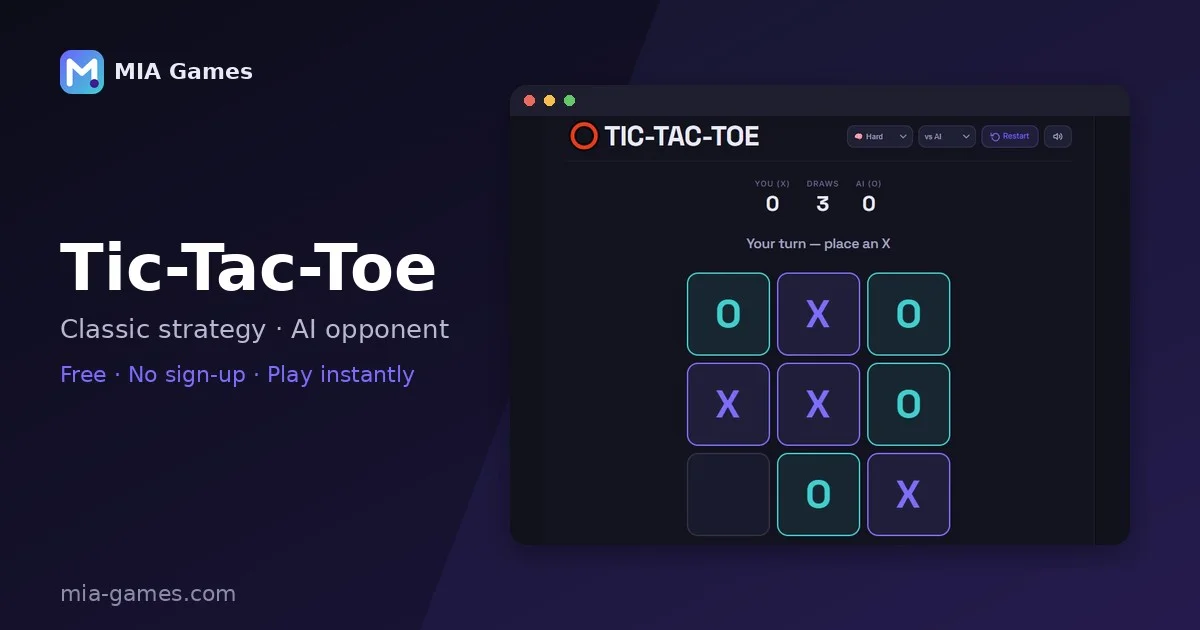
The short answer is yes — with optimal play, you can never lose a game of Tic-Tac-Toe. But here's the catch: you also can't always win. If both players play perfectly, every game ends in a draw. At MIA Games, we built our Tic-Tac-Toe game with an AI that uses the Minimax algorithm — the same mathematical strategy that ensures a computer will never lose. In this guide, we'll share that exact strategy with you.
💡 Key Insight: Tic-Tac-Toe is a solved game — meaning the outcome is determined with perfect play. The result is always a draw. No matter what your opponent does, you can force a draw. And if they make a mistake, you can win.
A Brief History of Tic-Tac-Toe
Tic-Tac-Toe has ancient roots. The game is believed to have originated in ancient Egypt, where similar grid games have been found carved into temple roofs. The Romans also played a version called "terni lapilli" — meaning "three stones" — which used a 3×3 grid and three pieces per player.
The modern name "Tic-Tac-Toe" comes from the sound made by the pencil when drawing the X's and O's — "tic" (the sound of the pencil hitting the paper) and "tac" (the sound of the pencil being lifted). The game was popularised in the 19th century in Britain and the United States, and it has remained a childhood staple ever since.
Understanding the Grid
Before diving into strategy, let's understand the grid. A Tic-Tac-Toe board has 9 squares arranged in a 3×3 grid. For reference, we number them like this:
- Top row: 1 (top-left), 2 (top-centre), 3 (top-right)
- Middle row: 4 (middle-left), 5 (centre), 6 (middle-right)
- Bottom row: 7 (bottom-left), 8 (bottom-centre), 9 (bottom-right)
The centre square (position 5) is the most valuable because it's part of four possible winning lines. The corners (positions 1, 3, 7, 9) are each part of three winning lines. The edges (positions 2, 4, 6, 8) are each part of only two winning lines. This understanding of the grid is the foundation of all Tic-Tac-Toe strategy.
The Mathematics Behind Tic-Tac-Toe
Before we dive deeper into strategy, let's understand the numbers. There are 255,168 possible games of Tic-Tac-Toe. Of these:
- 131,184 end in a win for X (the first player)
- 77,904 end in a win for O (the second player)
- 46,080 end in a draw
But here's the crucial fact: with perfect play, the game always ends in a draw. This was proven in 1998 by computer scientists who exhaustively searched the entire game tree. The first player (X) has a slight advantage, but not enough to force a win against a perfect opponent.
The Optimal First Move
If you're playing as X (first player), your optimal first move is the centre square (position 5). There's a reason for this: the centre square is part of four possible winning lines (two diagonals, one row, one column). No other square offers as many opportunities.
If you're playing as O (second player), your optimal first move is any corner (positions 1, 3, 7, or 9). This creates the most opportunities for a draw or a win if X makes a mistake. Avoid playing on an edge as your first move — it's the weakest response.
The Unbeatable Strategy (Playing as X)
Here's the step-by-step strategy to ensure you never lose when playing as X:
Move 1: Play the centre
- Place your X in the centre square (position 5). This gives you the most winning opportunities.
Move 2: Respond to O's move
- If O plays in a corner: Play in the opposite corner. For example, if O plays in position 1, you play in position 9. This creates a fork threat.
- If O plays in an edge (not corner): Play in any corner. Corners are more valuable than edges.
Move 3: Create a fork
- A fork is a move that creates two potential winning lines simultaneously. Look for opportunities to create a fork.
- If O blocks your first threat, look for another. A well-timed fork is often the winning move.
Move 4 and beyond: Block and build
- Always block O if they have two in a row. If you don't, they'll win on their next move.
- Build your own threats. If you can create a fork, do it.
- If no immediate threats or forks exist, play in any corner. Corners give you more options than edges.
The Unbeatable Strategy (Playing as O)
If you're playing as O (second player), your goal is to force a draw. Here's the strategy:
Move 1: Play in a corner
- Place your O in any corner (positions 1, 3, 7, or 9). This gives you the best chance of forcing a draw.
Move 2: Respond to X's move
- If X plays in the centre: Play in the opposite corner. This sets up a defensive position.
- If X plays in a corner: Play in the centre. This gives you control of the board.
- If X plays in an edge: Play in the centre. This is the strongest response.
Move 3 and beyond: Block and survive
- Always block X if they have two in a row. This is non-negotiable.
- If X creates a fork (two threats simultaneously), you may need to block one threat and hope they miss the other. With perfect play, X cannot force a win.
Key Strategies Summary
Centre First
Always play the centre as X. It gives you the most winning opportunities.
🔲 🔲 🔲🔲 ❌ 🔲
🔲 🔲 🔲
Opposite Corners
If O plays in a corner, play the opposite corner to create a fork threat.
⭕ 🔲 🔲🔲 🔲 🔲
🔲 🔲 ❌
Create Forks
A fork creates two winning threats. Your opponent can only block one.
❌ ❌ 🔲🔲 ⭕ 🔲
❌ 🔲 ⭕
Always Block
If your opponent has two in a row, block them immediately.
⭕ ⭕ 🔲🔲 ❌ 🔲
🔲 🔲 ❌
Corners Over Edges
Corners are more valuable than edges. They offer more winning lines.
❌ 🔲 🔲🔲 🔲 🔲
🔲 🔲 🔲
Think Ahead
Always consider your opponent's next move before playing yours.
❓ ❓ ❓❓ ❌ ❓
❓ ❓ ❓
The Minimax Algorithm: How AI Never Loses
The AI in our Tic-Tac-Toe game uses the Minimax algorithm — the same algorithm used in AI for Chess, Checkers, and Go. Here's how it works in simple terms:
- Minimax simulates every possible move and every possible response.
- It assigns a score to each move: +10 for a win, 0 for a draw, -10 for a loss.
- It assumes the opponent will play optimally — choosing the move that minimises your score.
- It chooses the move that maximises its own score, assuming the opponent plays perfectly.
This is why the AI never loses — it has already considered every possible outcome and chosen the best possible move. At higher difficulty levels, the AI looks further ahead, making it even more formidable.
🤖 Fun Fact: The Minimax algorithm was first developed in 1928 by mathematician John von Neumann. It wasn't until decades later that computers became powerful enough to use it effectively in games.
Playing Against the AI
Our MIA Games Tic-Tac-Toe features three difficulty levels. Here's how to approach each:
- Easy: The AI makes occasional mistakes. Focus on practising your fork creation and taking advantage of errors.
- Medium: The AI blocks most threats. You'll need to combine strategies and think ahead. This is where you practice the core techniques.
- Hard: The AI uses the full Minimax algorithm and plays perfectly. Your goal is to force a draw by playing optimally. This is the ultimate test of your Tic-Tac-Toe mastery.
Common Mistakes That Lead to Losses
If you're losing at Tic-Tac-Toe, you're likely making one of these common mistakes:
- Playing an edge as your first move: Edges offer fewer winning opportunities than corners or the centre. Always start with the centre (as X) or a corner (as O).
- Not blocking when your opponent has two in a row: This is the most common mistake. Always block — no exceptions!
- Playing in the corner without a plan: Corners are valuable, but only if you use them to create threats. Don't just play anywhere — have a purpose.
- Missing a fork opportunity: If you can create two threats simultaneously, do it. This is how you force wins against imperfect opponents.
How to Practice and Improve
Here's a training plan to master Tic-Tac-Toe:
- Week 1: Practice the centre-first strategy as X. Aim to force a draw against a friend or the Easy AI.
- Week 2: Practice the corner-first strategy as O. Focus on blocking and survival against the Medium AI.
- Week 3: Learn to spot forks. Can you create a fork on move 3? Can you block one? Practice specifically on fork creation.
- Week 4: Test yourself against the MIA Games AI at the hardest difficulty. Can you force a draw against a perfect opponent?
Beyond Tic-Tac-Toe: Other Strategy Games
Once you've mastered Tic-Tac-Toe, you might want to explore other strategy games that challenge your mind:
- Connect Four — A more complex version of Tic-Tac-Toe with a 7×6 grid. Requires deeper strategy and forward planning.
- 2048 — A puzzle game that requires planning and foresight. Great for spatial reasoning.
- Sudoku — A logic puzzle that builds your problem-solving skills and working memory.
- Minesweeper — A deduction game that sharpens your logical thinking and probability assessment.
Each game teaches different aspects of strategic thinking. Tic-Tac-Toe is the foundation — once you understand it, you'll approach all strategy games with a more analytical mindset.
Frequently Asked Questions
Can you ever force a win in Tic-Tac-Toe?
No — if both players play perfectly, the game always ends in a draw. However, if your opponent makes a mistake, you can capitalise and force a win. This is why practising against imperfect opponents (like the Easy AI) is valuable.
What's the best first move in Tic-Tac-Toe?
If you're X (first player), the centre square is the best first move. If you're O (second player), any corner is the best response.
What is a fork in Tic-Tac-Toe?
A fork is a move that creates two potential winning lines simultaneously. Your opponent can block one, but not both. Forks are the key to winning against imperfect opponents.
Is Tic-Tac-Toe a solved game?
Yes. Tic-Tac-Toe is a solved game, meaning the outcome is known with perfect play. With optimal play, the game always ends in a draw.
Can I play Tic-Tac-Toe online?
Yes! MIA Games offers a free online Tic-Tac-Toe game where you can play against the AI on three difficulty levels. It works on any device with a browser.
Why does the AI never lose?
The AI uses the Minimax algorithm, which simulates every possible move and chooses the optimal one. It assumes you'll play perfectly and responds with the best possible counter-move, ensuring it never loses.
Ready to Play?
Now that you know the secrets to never losing, it's time to put them into practice. Play Tic-Tac-Toe on MIA Games and challenge the AI. Test your skills against the three difficulty levels — Easy, Medium, and Hard. Can you force a draw against the unbeatable Minimax AI?
Remember: the goal isn't always to win — it's to play perfectly. Every move should have a purpose. And if you can force a draw against a perfect opponent, you've truly mastered the game.
Good luck, and may the best player draw!