📌 Key Takeaways
- Neuroplasticity means your brain can form new connections at any age
- Cognitive stimulation through games supports long-term brain health
- Different games target different cognitive skills — variety is key
- Consistency matters more than intensity for brain training
- Brain games are a supplement to, not a replacement for, a healthy lifestyle
For decades, scientists have been studying how the brain changes and adapts throughout our lives. This concept, known as neuroplasticity, has revolutionised our understanding of cognitive health. Brain training games — once dismissed as mere entertainment — are now recognised as valuable tools for maintaining and improving mental agility.
At MIA Games, our collection of puzzle, memory, and strategy games is designed with these scientific principles in mind. But what does the research actually say? Let's explore the science behind brain training and how games like Sudoku, 2048, and Memory Match can benefit your cognitive health.
What Is Neuroplasticity?
Neuroplasticity is the brain's ability to reorganise itself by forming new neural connections throughout life. Previously, scientists believed that the brain stopped developing after childhood. We now know that the brain remains adaptable well into old age — and that cognitive stimulation is key to maintaining this plasticity.
This discovery has profound implications. It means that you can actively improve your brain's function at any age. Whether you're 20 or 70, engaging in cognitively stimulating activities can strengthen neural pathways, improve processing speed, and even generate new neurons in the hippocampus — the brain's memory centre.
🔬 Key Insight: Every time you learn something new or solve a challenging problem, your brain forms new synaptic connections. This process strengthens neural pathways and can even generate new neurons in the hippocampus — the brain's memory centre.
Brain training games provide precisely this kind of stimulation. They challenge your working memory, attention, and problem-solving skills, encouraging the brain to adapt and grow. Regular engagement with cognitively demanding tasks has been linked to a lower risk of cognitive decline in later life.
What the Research Actually Says
There's real, credible research on cognitive training — and it's worth being upfront that the picture is more nuanced than "games make you smarter." Here's an honest summary of what the science shows.
The strongest evidence comes from the ACTIVE study (Advanced Cognitive Training for Independent and Vital Elderly), a major NIH-funded randomised trial published in JAMA (2002), which followed over 2,800 older adults. It found that structured cognitive training — including memory and reasoning exercises — produced real, measurable improvements in the specific skills trained, with some benefits still detectable a decade later in follow-up research.
The important caveat — and one worth being honest about — is that a widely-cited 2010 study by Adrian Owen and colleagues, published in Nature, tested over 11,000 participants using online brain-training games and found that while people got better at the specific games they practiced, this did not reliably transfer to broader, general cognitive improvement in everyday life. This is one of the most influential and most-cited findings in the entire brain-training research field, and it's the reason many scientists remain cautious about sweeping claims.
What this means for games like ours: Playing Memory Match, Sudoku, 2048, Minesweeper, and Simon regularly is genuinely good, healthy mental engagement — it exercises real cognitive skills like working memory, pattern recognition, and planning, in the moment you're playing. What the science doesn't support is the idea that playing these games will make you meaningfully sharper at unrelated life tasks. We think that's fine — these games are valuable as engaging, low-stakes mental exercise and genuine fun, and that's a good enough reason to play them without overselling the science.
How Different Games Target Different Cognitive Functions
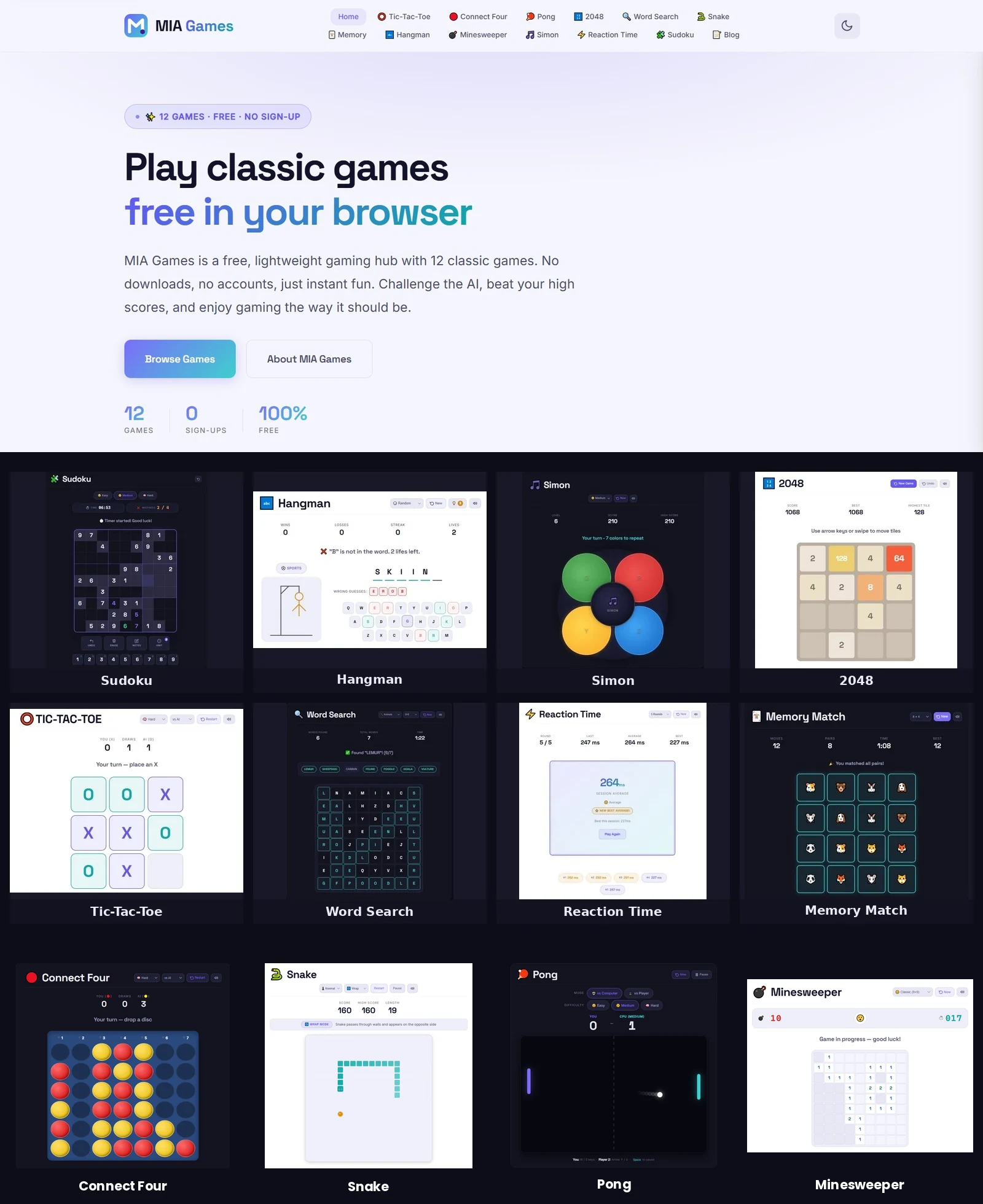
Not all brain training games are the same. Each type of game engages different cognitive functions. Here's a breakdown of what each game at MIA Games targets:
- Sudoku, 2048, and Minesweeper — Target logical reasoning, pattern recognition, and strategic planning. These games require you to hold multiple possibilities in mind while systematically testing and eliminating options.
- Memory Match and Simon — Improve short-term memory, attention to detail, and pattern recall. Simon adds an auditory component that strengthens auditory memory as well.
- Tic-Tac-Toe and Connect Four — Develop strategic thinking, foresight, and decision-making under pressure. These games teach you to think several moves ahead.
- Reaction Time and Pong — Enhance processing speed, hand-eye coordination, and quick decision-making. These games are excellent for training your brain to respond quickly to visual stimuli.
The key is variety. By rotating through different types of games, you engage multiple cognitive functions and avoid the diminishing returns that come from doing the same activity repeatedly.
The Role of Consistency
One of the most consistent findings in brain training research is that consistency matters more than intensity. Just like physical exercise, cognitive exercise yields the best results when it's done regularly. Experts recommend at least 15-20 minutes of cognitive stimulation daily for noticeable improvements.
At MIA Games, we've designed our games to be accessible in short bursts — perfect for fitting into a busy schedule. Whether you're waiting for a meeting to start or taking a lunch break, a quick game can provide the cognitive boost you need.
Potential Limitations
While the evidence is encouraging, it's important to note that brain training games are not a substitute for other healthy habits. A well-rounded approach to cognitive health includes:
- Physical exercise — Improves blood flow to the brain and promotes neurogenesis.
- Healthy nutrition — Omega-3 fatty acids, antioxidants, and B vitamins support brain function.
- Social engagement — Interacting with others stimulates multiple cognitive processes.
- Adequate sleep — Memory consolidation and neural repair occur during sleep.
💡 Takeaway: Brain training games are a powerful supplement to a healthy lifestyle — not a replacement. Use them as part of a holistic approach to cognitive wellness.
Frequently Asked Questions
Do brain training games actually work?
Yes — but with an important nuance. Research shows that brain training games improve the specific cognitive skills they exercise (like memory, attention, or processing speed). However, the evidence for broad transfer to unrelated tasks is mixed. They are best viewed as a healthy form of mental exercise rather than a cure-all.
How long should I play brain training games each day?
Most experts recommend 15-20 minutes of cognitive stimulation daily. Consistency matters more than the length of each session.
Are brain training games suitable for older adults?
Yes. The ACTIVE study showed that older adults can benefit significantly from cognitive training. Games that challenge memory, reasoning, and processing speed are particularly beneficial for maintaining cognitive health in later life.
Can brain training games help with ADHD or concentration issues?
Some research suggests that certain cognitive training games may help improve attention and focus in people with ADHD. However, they should be used as a supplement to, not a replacement for, professional medical advice and treatment.
What's the best game for improving memory?
Memory Match and Simon are specifically designed to challenge short-term and working memory. However, rotating through different games provides the most comprehensive cognitive benefit.
Can I train my brain too much?
Like anything else, moderation is key. Overdoing cognitive training can lead to mental fatigue. It's important to balance brain training with rest, physical activity, and social engagement.
Start Training Your Brain Today
The science is clear: regular engagement with cognitively challenging activities can improve memory, attention, and problem-solving skills while supporting long-term brain health. And the best part? You can start right now, for free, with MIA Games.
Browse our collection of 13 classic games — each designed to target specific cognitive functions. Whether you're looking to sharpen your memory, improve your strategic thinking, or simply enjoy a mental break, there's a game for you.
Ready to start your brain training journey? Explore our games collection and give your brain the workout it deserves.