📌 Key Takeaways
- Games can provide enjoyable mental practice, but they are not proven treatments for dementia or guaranteed ways to prevent cognitive decline
- Different games place different demands on memory, attention, planning, visual processing, and decision-making
- Research on structured cognitive training and video-game interventions cannot automatically be applied to every casual browser game
- Social play can add an important human element, while broader healthy-aging habits remain essential
- The most useful goal is regular, enjoyable cognitive engagement — not chasing a particular score or a promised “brain boost”
Staying mentally active is a reasonable part of healthy aging, but the science is more nuanced than the phrase “brain games” can make it sound. Some studies find benefits from particular forms of cognitive training, while other research shows associations between mentally stimulating activities and better cognitive outcomes. Those findings do not mean that every puzzle, app, or browser game has been proven to improve memory or prevent dementia.
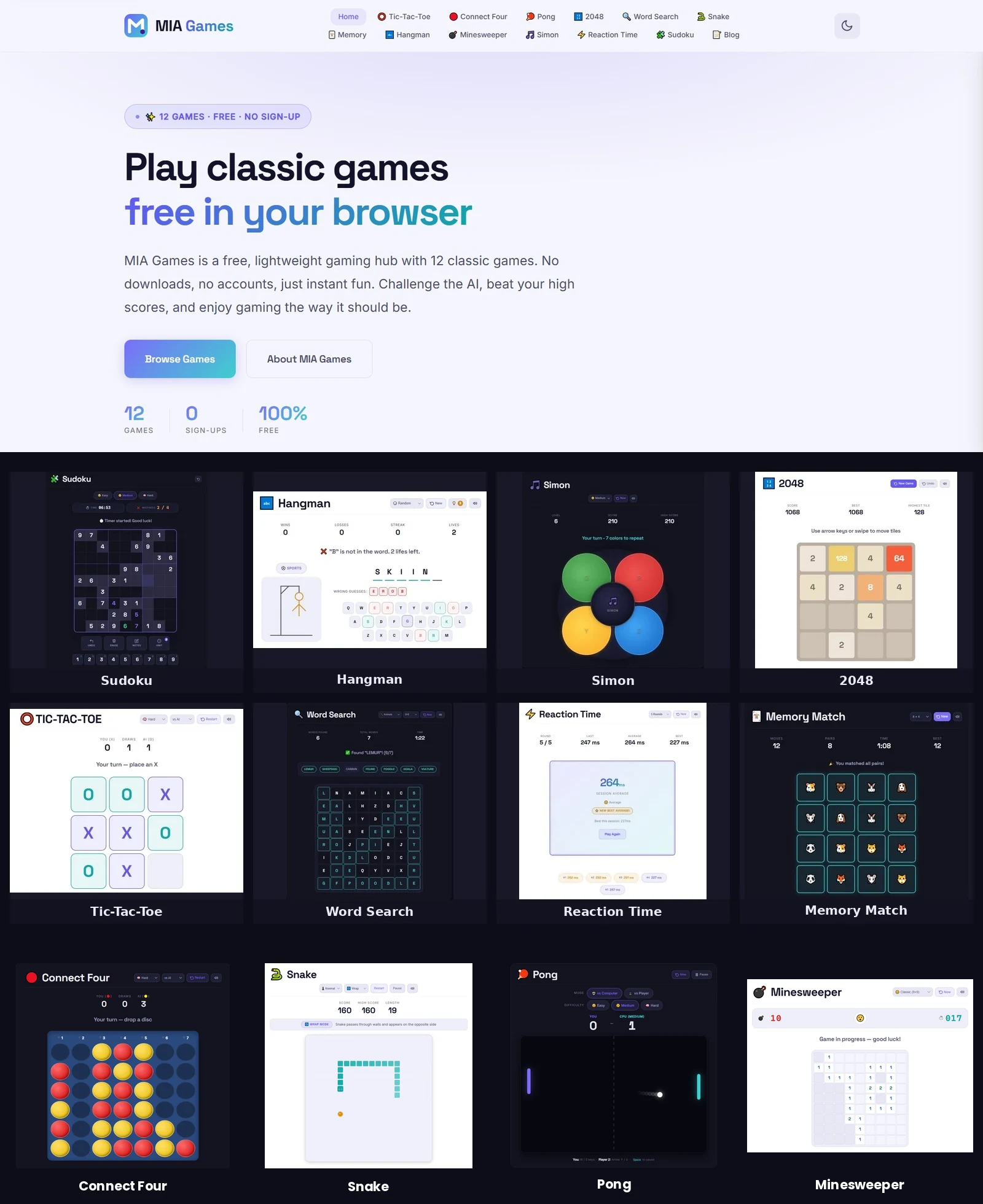
This article takes a more careful approach. We will look at five familiar games available at MIA Games — Sudoku, Memory Match, Simon, Tic-Tac-Toe, and Connect Four — and separate what the games require you to do from what research has actually tested. That distinction matters because a game can be mentally engaging without having been clinically studied itself.
🔎 The evidence rule used in this article
When a study tests a specific cognitive-training program, we describe that program and its findings. We do not present the result as proof that MIA Games — or a particular game such as Sudoku or Connect Four — produces the same outcome. This is the difference between describing a plausible cognitive demand and making a clinical claim.
Understanding Cognitive Health in Later Life
Cognitive health includes abilities such as remembering information, paying attention, processing information, using language, solving problems, and making decisions. Some changes in speed or memory can occur with normal aging, while more substantial changes can have many possible causes and may warrant professional assessment.
The National Institute on Aging (NIA) notes that mentally stimulating activities, physical activity, social engagement, and management of health conditions are all areas being studied in relation to cognitive health. NIA also cautions that evidence for commercially available computer-based “brain-training” products is not strong enough to assume they have the same effects as specific programs tested in clinical research.
A 2025 study in Frontiers in Aging Neuroscience illustrates why careful wording matters. Researchers studied 317 adults aged 65 and older who had subjective cognitive impairment, mild cognitive impairment, or dementia and found an association between the leisure-activity component of cognitive reserve and cognitive status. The study was cross-sectional, however, so it cannot show that leisure activities caused better cognition or that playing games prevents dementia.
1. Sudoku: Logic, Attention, and Keeping Track of Constraints
Game type: Number-placement logic puzzle
What the game requires: Constraint tracking, logical deduction, visual scanning, attention, and maintaining relevant information while considering possible moves
Sudoku asks the player to place digits in a grid so that each row, column, and smaller box contains the required set of numbers without repetition. The important cognitive point is not that Sudoku has been proven to “train the brain,” but that solving a puzzle requires active information processing: you inspect the board, eliminate possibilities, compare constraints, and decide what to do next.
Research on working-memory training provides useful context, but it should not be confused with Sudoku research. A 2025 pilot study of 30 community-dwelling older adults examined a brief working-memory training program and reported training-related cognitive and electrophysiological changes. The intervention was a structured working-memory program, not Sudoku, and the authors described the work as a pilot study. That makes it relevant to the broader idea of cognitive training, not proof that Sudoku produces the same effects.
Why someone might choose Sudoku
- Structured challenge: The rules stay constant while the difficulty of a puzzle can vary.
- Independent pace: A player can stop, think, and return to a puzzle without competing against a clock.
- Active decision-making: Progress depends on evaluating possibilities rather than simply watching content.
- Clear feedback: Incorrect assumptions can be identified and corrected during play.
In other words, Sudoku is a reasonable recreational activity for someone who enjoys logic puzzles. It should not be presented as a medical intervention or as a proven way to prevent memory disorders.
2. Memory Match: Recall, Visual Attention, and Location Memory
Game type: Card-matching memory game
What the game requires: Remembering locations, visual recognition, attention, and updating information after each turn
Memory Match has a straightforward cognitive demand: after seeing cards, the player tries to remember where particular symbols appeared and uses that information later. With more cards, more locations must be tracked. That makes the game a simple example of active recall and visual-location memory.
There is research on game-based memory training, but the details matter. A 2024 randomized controlled trial involving 118 self-assessed healthy older adults tested an augmented-reality game based on the n-back training paradigm. Participants trained for 30 minutes, three times per week for four weeks, and the study reported improvements on some working-memory and Stroop measures. This was a specific augmented-reality training program; it was not the same task as MIA Games' Memory Match.
The safest conclusion is therefore modest: Memory Match provides a convenient way to practice remembering visual locations while playing, but the cited trial does not establish that Memory Match itself improves memory outside the game.
Making Memory Match comfortable to play
Start with a smaller board if remembering many locations becomes frustrating. Take your time, use deliberate observation, and treat mistakes as part of the game rather than as a test of your health. For a family activity, a caregiver can also play alongside an older adult and turn the session into shared recreation.
3. Simon: Sequence Memory and Attention
Game type: Visual and auditory sequence game
What the game requires: Sequence recall, sustained attention, response selection, and monitoring a growing pattern
Simon presents a sequence and asks the player to reproduce it. As the sequence becomes longer, the player has to retain more ordered information and respond accurately. The combination of visual and auditory cues also makes the task different from a purely visual puzzle.
Recent research on video-game training gives some useful context. A 2026 randomized controlled trial assigned 70 younger adults and 70 older adults to either twenty 30-minute sessions of custom-developed cognitive games or a perceptual-matched control condition. The researchers reported immediate training-related gains in several executive functions, with different patterns of retention at three months. Importantly, the intervention used custom-developed cognitive games; it was not Simon.
That distinction is important for readers. Simon can be described accurately as a game that exercises sequence memory and attention during play. It cannot be described, on the basis of that trial, as a proven cognitive treatment.
4. Tic-Tac-Toe: Planning, Pattern Recognition, and Social Play
Game type: Two-player strategy game
What the game requires: Pattern recognition, planning, prediction, decision-making, and monitoring an opponent's moves
Tic-Tac-Toe is simple enough to learn in minutes, but a player still has to examine the board, recognize threats, choose a move, and anticipate what the other player might do next. When played with another person, the game also creates an opportunity for conversation and shared attention.
Research on social interaction is relevant to that second part, but it does not prove a Tic-Tac-Toe effect. A 2024 systematic review and meta-analysis of randomized trials in older adults without dementia found that social-interaction interventions had a significant effect on executive function, while effects on memory, attention, and global cognition were limited or not significant. The review also noted that the overall impact was modest and that the evidence base had limitations.
So the strongest case for Tic-Tac-Toe is practical rather than clinical: it is familiar, easy to explain, quick to play, and naturally suited to shared play. Those qualities can make it a pleasant way to spend time with another person.
5. Connect Four: Planning, Pattern Detection, and Anticipation
Game type: Two-player strategy game
What the game requires: Forward planning, visual pattern detection, decision-making, and anticipating an opponent's possible responses
Connect Four adds more strategic depth than Tic-Tac-Toe while keeping the basic rules easy to understand. Players must consider immediate opportunities and threats while also noticing how one move changes future possibilities on the board.
The 2026 randomized trial of custom-developed cognitive games mentioned above provides evidence that some structured game training can influence executive-function measures in younger and older adults. It does not establish that Connect Four produces the same effects. The appropriate description is therefore that Connect Four places demands on planning and pattern detection, not that it has been clinically validated as a cognitive-training intervention.
What Current Research Actually Tells Us About Video Games
One of the more relevant recent pieces of evidence is a 2026 meta-analysis of video-game interventions in older adults with mild cognitive impairment (MCI). The review included five randomized controlled trials involving about 215 participants. Across those studies, video-game interventions were associated with improvements in measures including MoCA, MMSE, and Trail Making Test performance.
That finding is encouraging, but its population and interventions were specific. The participants had MCI, the included interventions were not simply a collection of casual browser games, and the review itself called for more research, standardized protocols, and longer follow-up. It therefore cannot be used to claim that a healthy older adult will receive the same benefit from playing Sudoku, Simon, or Connect Four on a website.
Important: An improvement on a cognitive test after a training intervention is not automatically the same thing as preventing dementia, reversing cognitive aging, or improving everyday functioning. Researchers distinguish between performance on the trained task, transfer to other tasks, and meaningful long-term outcomes.
What About TV, Computer Use, and “Active” Screen Time?
It is tempting to conclude that playing games must be better for the brain than watching television. The evidence does not justify such a simple rule.
A large 2022 UK Biobank observational study followed 146,651 adults aged 60 and older without dementia at baseline. Over an average follow-up of about 11.9 years, television time was associated with higher incident-dementia risk, while computer use was associated with lower risk after adjustment for several factors. The study is important, but it is observational: it identifies associations, not proof that changing from television to computer games will prevent dementia.
Computer use also covers many different activities, from communication and learning to work and gaming. The study did not establish that browser games themselves were responsible for the observed association. For that reason, the sensible takeaway is that the quality and context of an activity matter, while avoiding claims that one particular screen activity is automatically protective.
Brain Training Is Not the Same as a Medical Treatment
Some structured cognitive-training programs have been studied in controlled research, and the results can be meaningful. The NIA, for example, describes evidence from the long-running ACTIVE trial showing lasting benefits in some trained cognitive abilities after structured reasoning and speed-of-processing training. At the same time, NIA specifically warns that there is not enough evidence to assume commercially available computer and online brain-training products have the same impact.
This is why MIA Games uses a recreational framing. Our games can give readers an easy way to play, think, remember, plan, and interact. They are not presented as a substitute for clinical cognitive assessment, treatment, or a professionally designed cognitive-training program.
How to Use Games as Part of a Healthy Routine
There is no scientifically established “brain-game prescription” for the five games in this article. Instead of promising a particular number of sessions or a guaranteed cognitive effect, use these practical principles:
- Choose enjoyment first. A game you genuinely like is easier to return to than an activity that feels like homework.
- Vary the mental demands. Rotate between memory, logic, planning, visual search, language, or other activities rather than assuming one game covers every cognitive skill.
- Increase challenge gradually. The goal is an activity that requires attention without becoming discouraging.
- Include social play when possible. Playing Tic-Tac-Toe or Connect Four with a family member can turn screen time into shared time.
- Keep games in perspective. Physical activity, social connection, sleep, management of health conditions, and other healthy behaviors also matter for healthy aging.
- Do not use game scores as a health test. A poor score can reflect fatigue, unfamiliarity with the interface, distraction, vision, hearing, or ordinary day-to-day variation.
When Memory Changes Should Be Discussed With a Doctor
Brain games should never be used to diagnose a memory problem. Occasional forgetfulness can happen with normal aging, but noticeable or worsening changes that interfere with everyday activities deserve attention. The NIA recommends talking with a doctor about concerning changes in memory or thinking because many different factors — including medications, sleep problems, depression, medical conditions, and neurological disorders — can affect cognition.
Examples that deserve professional attention include repeatedly asking the same questions, getting lost in familiar places, having increasing difficulty following familiar directions, or struggling with everyday tasks that were previously manageable. A clinician can assess the situation rather than relying on a game score.
Frequently Asked Questions
Are brain games effective for seniors?
Some structured cognitive-training and video-game interventions have shown improvements on particular cognitive measures, but results depend on the program, population, outcome, and study design. Evidence does not support treating every casual brain game as a proven cognitive intervention.
How often should seniors play brain games?
There is no evidence-based schedule specifically established for MIA Games' five featured games. Choose a comfortable routine that is enjoyable and sustainable rather than following a promised “dose” that has not been tested for these games.
Can caregivers play these games with seniors?
Yes. Tic-Tac-Toe and Connect Four are naturally suited to two players, and other games can be discussed or played side by side. Social play can add companionship and shared attention, although that should not be described as a proven treatment for cognitive decline.
Is Sudoku better than other brain games?
There is no good basis here for ranking Sudoku above the other games. Sudoku emphasizes logical constraints, while Memory Match emphasizes location recall, Simon emphasizes sequence memory, and the two strategy games emphasize planning and prediction. Different games simply place different demands on the player.
Can brain games prevent dementia?
No single game has been established as a guaranteed way to prevent dementia. Research into cognitive training and lifestyle-based risk reduction is ongoing, and the evidence is stronger for some structured interventions than for casual commercial games.
Are free browser games as effective as paid brain-training programs?
There is not enough evidence to say that free browser games are equivalent to structured commercial or clinical programs. Research findings apply to the interventions that were actually tested. MIA Games should therefore be viewed as a source of accessible recreation and cognitive engagement, not as a clinically validated brain-training system.
What if I am worried about my memory?
Do not rely on a game score to judge your memory. If you or someone close to you notices persistent or concerning changes in memory or thinking, speak with a healthcare professional so possible causes can be assessed.
Play These Games at MIA Games
If you enjoy this kind of play, the five games discussed above are available free at MIA Games. Choose based on the type of challenge you enjoy rather than on a promise of a medical or cognitive outcome.
Sudoku
Logic, attention, and constraint tracking
🃏Memory Match
Location recall and visual attention
🎵Simon
Sequence memory and attention
⭕Tic-Tac-Toe
Planning, patterns, and social play
🔴Connect Four
Planning, prediction, and pattern detection
You can also explore the full collection of 13 classic games. MIA Games is built for simple, accessible browser play — the kind of activity you can enjoy at your own pace.
Reader note: This article is for general educational information. It is not medical advice, diagnosis, or treatment, and MIA Games does not claim that playing its games prevents, treats, or reverses dementia, mild cognitive impairment, or other medical conditions.
📚 References & Source Notes
- Ottaviani S, Tagliafico L, Peruzzo S, Ponzano M, Signori A, Nencioni A, Monacelli F. “Beyond traditional proxies: the contribution of leisure to cognitive reserve and dementia.” Frontiers in Aging Neuroscience, 2025;17:1600798. doi:10.3389/fnagi.2025.1600798
- Borella E, Carbone E, Spironelli C. “Short- and long-term cognitive and electrophysiological effects of a brief working memory training in older adults: a pilot study.” BMC Geriatrics, 2025;25:856. doi:10.1186/s12877-025-06507-2
- Liu B, Li X, Cai H. “The effects of video games on cognitive function in older adults with mild cognitive impairment: a meta-analysis.” Frontiers in Aging Neuroscience, 2026;17:1756970. doi:10.3389/fnagi.2025.1756970
- Zhu D, Zhu B, Zhao J, Zhang C, He J, Song D, Han T. “Investigation on the Effectiveness of Augmented Reality Memory Training Game for Chinese Older Adults: A Randomized Controlled Trial.” Games for Health Journal, 2024;13(1):5–12. doi:10.1089/g4h.2022.0183
- “Video game training enhances executive function in younger and older adults: A randomized controlled trial.” Learning and Individual Differences, 2026;130:102968. doi:10.1016/j.lindif.2026.102968
- Wei C-C, Hsieh M-J, Chuang Y-F. “The Effects of Social Interaction Intervention on Cognitive Functions Among Older Adults Without Dementia: A Systematic Review and Meta-Analysis.” Innovation in Aging, 2024;8(10):igae084. doi:10.1093/geroni/igae084
- Raichlen DA, Klimentidis YC, Sayre MK, Bharadwaj PK, Lai MH, Wilcox RR, Alexander GE. “Leisure-time sedentary behaviors are differentially associated with all-cause dementia regardless of engagement in physical activity.” Proceedings of the National Academy of Sciences, 2022;119(35):e2206931119. doi:10.1073/pnas.2206931119
- National Institute on Aging. “Cognitive Health and Older Adults.” National Institute on Aging. nia.nih.gov/health/cognitive-health-and-older-adults
- National Institute on Aging. “Memory Problems, Forgetfulness, and Aging.” National Institute on Aging. nia.nih.gov/health/memory-problems-and-aging