📌 Key Takeaways
- Tic-Tac-Toe is easier to learn and gives young players a compact introduction to turns, threats, and blocking.
- Connect Four adds gravity, a larger board, longer planning chains, and more complicated threats.
- Both games are mathematically solved, but that describes perfect play — not how children normally experience them.
- Hasbro currently labels the classic Connect 4 game for ages 6 and up; age is a useful guide, not a developmental cutoff.
- For most families, the best choice is not either/or: start with the simpler game, then offer the deeper one when the child wants more challenge.
Every parent knows the moment. Your child is ready for something beyond pure luck — a game where thinking matters. And two names come up first: Tic-Tac-Toe and Connect Four. Both are classics. Both teach strategy. But which one should your kid learn first?
At MIA Games, we offer both Tic-Tac-Toe and Connect Four free in the browser. This comparison focuses on the games themselves: their rules, strategic demands, practical age fit, and the kinds of decisions a child makes while playing. It is a practical guide, not a developmental or educational assessment.
Let's break it down — what each game teaches, when kids are ready, and how to know when it's time to move up.
💡 The practical answer: There is no universal "best" age at which every child should switch games. Tic-Tac-Toe is the easier starting point; Connect Four is the more demanding follow-up. Use the child’s interest, ability to follow the rules, and tolerance for longer games alongside the manufacturer’s age guidance.
Tic-Tac-Toe: Where Every Strategist Starts
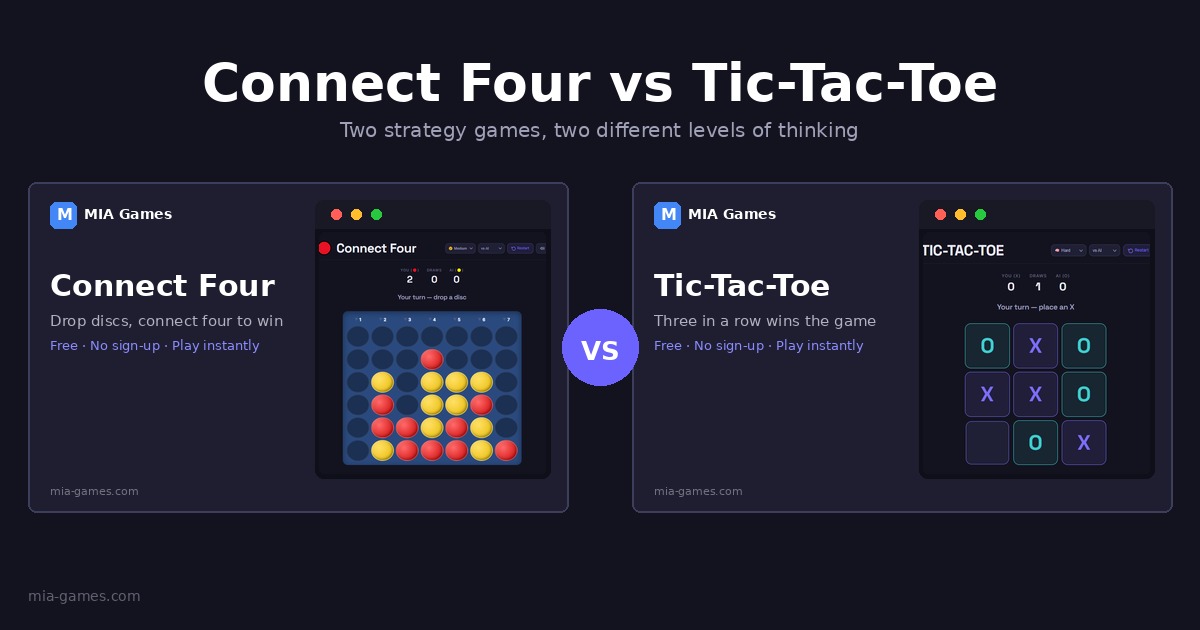
Tic-Tac-Toe is the world's simplest strategy game — and that's exactly why it's brilliant for young kids. Two players take turns marking X and O on a 3×3 grid. The first to get three in a row wins. If neither manages it, the game is a draw. A full game takes about a minute. The rules take thirty seconds to explain.
The modern game has a long history of related three-in-a-row games, but it is better not to treat every ancient grid game as simply "Tic-Tac-Toe." One well-documented milestone is OXO, Alexander Douglas's 1952 computer version of noughts and crosses on Cambridge's EDSAC. The Computer History Museum describes OXO as one of the earliest computer games. That history matters here because it shows how a very small rule set can work both as a physical game and as a computational problem.
Tic-Tac-Toe makes several strategic ideas easy to see on a small board. A player can learn to look for an immediate win, block an immediate threat, and eventually create a fork — two winning threats that cannot both be blocked. The centre is part of four winning lines, while a corner is part of three, so experienced players value them differently from edge squares. These are features of the game itself; they should not be confused with proof that playing the game improves general intelligence or school performance.
What kids learn: turn-taking, spotting patterns, blocking an opponent's immediate threat, and the very idea that thinking ahead beats playing randomly. It's also a gentle first lesson in losing gracefully — draws are common, so nobody feels crushed.
Connect Four: The Next Level Up
Connect Four takes the same "get four in a row" idea and adds gravity. Players drop colored discs into a vertical 7-column, 6-row grid. Discs fall to the lowest open space. The first to connect four — horizontally, vertically, or diagonally — wins. A game takes five to ten minutes. The rules are still simple enough for a six-year-old.
But the strategic demands are greater. Connect Four was invented by Howard Wexler in 1973 and introduced by Milton Bradley in 1974; Wexler’s own account also describes Ned Strongin as his financial partner in the Connect Four contract. In 1988, James Allen and Victor Allis independently established that the standard 7×6 game is a first-player win with perfect play. The important distinction is between the mathematical result and ordinary play: a child does not need to know the complete solution to benefit from comparing threats and consequences on the board.
For kids, the key lessons are forward planning and reading the opponent. A beginner drops discs where they want to build. An intermediate player starts noticing: "If I play here, they'll win there — so I must block first." An advanced young player learns to set traps, forcing the opponent to block one threat while another one lands. The gravity mechanic adds a whole dimension Tic-Tac-Toe doesn't have — every move changes what's possible above it.
What the game directly practises: planning beyond the immediate move, noticing threats, comparing candidate columns, and understanding how one move changes the spaces available later. A parent can also use a loss as an opportunity to ask what the child noticed or would try differently next time; that is a better-supported claim than saying the game automatically builds "resilience."
Side-by-Side Comparison
Here's how the two games stack up for parents deciding where to start:
| Tic-Tac-Toe | Connect Four | |
|---|---|---|
| Age guidance | A practical starting point for young children; no single official cutoff | Hasbro: ages 6 and up for the classic game |
| Typical feel | Very short rounds; easy to restart | Longer rounds; more board state to track |
| Perfect-play result | Draw | First player wins |
| Strategic demands | Immediate threats, blocking, forks | Gravity, multiple threats, move-order and position planning |
| What it directly practises | Turns, pattern scanning, blocking, threat creation | Threat detection, planning, comparison of moves, opponent prediction |
| Practical fit | Good when attention, patience, or rules need to stay simple | Good when the child wants a longer and more demanding challenge |
What "Solved" Really Means (and Why It Matters for Kids)
You may have noticed both games are described as "solved." That sounds like the fun is over — but for parents, it's actually useful to understand.
A solved game is one for which the game-theoretic result is known under perfect play. For Tic-Tac-Toe, there are 255,168 legal complete move sequences if different move orders are counted separately and play stops as soon as the game ends. That number is not the same thing as 255,168 board positions. The important result is simpler: with perfect play from both sides, Tic-Tac-Toe is a draw. A child can still win plenty of casual games because human players make mistakes; "solved" does not mean "uninteresting."
Connect Four's result is different: for the standard 7×6 game, the first player can force a win with perfect play. James Allen announced a solution in September 1988, and Victor Allis independently announced his solution shortly afterward. Opening in the centre is part of the winning strategy. In everyday family play, however, the complete solution is far beyond what a child is expected to memorise. The useful lesson is that move order and position matter — not that every game has a predetermined human outcome.
📊 What this means in practice: Tic-Tac-Toe is easier to exhaust strategically because the board is tiny. Connect Four offers a much larger space of positions and more complicated interactions. That makes Connect Four the more natural follow-up when a child wants greater challenge — but it does not prove that one game produces better cognitive development than the other.
Which Game for Which Age?
Young children who are ready for simple turn-based rules: Try Tic-Tac-Toe first. There is no need to make age 4 or 5 a hard cutoff. A child is a good candidate when they can understand alternating turns, recognise the goal of three in a row, and stay interested for a short round. Play on paper, a whiteboard, or in the browser.
Around age 6 and up: Consider Connect Four when the child wants more challenge. Hasbro currently labels the classic Connect 4 game for ages 6 and up. That is useful product guidance, but children develop at different rates. Look for interest in longer games, comfort tracking an opponent's move, and willingness to think before dropping a disc.
Older children: Let interest guide the choice. Some will enjoy the compact tactics of Tic-Tac-Toe; others will prefer the deeper board of Connect Four. If they become curious about openings, our strategy articles go deeper — including the history of Connect Four, from its 1973 invention to its 1988 solution.
Frequently Asked Questions
At what age can a child play Connect Four?
Hasbro currently labels its classic Connect 4 game for ages 6 and up. Treat that as product guidance rather than a developmental rule: a child's interest, ability to follow turns, and comfort with a longer game matter too.
What skills does Tic-Tac-Toe directly practise?
The game directly requires turn-taking, scanning a small pattern space, recognising immediate threats, blocking, and creating winning threats. That is different from claiming that Tic-Tac-Toe improves general intelligence, school grades, or "brain development"; this article does not make those broader claims.
Which game is better for a 5-year-old?
Tic-Tac-Toe is usually the easier fit because its rules and board are much smaller, but "better" depends on the child. If a five-year-old already enjoys longer turn-based games, an adult can introduce Connect Four as a challenge rather than waiting for a specific birthday.
Can the first player always win Connect Four?
With perfect play, yes — researchers proved in 1988 that the first player can force a win, ideally by opening in the center column. In practice, kids (and most adults) don't play perfectly, so the second player wins plenty of games. The important lesson is that the opening move matters.
Why does Tic-Tac-Toe always end in a draw between skilled players?
Because the complete game can be analysed and neither player has a forced win under perfect play. The often-quoted 255,168 figure counts legal complete move sequences, not "outcomes" or unique board positions. In real games, mistakes create wins, so a solved result does not make the game pointless.
What should my child play after Tic-Tac-Toe gets too easy?
Connect Four is the natural next step — same "line up your pieces" idea, much deeper strategy. After that, kids who love planning ahead often enjoy 2048 or Sudoku, which train different kinds of thinking.
How Reliable Is This Comparison?
Some parts of this article are factual game information; other parts are MIA Games' practical editorial judgement about how the two games differ for families. We have deliberately avoided claiming that either game makes children smarter, raises school performance, or produces lasting cognitive benefits without direct evidence.
For the factual points, we checked primary or institutional sources where practical: Hasbro for the current Connect 4 age guidance and rules, The Strong National Museum of Play and Howard Wexler's own account for Connect Four's history, the published work of Victor Allis and James Allen's Connect Four material for the 1988 solution, and the Computer History Museum for OXO. The mathematics of Tic-Tac-Toe is also straightforward to reproduce, but the exact 255,168 figure should be described as a count of complete legal move sequences rather than a count of unique positions.
Sources & Further Reading
- Hasbro — Connect 4 Game Instructions: current product rules, two-player format, and ages 6+.
- The Strong National Museum of Play — One-on-One Strategy Games: historical and gameplay context for Connect Four.
- Howard Wexler — Original game (Milton Bradley): Wexler's first-person account of the 1973 invention and 1974 introduction.
- Howard Wexler — Working at Hasbro: account of Wexler's relationship with Ned Strongin and the Connect Four contract.
- Victor Allis — A Knowledge-Based Approach of Connect-Four: 1988 published solution work.
- John Tromp — Connect Four Playground: historical notes on the independent 1988 solutions and later computational work.
- Computer History Museum — 1952 timeline: Alexander Douglas's OXO implementation on EDSAC.
- Jesper Juul — 255,168 ways of playing Tic-Tac-Toe: explanation of the 255,168 complete-game count and perfect-play draw.
The Verdict
So, which strategy game is best for kids — Connect Four or Tic-Tac-Toe?
The honest answer is: there is no universal winner. Tic-Tac-Toe is the easier entry point because the board, rules, and decision space are small. Connect Four is the stronger choice when a child wants a longer game with more interacting threats. For many families, playing them in that order is sensible — but it should be a progression based on readiness and interest, not a rigid age prescription.
If you take one thing from this article, let it be this: choose the game that creates the right level of challenge. Tic-Tac-Toe gives a child a compact space in which to learn the basic language of strategy. Connect Four expands that language with gravity, deeper positions, and more complicated threats. Neither needs exaggerated educational promises to be worth playing.
More Strategy Games at MIA Games
Once your child has conquered both games, there's a whole world of thinking games waiting. Try Connect Four against our AI, test memory with Simon, or work up to the logic puzzles in Sudoku. Every game is free, runs in the browser, and needs no download.
Ready to Play?
Put theory into practice — play both games free right now.
Play Tic-Tac-Toe Play Connect Four