📌 Key Takeaways
- Pong debuted in 1972 as an arcade game and became the first mass-market video game success
- It was created by Allan Alcorn as a training exercise for Atari
- Pong proved home video games were commercially viable with its 1975 console release
- The game pioneered the "easy to learn, hard to master" design philosophy
- Modern HTML5 versions keep Pong alive across all devices, over 50 years later
It was a Friday night in 1972. A young engineer named Allan Alcorn was tinkering in his lab at a small startup called Atari. His boss, Nolan Bushnell, had given him a seemingly simple assignment: build a table tennis game. It was meant to be a training exercise — nothing more. But when the final product was placed in a bar in Sunnyvale, California, something extraordinary happened. The machine broke. Not because it was faulty, but because so many people wanted to play that the coin box overflowed.
That machine was Pong. And it would go on to change the world.
Over 50 years later, Pong is still being played. At MIA Games, we're proud to offer our own Pong game — a faithful recreation of the arcade classic that started it all. But Pong's journey from a single arcade cabinet to your browser is one of the most remarkable stories in gaming history. Let's trace that journey together.
🏓 Did You Know? The first Pong arcade machine was placed in a bar called "Andy Capp's Tavern" in Sunnyvale, California. Within two weeks, it was broken — not from damage, but from overuse. The coin box was overflowing with quarters.
1972: The Birth of an Industry
When Pong debuted in November 1972, the video game industry barely existed. There were a few games, mostly in university laboratories. But Pong was different. It was accessible, addictive, and designed for the masses.
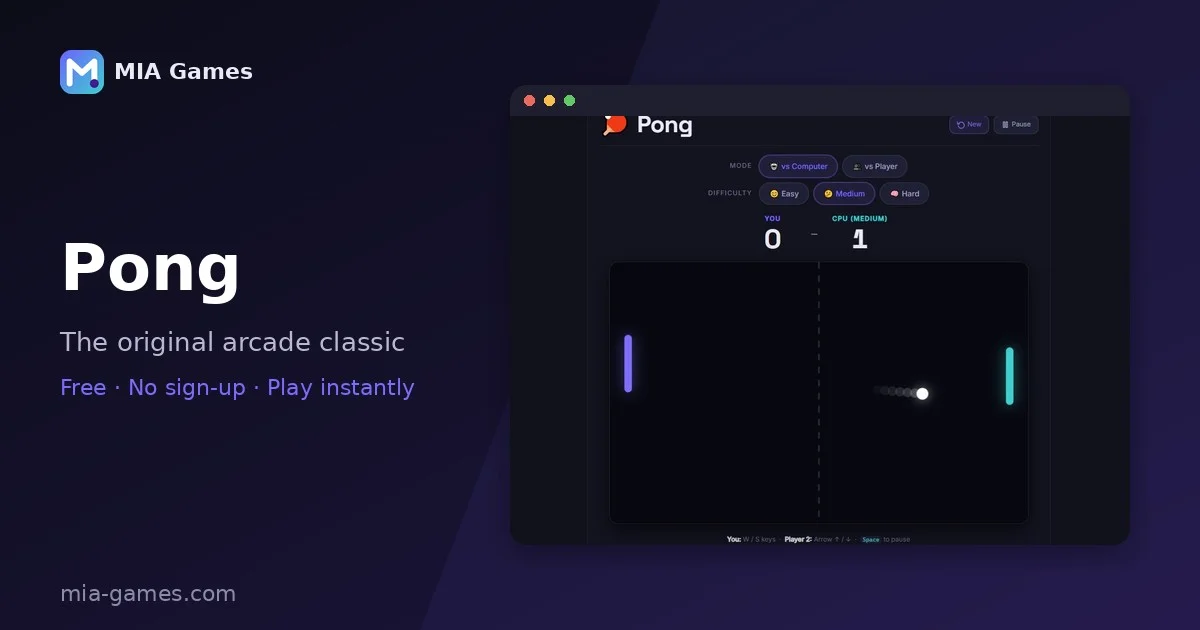
The game was simple: two paddles, a ball, and a line down the middle. You moved your paddle up and down, trying to hit the ball past your opponent. That was it. No story, no graphics, no sound effects beyond a simple beep. And yet, millions of people couldn't get enough of it.
Pong's success was immediate and overwhelming. Atari sold over 8,000 arcade cabinets in the first year alone. It spawned countless imitators and established the business model for the entire video game industry. Suddenly, video games were big business.
The engineering behind Pong was also remarkable. Alcorn built the game using discrete logic chips — no microprocessors, no software. Each component had a specific job: one chip controlled the ball's movement, another tracked the paddles, and a simple sound circuit produced the iconic beep. The entire game fit on a single circuit board.
Key Moments in Pong's Evolution
Arcade Debut
Allan Alcorn creates Pong for Atari. The first machine is placed in Andy Capp's Tavern.
Home Console
Atari releases a home version of Pong. It becomes the first popular console game.
Pong in Your Pocket
Handheld electronic versions of Pong hit the market, making the game portable.
Nostalgia Revival
Classic gaming enthusiasts rediscover Pong. Emulators and ports bring it to new platforms.
Flash & Java Era
Pong finds a new home on the web, with Flash and Java versions reaching millions.
HTML5 & Browser
Pong is recreated in pure HTML5. It works on any device, anywhere, instantly.
1975: Pong Goes Home
The arcade success of Pong was just the beginning. In 1975, Atari released a home console version of Pong. It was a single-game system that connected to your television. No cartridges, no expansion packs, no extra controllers. Just Pong.
The home Pong console was a sensation. It sold over 150,000 units in its first year — an extraordinary number for the time. It proved that people wanted to play video games in their own homes. And it sparked the home console revolution that would eventually lead to the PlayStation, Xbox, and Nintendo systems we know today.
"When we first showed Pong to retailers, they were skeptical," recalled Nolan Bushnell in a later interview. "They said, 'People don't want to play games on their TVs.' But once they saw it in action, they changed their minds. Pong was the game that convinced the world that home video games were viable."
The home version was also a technical challenge. Atari had to shrink the arcade hardware into a box that could sit under a television. The solution was a dedicated chip designed by Alcorn himself — one of the first custom silicon chips created specifically for a consumer product.
1976: Pong Goes Portable
In 1976, Coleco released a handheld electronic version of Pong. It was a simple device with a small LCD screen and built-in paddles. You could play it anywhere — on the bus, in the car, at the park.
This portable Pong introduced the game to an entirely new audience. Suddenly, Pong wasn't just for arcades or living rooms. It was a game you could carry in your pocket. It was the beginning of portable gaming — a trend that would later give us the Game Boy, the DS, and the Nintendo Switch.
The Coleco version was also one of the first games to use an LCD display for gameplay. While primitive by today's standards, it was a marvel of engineering at the time. The screen showed a simplified version of Pong with blocky paddles and a ball that moved in discrete steps.
1990s: The Nostalgia Revival
By the 1990s, Pong had been overshadowed by more advanced games. The graphics were primitive, the gameplay was simple, and younger gamers were flocking to 3D worlds and cinematic experiences. But for a generation of players, Pong was the game of their childhood.
The nostalgia revival began with emulators and classic game compilations. Suddenly, you could play Pong on your computer, decades after its original release. The game was being rediscovered by a new generation — and appreciated by those who had grown up with it.
Pong's simplicity, once seen as a limitation, was now seen as a virtue. In an era of increasingly complex games, Pong offered a return to fundamentals. It was a reminder of why people fell in love with video games in the first place.
This revival also inspired a wave of "Pong clones" and homages. Developers created versions with updated graphics, power-ups, and even multiplayer modes. The core gameplay remained unchanged, but the presentation evolved to match modern tastes.
📊 By the Numbers: Pong has been ported to more than 30 platforms and translated into over a dozen languages. It's estimated that over 100 million people have played some version of Pong since 1972.
2000s: The Web Era
The rise of the web in the 2000s gave Pong a new lease on life. Flash and Java allowed developers to recreate the game in their browsers. Pong became one of the first truly viral web games.
Suddenly, anyone could play Pong at work, at school, or at home. No coins, no consoles, no downloads. Just a browser and an internet connection. It was the beginning of browser gaming — a trend that continues to this day.
The web era also brought multiplayer Pong. You could play against friends across the world, not just the person sitting next to you. It made the game more social and more competitive. Pong was evolving.
The Flash version of Pong was particularly popular. It was lightweight, ran on almost any computer, and could be embedded on any website. At its peak, there were hundreds of Pong clones on the web, each with its own twist on the classic formula.
2010–Present: HTML5 and the Browser Era
The final chapter in Pong's evolution is the one we're living in now. With the arrival of HTML5 and modern web technologies, Pong was rebuilt from the ground up. No plugins, no downloads, no compromises.
Our MIA Games Pong is a perfect example of this evolution. It's:
- Cross-platform: Works on desktop, tablet, and mobile.
- Instant: No downloads, no installs, no waiting.
- Modern: Smooth 60fps gameplay with responsive controls.
- Accessible: Supports mouse, keyboard, and touch input.
- Competitive: Play against AI or challenge a friend.
But underneath all the modern polish, it's still the same game. Two paddles, a ball, and a line down the middle. Simple, addictive, and timeless.
The HTML5 version also introduced new possibilities. We added difficulty levels, so players can adjust the challenge. We included a local two-player mode, so friends can compete on the same device. And we built it with accessibility in mind, supporting keyboard shortcuts and high-contrast visuals.
The Secret to Pong's Enduring Appeal
Why does Pong still captivate players after 50 years? We've thought about this a lot while building our Pong game at MIA Games. Here's what we've concluded:
- Simplicity: You can learn to play in 10 seconds. No tutorials, no complex mechanics.
- Instant gratification: You score, you win, you lose — it's all immediate and clear.
- Skill progression: The game gets harder as you get better, thanks to AI difficulty levels.
- Universal appeal: Anyone can play, regardless of age, gender, or gaming experience.
- Nostalgia: For millions of people, Pong is a direct link to their childhood.
- Pure competition: There's no luck involved. The better player wins.
As we've written in our article on classic games, there's something deeply satisfying about games that don't overcomplicate themselves. Pong is the ultimate example of this philosophy.
Frequently Asked Questions
Who created Pong?
Pong was created by Allan Alcorn in 1972 as a training exercise for Atari. His bosses, Nolan Bushnell and Ted Dabney, were so impressed that they turned it into a product.
Was Pong the first video game?
No. Earlier games like Tennis for Two (1958) and Spacewar! (1962) existed, but Pong was the first to achieve mass-market commercial success.
How much did the first Pong machine cost?
The first Pong arcade machine cost about $1,200 to manufacture and sold for around $2,100. It made back its cost in a matter of weeks.
Why was Pong so popular?
Pong was simple to understand, challenging to master, and accessible to everyone. It was also one of the first games to create a truly social experience — you played against another person, not just a machine.
Can I still play the original Pong?
Yes. MIA Games Pong offers a modern version of the classic game with responsive controls, multiple difficulty levels, and support for all devices. You can play it instantly in your browser.
What made Pong different from other early games?
Pong's genius was its simplicity. It didn't require a manual, a backstory, or expensive hardware. Anyone could walk up to the machine, drop in a quarter, and start playing. This accessibility was revolutionary at the time.
Pong's Legacy
Pong didn't just start the video game industry — it defined it. It established the business model for arcade games. It proved that home consoles could be commercially viable. It inspired a generation of game designers. And it created the template for competitive multiplayer gaming.
Without Pong, there might not have been Atari. Without Atari, there might not have been Nintendo. Without Nintendo, there might not have been PlayStation. The entire video game industry can trace its roots back to that simple table tennis game in a Sunnyvale bar.
As Nolan Bushnell himself said: "Pong was the beginning. It was the game that started everything. And the fact that people are still playing it today, 50 years later, tells you something about its genius."
Ready to Play?
Play Pong on MIA Games and experience a piece of gaming history. Whether you're a veteran player who remembers the original arcade or a newcomer discovering it for the first time, Pong is a game that never gets old.
Challenge the AI, compete with a friend, or just enjoy the satisfying simplicity of two paddles and a ball. And while you're here, explore our other classic games — from Snake to 2048, there's a whole world of gaming history waiting for you.
Keep paddling!