📌 Key Takeaways
- Hangman is a deduction puzzle: every correct and incorrect guess changes the information available to the player.
- Strong guesses combine the visible pattern, word length, category, repeated letters, and previously rejected letters.
- Hangman can support spelling and vocabulary practice, but playing a game is not the same thing as proving a broad learning outcome.
- Research on retrieval practice supports the value of actively recalling information; Hangman can incorporate that kind of activity, especially when players revisit unfamiliar words.
- MIA Games Hangman uses 474 hand-checked words across six categories, three difficulty bands, a no-repeat word deck, scoring, and word-mastery tracking — designed so every round feels fresh while leaving room for deduction.
Hangman is easy to explain and surprisingly difficult to master. You see a hidden word, choose a letter, and gradually reveal the answer before the available guesses run out. The rules fit on a few lines, but the decisions inside those rules are richer than they first appear.
A good player is constantly updating a mental shortlist. The category narrows the subject. The number of spaces limits the possible word shapes. A repeated letter can suddenly make several answers plausible, while a failed guess removes an entire branch of possibilities. The puzzle is therefore less about throwing letters at the screen and more about extracting information efficiently.
That practical side is the focus of this article. We will look at how Hangman works, how to make better guesses, where vocabulary practice genuinely fits, what research can and cannot tell us about learning through Hangman, and why the design of a word bank matters. We will also show how those ideas appear in MIA Games Hangman itself.
💡 The central idea: In Hangman, information is the real resource. A correct letter gives you positions; an incorrect letter removes possibilities. Better play comes from using both.
How Hangman Works as a Deduction Puzzle
At the start of a round, the player has incomplete information. You may know the category and the number of letters, but not the answer. As letters are guessed, the uncertainty changes. This makes the board a running record of what is known and what has already been ruled out.
- Start with the shape: Count the positions and note every visible letter.
- Use the category: A category such as Animals or Technology changes the pool of plausible words.
- Watch repeated positions: If a letter appears more than once, the pattern may become much more distinctive.
- Remember misses: A wrong letter is not wasted information; it eliminates candidates.
- Update your hypothesis: A sensible early guess may become unnecessary after two or three letters are revealed.
The important word here is update. Hangman rewards a player who changes their thinking as the evidence changes. That is why a strategy that works reasonably well on the first move can be the wrong strategy later in the same round.
Reading the Pattern Instead of Guessing Randomly
Consider a fictional pattern such as _ A _ _ A _. You still do not know the word, but the two A positions have already supplied structure. If the category is Animals, the candidate set is different from what it would be under Technology or Food. If another letter appears, the pattern may narrow again.
This is where common word beginnings, endings, and letter combinations can help. Players do not need a dictionary in their head. They simply need to notice when a partial pattern begins to resemble familiar words. The best guess is often the one that separates the remaining possibilities most effectively.
🔎 A useful habit: Before pressing a letter, ask, “What will I learn if this is correct?” and “What will I rule out if it is wrong?” That turns a guess into a deliberate information-gathering move.
How to Choose Better Letters
Letter-frequency strategies can be useful, especially early in a round, because some letters occur more often than others in English. But frequency should be treated as a starting point rather than a universal rule. The category and the visible pattern can make a less common letter the more informative choice.
For example, suppose the board already suggests a word with a distinctive ending. Continuing to choose letters only because they are common may be less useful than testing a letter that separates two or three plausible candidates. Likewise, if the category strongly narrows the possibilities, contextual knowledge can matter more than a generic frequency list.
A practical sequence is therefore: inspect the pattern, use the category, check which letters have failed, then choose a letter that is likely to reveal something useful. When the answer becomes highly constrained, it can make sense to stop thinking in terms of individual letters and consider the whole word.
Vocabulary and Spelling: What Hangman Can Actually Practise
Hangman has an obvious connection with spelling because the player reconstructs a word one letter at a time. It can also expose players to vocabulary, especially when words are organised into meaningful categories. These are observable features of the activity, not promises that every player will automatically learn or retain every word encountered.
The difference matters. Seeing a word once is exposure. Remembering what it means later is a learning outcome. If the goal is vocabulary practice, the most useful moment may come after the round: read the completed word, say it aloud, check its meaning, and use it in a sentence. That turns a game answer into something more deliberately processed.
This idea is consistent with the broader learning literature on retrieval practice. A major review in Annual Review of Psychology describes retrieval practice as a robust way to support later recall across materials and learners. That does not mean Hangman itself has been proven to produce the same effect in every setting; it means that an activity involving active retrieval can be connected to a well-studied learning principle when it is used thoughtfully. McDermott's review on retrieval practice is a useful starting point.
What Research on Hangman Tells Us — and What It Does Not
Hangman has been used in language-learning contexts, and there are published classroom studies reporting vocabulary improvements after Hangman-based instruction. That evidence is interesting, but it should be read with the same care as any small educational study.
For example, a 2024 quasi-experimental study involving 40 seventh-grade students in Indonesia reported higher post-test vocabulary scores in the Hangman group and an average N-Gain of 0.61. The study is useful evidence that Hangman can be incorporated into vocabulary instruction, but its participants, setting, teaching period, and design limit how broadly the result should be generalized. Read the 2024 Tarling study.
More recent evidence also shows why simple claims need qualification. A 2026 quasi-experimental study of Hangman-based Arabic vocabulary instruction reported significant improvement within the experimental group, but the between-group comparison was not statistically significant. The authors described the overall effect on vocabulary mastery as moderate and noted factors such as implementation time, classroom atmosphere, and student readiness. Read the 2026 DIAJAR study.
The sensible conclusion is narrower than “Hangman makes you smarter” or “Hangman guarantees vocabulary growth.” Hangman can create opportunities to work with spelling, word patterns, and retrieval. Whether those opportunities produce measurable learning depends on the learner, the words, the instructions, the feedback, and how the activity is used.
Why the Word Bank Matters
A Hangman game is only as good as the words it asks players to solve. An enormous word list is not automatically a better word list. If the answers are too obscure, the category is too broad, or the vocabulary is poorly matched to the intended audience, the player may be forced into lucky guessing rather than useful deduction.
Good word selection creates a middle ground: familiar enough to reason about, varied enough to remain interesting, and structured enough that clues actually help. This is particularly important for a browser game because the player has no teacher or friend sitting beside them to explain why an answer was chosen.
What We Built Into MIA Games Hangman
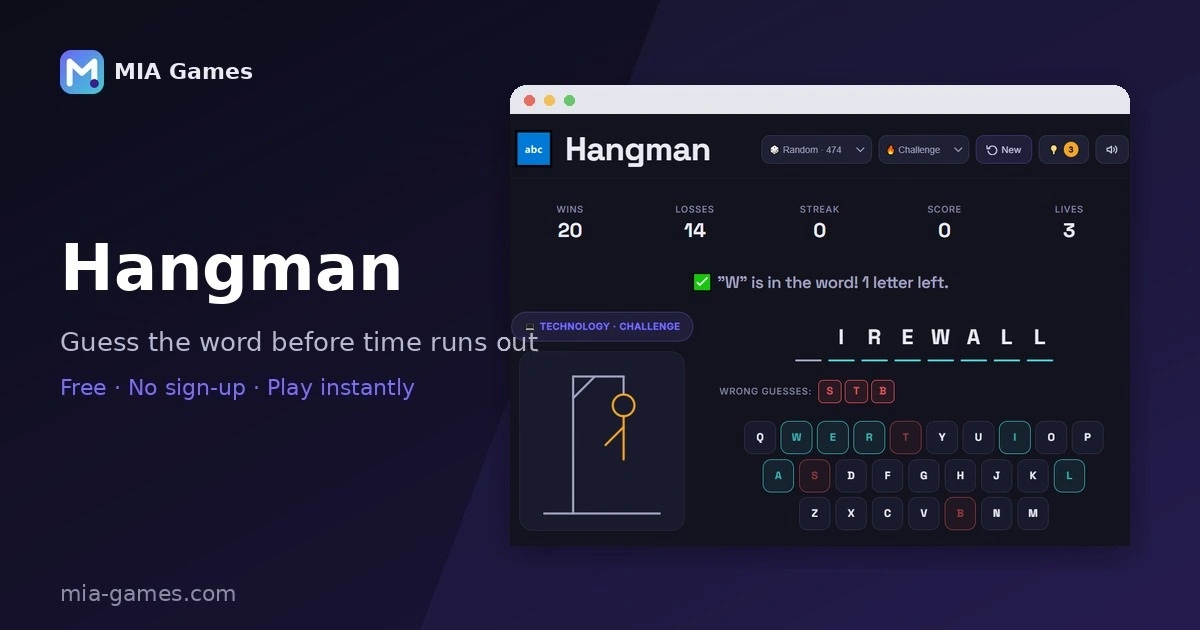
This is where MIA Games can offer something more concrete than a generic article about Hangman. Our current Hangman uses 474 hand-checked words across six categories: Animals, Food, Nature, Technology, Sports, and Countries. Every entry was reviewed for accuracy — country names are complete rather than truncated, and singular/plural duplicates were removed. The category is part of the puzzle, not just a decorative label.
Two design choices keep the game fresh for returning players. First, a no-repeat deck deals every word in a category-and-difficulty pool before any word can reappear, so each round genuinely presents something new. Second, three difficulty bands — Casual for shorter words, Classic for the full bank, Challenge for words of eight letters or more — let players tune the difficulty without changing the rules. Wins earn points based on word length, lives remaining, and difficulty, with hints costing a few points each; a word-mastery meter tracks how many of the 474 words a player has solved, giving the game a long-term completion goal.
474-Word Bank
A defined, reviewed collection — no duplicates, no truncated answers — with a no-repeat deck so every round presents a genuinely new word.
Six Categories
Animals, Food, Nature, Technology, Sports, and Countries give players context before the first guess.
Progressive Reveal
Correct letters expose their positions, allowing the player to refine the candidate word.
Hint System
Hints provide a recovery path when a round becomes difficult without removing the need to solve it.
Scoring & Mastery
Points for clean solves, a best score to chase, and a word-mastery meter tracking how many of the 474 words you have conquered.
Quick Browser Play
The game is available directly in a modern browser, so a player can start a round without a download.
These choices also reveal a design trade-off. A curated word bank makes quality control possible, but it can eventually become familiar to frequent players. The answer is not to replace familiar words with obscure ones simply to increase difficulty. Better variety can come from category balance, word length, pattern diversity, and thoughtful hint design.
Why Hint Design Matters
A hint has a difficult job. If it reveals the answer too directly, the player no longer has much to solve. If it is so vague that it changes nothing, it feels pointless. A useful hint should reduce uncertainty while leaving the final step to the player.
This principle is especially important when Hangman is used for vocabulary practice. A hint that supplies useful context can help a learner connect the word to its category or meaning. The aim is not to make every round effortless; it is to prevent a difficult word from becoming an arbitrary dead end.
Hangman for Language Learners
Hangman fits naturally into language practice because the learner must pay attention to letters and word forms. It can be used as a short supplementary activity rather than as a replacement for structured language instruction.
- Start with a familiar category: Context reduces the number of possibilities a learner has to consider.
- Say the completed word: Add pronunciation practice after the answer appears.
- Check meaning: Look up unfamiliar words rather than assuming the category tells you everything.
- Use the word: Write or say a short sentence with a newly encountered word.
- Revisit difficult words: Words that caused repeated problems are good candidates for later review.
An important distinction is that Hangman gives the learner a reason to retrieve or reconstruct a word, while deliberate vocabulary study provides the broader context needed for durable language development. Used together, the game can be a useful practice layer without pretending to replace a complete learning program.
Hangman for Children
For children who can already recognise letters and handle the game's reading demands, Hangman can be a simple way to practise spelling and word construction. The right level depends on the child's age, reading ability, vocabulary, and tolerance for frustration.
- Keep the category familiar: Start with topics the child already knows.
- Let the child explain guesses: Asking “Why that letter?” turns guessing into reasoning.
- Talk about unfamiliar answers: A completed word can lead to a quick meaning, spelling, or pronunciation discussion.
- Do not make every round a lesson: Sometimes the value is simply enjoying a puzzle together.
- Adjust the challenge: If a child is repeatedly stuck, use hints or an easier category rather than making the session feel like a test.
👨👩👧 Parent Tip: After a round, ask one small question: “What does that word mean?” or “Can you use it in a sentence?” One useful conversation is enough; the game does not need to become homework.
Playing With Other People
Traditional Hangman is naturally social: one person chooses the word while another guesses. That format creates conversation around the puzzle, including explanations of why a letter seems likely and discussion of the completed word.
MIA Games Hangman is designed for solo browser play, but it can still become a shared activity. A parent and child can suggest letters together, two friends can take turns, or a small group can discuss the pattern before committing to a guess. The social benefit comes from the interaction between players, not from a claim that the software itself creates a special social skill.
A Practical Hangman Strategy
If you want a repeatable method rather than a collection of random tips, use this five-step routine:
- Read the category. Treat it as evidence about the answer.
- Inspect the pattern. Note length, visible letters, and repeated positions.
- Track the misses. Do not guess the same failed letter twice in your mental shortlist.
- Choose for information. Prefer a letter that can reveal several positions or separate plausible candidates.
- Reassess after every reveal. Once the pattern changes, update your next move rather than following a fixed script.
This method is deliberately simple. It does not require memorising a giant frequency table, and it works because it keeps the player's attention on the information actually present in the current round.
The History of Hangman: A Careful Version
Hangman's exact origin is not firmly established. A related word-guessing game appears in Alice Bertha Gomme's The Traditional Games of England, Scotland, and Ireland, published in 1894. The documented game, “Birds, Beasts, and Fishes,” is related to modern Hangman but does not establish a single inventor or prove that today's full gallows-and-stick-figure format existed in exactly the same form at that time.
That distinction is important because the history of traditional games is often reconstructed from later descriptions, regional variants, and oral traditions. Project Gutenberg's digital edition of Gomme's 1894 volume provides a useful primary-source starting point for readers who want to examine the historical material directly.
What is easier to explain is why the format endured. The rules are inexpensive to reproduce, the feedback is immediate, and the difficulty can be adjusted simply by changing the word, category, number of guesses, or amount of information supplied at the start.
What Makes a Good Hangman Round?
From a design perspective, the sweet spot lies between obvious and arbitrary. If the answer becomes clear after one letter, there is little puzzle left. If the word is obscure and the clues provide no meaningful context, success may depend more on luck than deduction.
A strong round gives the player something to work with: a recognisable category, a fair word, a developing pattern, useful feedback, and enough remaining guesses to make decisions matter. This is why word selection, hint design, and interface clarity are not secondary details. They determine whether the basic rules actually produce an enjoyable puzzle.
For MIA Games, this is also why a controlled word bank is useful. We can think about categories and presentation instead of treating the game as a random dictionary search. The goal is not to make every round easy; it is to make the difficulty feel earned.
Beyond Hangman: Other MIA Games to Try
If you enjoy Hangman, changing the puzzle type can make a game session more varied. MIA Games has several options that ask for different kinds of interaction.
- Word Search — Find hidden words in a letter grid and practise visual scanning.
- Memory Match — Match pairs while remembering previously revealed cards.
- Sudoku — Place numbers by reasoning from row, column, and grid constraints.
- 2048 — Combine matching tiles while managing limited board space.
These games should not be described as interchangeable “brain training.” Their mechanics are different. That is precisely what makes rotating between them interesting: Hangman centres on words and incomplete information, while the others use visual search, memory for locations, logical constraints, or spatial planning.
How to Use Hangman Without Overclaiming Its Benefits
The strongest way to talk about a game is often the most precise. Hangman clearly requires letter selection, pattern reading, memory for previous guesses, and word reconstruction. It can also be incorporated into vocabulary activities. Those are concrete observations.
What we should avoid is jumping from those observations to claims that a few rounds will improve general intelligence, guarantee better grades, or produce a broad “brain boost.” Research on learning mechanisms can inform how an activity might be used, but it does not automatically validate every claim made about a particular game.
📚 Our editorial standard: We separate what a player visibly does in the game from what research has actually tested. That makes the article more useful—and more trustworthy—than promising benefits that the evidence cannot support.
Frequently Asked Questions
Is Hangman an educational game?
It can be used as a learning activity because it involves letters, spelling, word patterns, and vocabulary. Its educational value depends on how the activity is designed and used; it should not be treated as a substitute for structured instruction.
Can Hangman help with vocabulary?
It can provide repeated exposure to words and require players to reconstruct spelling. For stronger vocabulary practice, pause after unfamiliar answers and check their meaning, pronunciation, and use in a sentence.
What is the best Hangman strategy?
Use the category, word length, visible pattern, repeated letters, and failed guesses together. Choose letters for the information they can reveal, then reassess after each new clue.
How many words are in MIA Games Hangman?
MIA Games Hangman currently uses 474 hand-checked words across six categories: Animals, Food, Nature, Technology, Sports, and Countries — with three difficulty bands (Casual, Classic, Challenge) that adjust word length without changing the rules.
Is Hangman suitable for children?
It can be, provided the vocabulary, presentation, and difficulty suit the child's age and reading ability. MIA Games Hangman uses family-friendly categories and a cartoon-style presentation.
What is retrieval practice?
Retrieval practice means actively trying to recall previously encountered information instead of only rereading it. Research reviews find that retrieval can support later retention, but that evidence should not be treated as proof that every game produces the same effect.
How does scoring work in MIA Games Hangman?
Each win earns 10 points per unique letter, 15 points per life remaining, and a difficulty bonus (25 for Classic, 60 for Challenge), minus 20 points per hint used. A word-mastery meter separately tracks how many of the 474 words you have solved at least once.
Can Hangman be used for language learning?
Yes. It can be a short supplementary activity for spelling and vocabulary. Learners can make it more useful by saying completed words aloud, checking meanings, and reusing unfamiliar words.
References & Further Reading
Sources used for this article
- Google Search Central. Creating Helpful, Reliable, People-First Content. Guidance on original analysis, substantial value, clear authorship, first-hand expertise, and avoiding search-engine-first content. Read the guidance.
- McDermott, K. B. (2021). Practicing Retrieval Facilitates Learning. Annual Review of Psychology, 72, 609–633. DOI: 10.1146/annurev-psych-010419-051019. PubMed.
- Mardikawati, A. N., & Kusumawanti, W. D. (2024). The Effectiveness of Hangman Game Towards Students’ English Vocabulary Mastery at 7th Grade of MTs Muhammadiyah Wangon Banyumas. Tarling: Journal of Language Education, 8(2), 301–320. DOI: 10.24090/tarling.v8i2.11306. Article.
- Azoes, P. F., Sopian, A., & Saleh, N. (2026). The Efectiveness of Using the Hangman Game in Teaching Arabic Vocabulary in Elementary Schools. DIAJAR: Jurnal Pendidikan dan Pembelajaran, 5(2), 754–761. DOI: 10.54259/diajar.v5i2.7507. Article.
- Gomme, Alice Bertha (1894). The Traditional Games of England, Scotland, and Ireland, Vol. I. Project Gutenberg eBook 41727. The volume provides a historical primary-source record of traditional games, including the related “Birds, Beasts, and Fishes.” Project Gutenberg.
Ready to Play?
Play Hangman on MIA Games and put the strategy into practice. Read the category, inspect the pattern, remember your misses, and choose guesses that give you useful information. If an unfamiliar word appears, take a moment to look beyond the puzzle and learn what the word means.
The game is designed for quick browser play, with 474 reviewed words across six categories, three difficulty bands, a no-repeat word deck, a scoring system, and word-mastery tracking alongside the usual wins, losses, and streaks. The aim is straightforward: give players a clean word puzzle that remains approachable while leaving room for deduction.
Happy guessing!