📌 Key Takeaways
- Gabriele Cirulli built 2048 over a single weekend in March 2014 as a web-development experiment.
- The immediate influences were 1024! and an earlier game also called 2048 by Saming; Threes! was the deeper ancestor of that chain.
- Cirulli's own retrospective says he did not know about Threes! while building 2048 and later acknowledged how much the game owed to it.
- The game spread through GitHub Pages, Hacker News and word of mouth, then became a worldwide hit within weeks.
- Its MIT-licensed source code helped other developers study, modify and redistribute the game, producing a large ecosystem of variations.
Some games arrive after years of production, large teams and carefully planned launches. 2048 followed a very different path: a web developer spent a weekend experimenting with a simple sliding-tile idea, published the result openly, and watched an ordinary side project become an international gaming story.
Gabriele Cirulli built 2048 in March 2014. His own retrospective explains that he was already enjoying 1024! and another game also called 2048, and wanted to make his own version with a different visual style and faster animations. He published the project as open-source software, initially looking for feedback rather than building a commercial game. This distinction matters because the popular version of the story often makes it sound as though Cirulli independently invented the entire sliding-number genre in one weekend. He did not.
💡 The short version: 2048 was a remarkably fast implementation and refinement of an existing idea, not the beginning of that idea. Cirulli's own account is unusually clear about the game's lineage: he knew 1024! and another 2048, did not know about Threes! at the time, and later acknowledged Threes! as the deeper source behind the family of games.
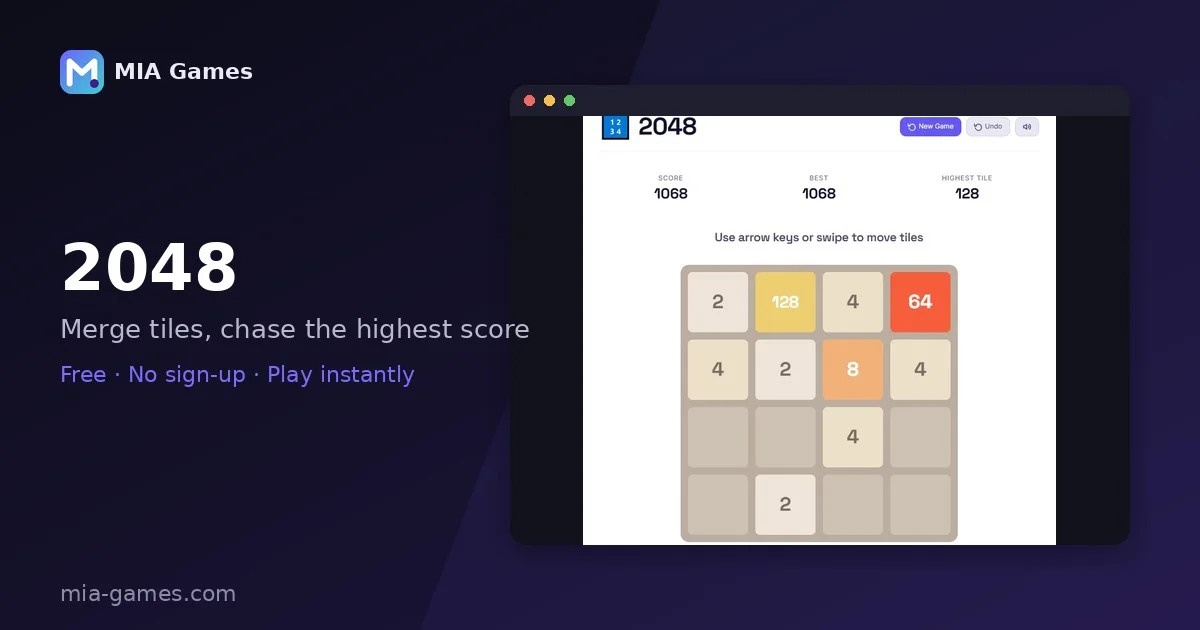
Who Created 2048?
Gabriele Cirulli was a 19-year-old Italian web developer when 2048 appeared in 2014. Contemporary reporting described him primarily as a web developer rather than as an established game-industry figure. That background helps explain why the project was built around familiar web technologies and why the first release was a browser game rather than a conventional boxed or studio-produced title.
Cirulli's later account is more useful than the mythology that grew around the game. He says he built 2048 "just for fun," after becoming interested in 1024! and another game called 2048, and that he wanted to experiment with the presentation and animation of the concept. He was not setting out to create a global franchise.
The Puzzle Family Before 2048
The history becomes much clearer when the games are placed in sequence. Threes! was released for iOS on February 6, 2014, by Sirvo, the team associated with Asher Vollmer and Greg Wohlwend. It used a 4×4 grid and a distinctive number system in which 1 and 2 combine to make 3, while matching multiples of three combine into larger values.
1024! appeared soon afterward and adapted the basic sliding-and-merging idea to powers of two. The creators of Threes! later described 1024 as one of the early games that followed their release and published a detailed account of Threes!' 14-month development and the copying debate that followed.
There was also an earlier web game called 2048, created by Saming. Cirulli's original repository describes his own game as a small clone of 1024, based on Saming's 2048, and says that 2048 was indirectly inspired by Threes!. That repository description is one of the clearest primary-source explanations of the game's lineage.
🔗 The lineage in one line: Threes! → 1024! → Saming's 2048 → Cirulli's 2048. The relationship is not a simple one-to-one invention story; it is a chain of iteration in which each version changed the rules, presentation or implementation.
The Important Detail: Cirulli Did Not Know About Threes! Yet
This is one of the most important corrections to make to simplified histories of 2048. In his retrospective, Cirulli says that while building the game he did not know about Threes!. He had been playing 1024! and Saming's 2048 and wanted to create his own version.
After 2048 became successful, Cirulli learned more about Threes! and explicitly acknowledged the work of Vollmer and Wohlwend. He wrote that 2048 "owes its existence" to Threes! and said he understood why its creators were frustrated by the success of the later clones. That makes the historical relationship more nuanced than either "2048 copied Threes!" or "2048 had nothing to do with Threes!" Neither description captures the documented chain accurately.
The Weekend Project
In March 2014, Cirulli built his version over a single weekend. Contemporary reporting described the project as taking a little more than two days. His stated motivation was experimentation: he wanted to see whether he could build the game and give it a different visual treatment and quicker animations.
The implementation used the technologies that were natural for a web developer: HTML, CSS and JavaScript. That choice was strategically important even if it was not intended as a marketing strategy. A browser game could be opened through a link, played without an installation step and shared immediately.
The name 2048 came from the game's target tile. The number is a power of two, fitting the numerical progression of the game and giving players a clear milestone to pursue. Reaching 2048 is the original game's central objective, but the player can continue after reaching it.
How 2048 Actually Works
Part of 2048's historical importance comes from how little the player has to learn before making meaningful decisions. The original game uses a 4×4 board. A move shifts the occupied tiles in one of four directions, and matching values can merge during that movement. The resulting tile carries the sum of the two merged values.
A new tile is introduced after a successful board change, which means the player is making decisions under uncertainty rather than solving a fixed sequence of moves. The board gradually becomes more constrained, so a move that looks harmless in the short term can make later merges much harder.
This is where the apparent simplicity of 2048 becomes deceptive. The rules can be explained in a few sentences, but good play involves preserving empty space, arranging large values so they remain usable, anticipating future merges and avoiding moves that destroy the board's structure. The original source code makes those mechanics directly inspectable rather than leaving them to interpretation.
March 2014: The Game Takes Off
Cirulli first published the game on GitHub Pages and shared it on Designer News. According to his later account, a friend soon told him that 2048 had reached the front page of Hacker News, where Google Analytics showed thousands of visitors. The traffic did not disappear after the initial spike; it kept growing.
Contemporary coverage from the Los Angeles Times reported on March 24 that 2048 had become a major online craze, while a March 27 follow-up described the game as a weekend project that had quickly attracted attention. Those reports also document the growing ecosystem of copycat and derivative games.
Cirulli's own May 2014 retrospective gives a useful measure of the scale: he wrote that the game had been played by more than 23 million people in the weeks following its release. That is a creator-reported figure, not a permanent audited player-count database, but it provides a far stronger historical anchor than vague claims that the game simply "went viral."
Why the Open-Source Release Mattered
Cirulli released 2048 as open-source software, and the project is licensed under the MIT License. The repository remains public and documents contributions from other developers, including improvements to best-score storage and mobile swipe handling.
Open source did more than make the code visible. It lowered the barrier for developers who wanted to understand the implementation, adapt the interface, port the game to another platform or create a variation. The result was a rapidly expanding family of 2048-inspired projects.
Cirulli's retrospective shows that he viewed this derivative ecosystem with mixed but ultimately positive feelings. He was unhappy when people used the work without attribution or impersonated him, but he also described the creativity of many open-source derivatives as one of the most rewarding parts of the experience.
🌐 A useful distinction: "Open source" does not mean "ownerless." The original 2048 code remains copyrighted and is distributed under the MIT License, which grants broad permissions subject to its license terms. The historical importance of the release is that those permissions made experimentation and redistribution unusually easy.
The Threes! Controversy
The rapid success of 2048 created an uncomfortable question: how much credit should go to the creators of Threes!, and how much belongs to the developers who iterated on the idea afterward?
The creators of Threes! published a detailed post in March 2014 explaining the game's development and their frustration with the wave of games that followed it. They specifically described 2048 as a simpler version of the idea and emphasized the amount of design and iteration that had gone into Threes!.
Cirulli's own later account does not deny that debt. He acknowledged the work of Vollmer and Wohlwend, explained that he had not known about Threes! while building his version, and said that he had released 2048 openly partly because he did not feel comfortable keeping private a project that was heavily based on someone else's work.
It is therefore better to describe 2048 as a descendant in a chain of game designs than to present a legal or moral verdict about whether it was "a clone." The historical record clearly establishes the influences and the disagreement; the broader question of where inspiration ends and imitation begins is a matter of interpretation.
What Happened After the Viral Breakout?
The story did not end when the browser game became popular. Cirulli initially decided to keep 2048 open-source and not pursue a mobile version. His retrospective explains that he felt uncomfortable profiting from a concept that he had not invented.
He later changed his mind. Rather than simply wrapping the existing web code in an app, he spent about a month building the mobile application and wrote that most of its code was new, retaining the core tile-movement logic from the open-source version. Official mobile apps followed in 2014.
This part of the story is important because it corrects another common oversimplification: Cirulli did not permanently reject monetization or mobile development. He initially rejected those plans, then reconsidered after the scale of the opportunity became clear.
Why 2048 Has Such Strong Replay Value
Rather than relying on vague claims about "addiction" or unverified psychological effects, the game's staying power can be explained through observable design characteristics.
- Immediate rules: A new player can understand the basic objective and controls almost immediately.
- Visible progress: Every successful merge produces a larger number, giving the player a clear sense of advancement.
- Constrained space: The 4×4 board forces trade-offs; every new tile can change the value of future choices.
- Uncertainty: New tiles appear during play, so the player must adapt instead of following a completely fixed solution.
- Long-term mastery: Reaching 2048 is only one milestone; experienced players can continue pursuing larger tiles and higher scores.
- Low friction: The original browser implementation could be reached through a link rather than a traditional installation process.
These features also explain why the game works as both a casual time-filler and a deeper strategy puzzle. The first few moves are understandable without instruction, while stronger play requires thinking several moves ahead and managing the geometry of the board.
2048 Beyond the Original Browser Game
The open-source project made 2048 unusually easy to adapt. The original repository records contributions for mobile interaction and score handling, while the wider ecosystem produced themed versions, ports and experimental variants. This is a useful example of how a small open-source project can become a platform for other developers rather than remaining a single fixed implementation.
The game also became an object of technical study. For example, Rodgers and Levine examined artificial-intelligence strategies for 2048, while Langerman and Uno studied the computational complexity of 2048 and related slide-and-merge games. That later research is separate from the game's original history, but it shows how a simple recreational program became useful as a technical problem as well.
What the History of 2048 Really Teaches
The most interesting lesson is not simply that one developer "got lucky." The documented story shows a more useful combination of factors: an existing game idea, a developer willing to iterate on it quickly, a browser-based distribution model, an open-source license, and an internet community capable of spreading and modifying the result almost immediately.
It also shows why historical accuracy matters. Saying that Cirulli invented the sliding-number puzzle in a weekend removes the work that came before him. Saying that he simply copied Threes! removes the documented fact that he was working from 1024! and Saming's 2048 and did not know about Threes! at the time. The stronger story is the complete one: Threes! established an important design ancestor, 1024! and Saming's 2048 carried the idea forward, and Cirulli created the version that became a worldwide web phenomenon.
Finally, 2048 demonstrates the value of restraint in game design. Its original interface is remarkably small: a grid, numbers, four directions, merging rules and a score. There is no elaborate world to learn before the first move. The depth comes from the interaction of those few rules.
🎯 The enduring idea: 2048 did not become historically interesting because it was the first game of its kind. It became historically interesting because it showed how far a small, accessible browser game could travel when a familiar idea was implemented cleanly, released openly and amplified by the web.
Play 2048 on MIA Games
At MIA Games, we offer our own browser version of 2048 as part of our collection of classic games. It is designed for quick access: no download and no account are required to start playing.
If you are new to 2048, start by focusing on the basic merge rule and keeping the board open. If you already know the game, try treating each move as a board-management decision rather than simply chasing the largest number you can create immediately.
Happy merging — and now you know the story behind the numbers.
Frequently Asked Questions
Who created 2048?
2048 was created by Gabriele Cirulli, an Italian web developer who was 19 years old in 2014. He built the game over a single weekend in March 2014.
When was 2048 released?
The original web version appeared in March 2014, with March 9 commonly recorded as its release date. Cirulli's own retrospective explains that he published the project on GitHub Pages before it spread through Hacker News and other channels.
What inspired 2048?
Cirulli's immediate influences were 1024! and an earlier game also called 2048 by Saming. Those games were part of a design lineage that traces back to Threes!, which Cirulli says he did not know about while building his own version.
Why is 2048 called "2048"?
The game is named after its target tile. Players combine equal-numbered tiles until they create a tile worth 2048, although the original game allows play to continue afterward.
Is 2048 open-source?
Yes. Cirulli released the source code publicly, and the original repository is licensed under the MIT License. The repository also records contributions from other developers who improved parts of the project.
Did Gabriele Cirulli make money from 2048?
His position changed over time. He initially decided not to pursue monetization or a mobile app because he was uncomfortable profiting from a concept derived from earlier games. He later changed his mind and developed a mobile application after the game's success.
Is 2048 a clone of Threes!?
The historical record establishes a clear design relationship, but the wording matters. Threes! is an important ancestor, while Cirulli's immediate influences were 1024! and Saming's 2048. The creators of Threes! criticized the later games, while Cirulli acknowledged the debt and the distinction is still discussed in accounts of the game's history.
Can I play 2048 on MIA Games?
Yes. Our 2048 game is available in the browser and can be started without a download or account.
📚 References & Further Reading
- Cirulli, Gabriele. 2048, success and me. Originally published May 9, 2014; republished by the author in 2017. Author's retrospective.
- Cirulli, Gabriele. 2048 source repository. GitHub. Original 2048 repository.
- Cirulli, Gabriele. 2048 license. GitHub. MIT License.
- Vollmer, Asher & Wohlwend, Greg. The Rip-offs & Making Our Original Game. Threes! official site, 2014. Original development account.
- Rodriguez, Salvador. Maker of hit puzzle game '2048' says he created it over a weekend. Los Angeles Times, March 27, 2014. Article.
- Rodriguez, Salvador. Move over Flappy Bird: The latest gaming craze is 2048. Los Angeles Times, March 24, 2014. Article.
- 2048 Classic Edition by Gabriele Cirulli. Original game and rules.
- Rodgers, Philip & Levine, John. An Investigation into 2048 AI Strategies. IEEE Conference on Computational Intelligence and Games, 2014. DOI.
- Langerman, Stefan & Uno, Yushi. Threes!, Fives, 1024!, and 2048 are Hard. Theoretical Computer Science, 2018. DOI.