📌 Key Takeaways
- Tetris was created by Alexey Pajitnov in Moscow in 1984 on an Elektronika 60
- Its design was inspired by the puzzle game Pentominoes and simplified into seven four-square pieces
- The game spread internationally through a complicated chain of ports, publishers, and licensing deals
- Nintendo's 1989 Game Boy release helped turn Tetris into a mainstream worldwide hit
- Its simple rules, escalating difficulty, and ease of learning help explain much of its longevity
Few video games have travelled as far, lasted as long, or crossed as many cultural boundaries as Tetris. It began in Moscow in 1984 as a small computer experiment by programmer Alexey Pajitnov and eventually became one of the most recognisable game brands in the world. The story is not simply about a clever puzzle. It is also a story about Soviet computing, international publishing, licensing rights, Nintendo, and a design idea that remains remarkably effective more than four decades later.
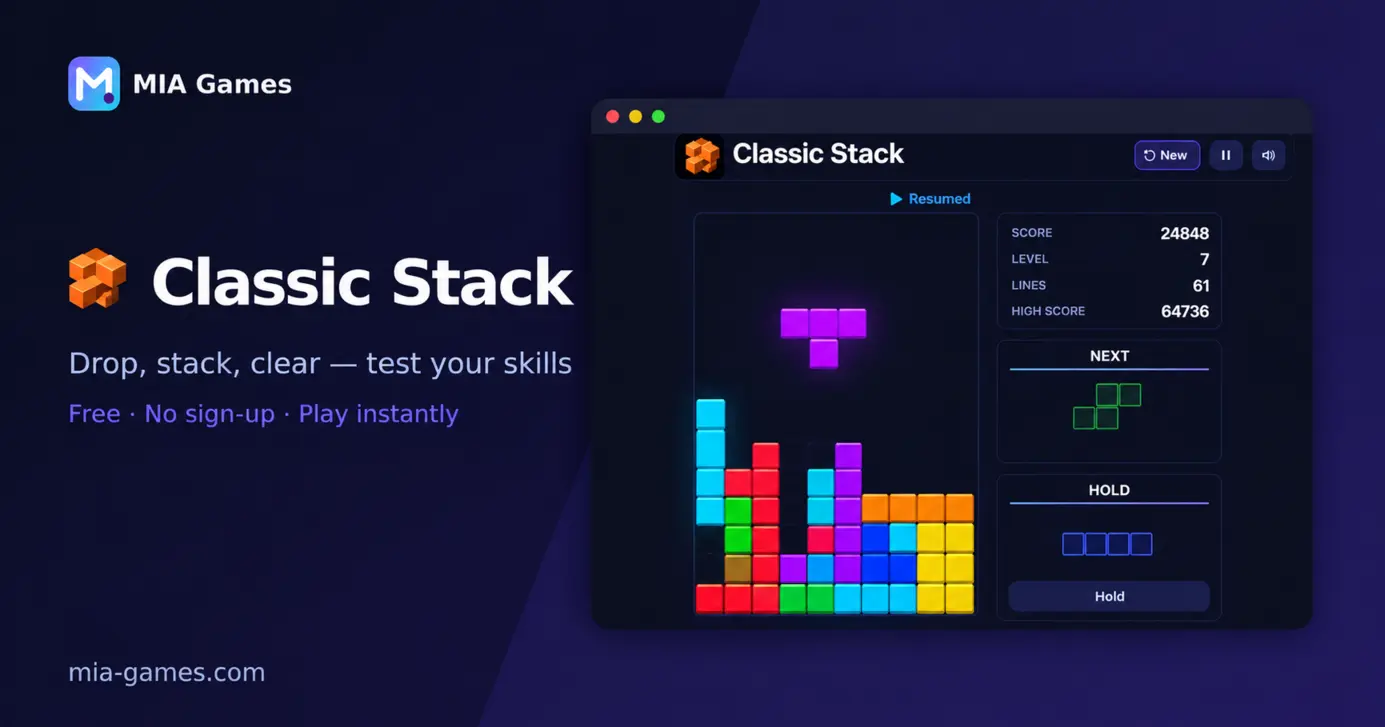
At MIA Games, we are especially interested in what makes classic games endure. Our own Classic Stack takes inspiration from the falling-block genre, but understanding Tetris means looking beyond the familiar pieces. Why did a game with no characters, story campaign, or elaborate graphics become a worldwide phenomenon? The answer begins with the unusual circumstances in which it was created.
💡 The name in one line: “Tetris” combines tetra, the Greek-derived prefix associated with four, with tennis, Pajitnov's favourite sport. The name reflects the game's four-square pieces.
The Birth of Tetris in Moscow, 1984
Pajitnov was working as a computer programmer at the Academy of Sciences in Moscow. He was interested in puzzles and wanted to explore what a computer could do with a familiar kind of geometric challenge. His starting point was Pentominoes, a puzzle built around shapes made from five connected squares.
For a falling computer game, however, five-square shapes were more complicated than Pajitnov wanted. He simplified the concept to pieces made from four squares. The result was a set of seven distinctive shapes — commonly represented as I, O, T, S, Z, J, and L — that could fall, rotate, and combine to form complete horizontal lines.
The first version was created on the Elektronika 60, a Soviet computer without the kind of graphical display modern players take for granted. Blocks were represented using text characters. The technology was limited, but the underlying idea was already powerful: pieces arrive one after another, the player decides where they belong, completed lines disappear, and the empty space creates room for the next decision.
1984
Pajitnov creates the first version in Moscow on an Elektronika 60.
Pentominoes
The original inspiration was a geometric puzzle using five-square pieces.
Seven pieces
The familiar Tetris set uses seven tetromino shapes made from four squares.
Worldwide reach
The game eventually appeared across computers, consoles, handhelds and modern platforms.
How a Soviet Computer Game Escaped the USSR
Tetris spread quickly among programmers and computer enthusiasts. Because software ownership worked very differently in the Soviet system, the commercial path was far from straightforward. Versions moved between machines and eventually reached Hungary, where Western companies began to notice the game's potential.
British publisher and entrepreneur Robert Stein became involved in attempts to secure international rights. What followed was a complicated licensing chain involving different publishers, computer versions, and competing claims. The unusual legal situation surrounding a game created inside a Soviet state institution made Tetris very different from a typical commercial release.
This part of the story matters because Tetris was not launched worldwide by a single publisher according to one neat plan. Its international expansion happened through a series of negotiations and releases. The rights question eventually drew in Henk Rogers, a game designer and publisher who encountered Tetris in the late 1980s and became determined to secure the handheld rights.
📜 Why the licensing story matters: Tetris became famous partly because its gameplay was exceptional, but its route to the global market was equally unusual. The rights negotiations eventually brought Pajitnov and Rogers together and helped establish the business relationship behind the modern Tetris brand.
The Game Boy Moment: 1989
The pairing worked remarkably well. The Game Boy made gaming portable, while Tetris could be learned quickly and played in short sessions. You could understand the objective immediately, start playing within seconds, and stop after a few minutes — or continue until the stack reached the top.
Just as importantly, Tetris did not depend on a particular language or a complex fictional world. Its visual vocabulary was almost universal: shapes fall, lines disappear, and the next piece is already waiting. That made the game unusually easy to understand for players who had never considered themselves serious gamers.
Why Tetris Feels Simple — but Never Stays Easy
Tetris does not rely on complicated rules. Instead, The challenge comes from the interaction between time, space, probability, and decision-making. Every piece creates a new problem, and every placement changes the shape of the board.
Early moves feel forgiving because the player has plenty of empty space. As the board fills, mistakes become more expensive. A badly placed piece can create a hole, force awkward placements, or make the next few moves harder. Clearing a line gives temporary relief, but the game immediately continues with another decision.
This creates a distinctive rhythm: observe, choose, place, clear, repeat. There is no need for a large tutorial because players learn the system naturally through play. That low barrier to entry, combined with room for increasingly skilled play, helps explain why the formula has remained durable.
🎮 MIA Games perspective: When we build or evaluate a browser game, we look for the same qualities: an understandable objective, responsive controls, meaningful decisions, and a difficulty curve that rewards practice rather than simply blocking the player. Classic Stack applies that philosophy to a modern falling-block experience.
This is one reason Tetris remains such a useful reference point for browser-game design. A strong casual game does not necessarily need a large amount of content; it needs a small set of rules that interact well, communicate clearly, and give the player a reason to make the next decision.
History explains what happened to Tetris. Its design explains why the game could travel so well. Looking at the original formula from a modern browser-game perspective reveals several lessons that are still useful today.
What Tetris Teaches Us About Great Game Design
Tetris Beyond the Game Boy
Tetris did not stop evolving after its breakthrough on Nintendo's handheld. Over the following decades, the game appeared in countless forms across computers, consoles, handheld systems, mobile devices and online services. New modes added competition, time pressure, multiplayer play and different scoring systems without abandoning the central falling-block idea.
The brand's official history now spans more than four decades, with Tetris continuing to appear in new products and collections. One modern example is Tetris Forever, released in 2024 as a celebration of the series' 40-year history. It includes more than 15 classic Tetris games and an accurate recreation of the original Elektronika 60 version, giving players a direct way to explore how the concept began.
The “Tetris Effect” — and What It Really Means
Players sometimes notice that after playing for a long time, they start thinking about how objects could fit together in everyday life. You might mentally arrange luggage, shelves, boxes, or other objects as if they were pieces on a board. This experience is commonly called the “Tetris Effect.”
The term is useful because it describes a familiar player experience: after playing, some people continue to notice patterns, gaps, rotations, and ways of arranging objects in everyday situations. It is better understood as a description of a player's experience than as a claim that Tetris is a medical treatment or a guaranteed cognitive benefit. That distinction is important when discussing classic games and psychology responsibly.
Why Tetris Still Matters
Tetris offers a particularly clear example of several enduring game-design principles. It demonstrates that a game does not need a huge world, dozens of characters, or complicated controls to remain engaging. A small set of rules can create considerable depth when those rules interact in interesting ways.
It also shows the value of progressive difficulty. The player is never asked to understand everything before starting. The rules are visible from the first move, while mastery emerges gradually through practice. That makes Tetris approachable for beginners and satisfying for experienced players at the same time.
For MIA Games, that philosophy is one reason we created Classic Stack. Our version adds a modern presentation, touch-friendly controls and features designed for today's browsers, while keeping the central appeal of falling blocks: quick decisions, clear goals, and the satisfying moment when a carefully built row disappears.
The Legacy of Alexey Pajitnov
Pajitnov's story is especially remarkable because he was not trying to build a global entertainment empire when he created Tetris. He was experimenting with a puzzle concept on the computers available to him. The game travelled much further than its creator could reasonably have expected.
In 1996, Pajitnov and Henk Rogers established the company relationship that became central to the modern Tetris brand. The official Tetris history describes The Tetris Company as the exclusive source of Tetris licenses. Pajitnov's role also remained visible: decades after the original 1984 experiment, he remains widely recognised as the creator of one of the most influential puzzle games in video-game history.
Frequently Asked Questions
Who created Tetris?
Alexey Pajitnov created Tetris in Moscow in 1984 while working as a computer programmer for the Soviet Academy of Sciences.
What inspired Tetris?
Pajitnov was inspired by Pentominoes, a geometric puzzle built around five-square pieces. He adapted the idea into a real-time computer game using four-square pieces.
What computer was the original Tetris made on?
The first version was developed on an Elektronika 60, a Soviet computer. Its limited display meant that the original game represented pieces with text characters.
Why was the 1989 Game Boy release so important?
The Game Boy made Tetris portable and put the game in front of a huge mainstream audience. The simple controls and short-session format were an excellent match for handheld play.
What is the Tetris Effect?
It describes the experience of continuing to notice Tetris-like patterns or mentally arranging objects after playing. The official Tetris site uses the term for this familiar pattern-and-organisation experience.
Is Tetris still relevant today?
Yes. New versions, collections, competitive formats and modern platforms continue to introduce Tetris to new players, while the original design remains influential across the puzzle genre.
Why does Tetris remain so replayable?
Each game develops differently, and every new piece changes the set of choices available to the player. That combination of familiar rules and constantly changing situations gives Tetris a strong replay loop without requiring a new story or world each time.
Why are there seven Tetris pieces?
The classic Tetris set uses seven tetrominoes, each made from four connected squares. Together they provide a compact vocabulary of shapes with different strengths and weaknesses, creating variety without making the basic rules difficult to learn.
Experience the Falling-Block Genre Today
The history of Tetris is ultimately a story about a small idea that proved almost endlessly adaptable. From a text-based Soviet computer to a worldwide handheld hit and modern competitive play, the core formula has remained recognisable because the problem it presents is timeless: where should this piece go?
If you enjoy that style of quick, focused puzzle play, try Classic Stack on MIA Games. It brings the familiar falling-block concept to the browser with all seven tetrominoes, a modern visual style, a ghost-piece preview, and touch controls for mobile devices.
Ready to stack some blocks? Play Classic Stack on MIA Games and put the history into practice.
Sources & Further Reading
We checked the historical details in this article against primary or institutional sources rather than relying on a single retelling. These references are also useful if you want to explore the story in more depth.
- The Official Tetris History — timeline of major milestones, including the 1984 creation, 1988 discovery by Henk Rogers, 1989 Game Boy release, and 1996 formation of The Tetris Company.
- Official Tetris About Page — background on Pentominoes, the seven tetrominoes, the name Tetris, and the Tetris Effect.
- Tetris Corporate Bios — background on Alexey Pajitnov and Henk Rogers and their roles in bringing Tetris to the international market.
- Computer History Museum: Tetris game cartridge — historical context for the Elektronika 60 and the game's early route to the West.
Editorial note: We distinguish documented history from our own game-design analysis. Where figures or milestones come from Tetris brand materials, we identify them as such rather than presenting brand claims as independent estimates.