📌 Key Takeaways
- Pong is a powerful tool for improving hand-eye coordination and reaction time
- Regular play strengthens neural pathways between visual and motor brain regions
- Pong trains predictive ability — anticipating where the ball will go
- Benefits transfer to real-world skills like driving and sports
- Consistency matters — just 10-15 minutes daily shows measurable improvement
It's one of the simplest video games ever created: two paddles, a bouncing ball, and a line down the middle. Yet Pong — the 1972 arcade classic — is more than just a nostalgic relic of gaming's early days. It's a surprisingly effective tool for improving hand-eye coordination, reaction time, and cognitive processing speed.
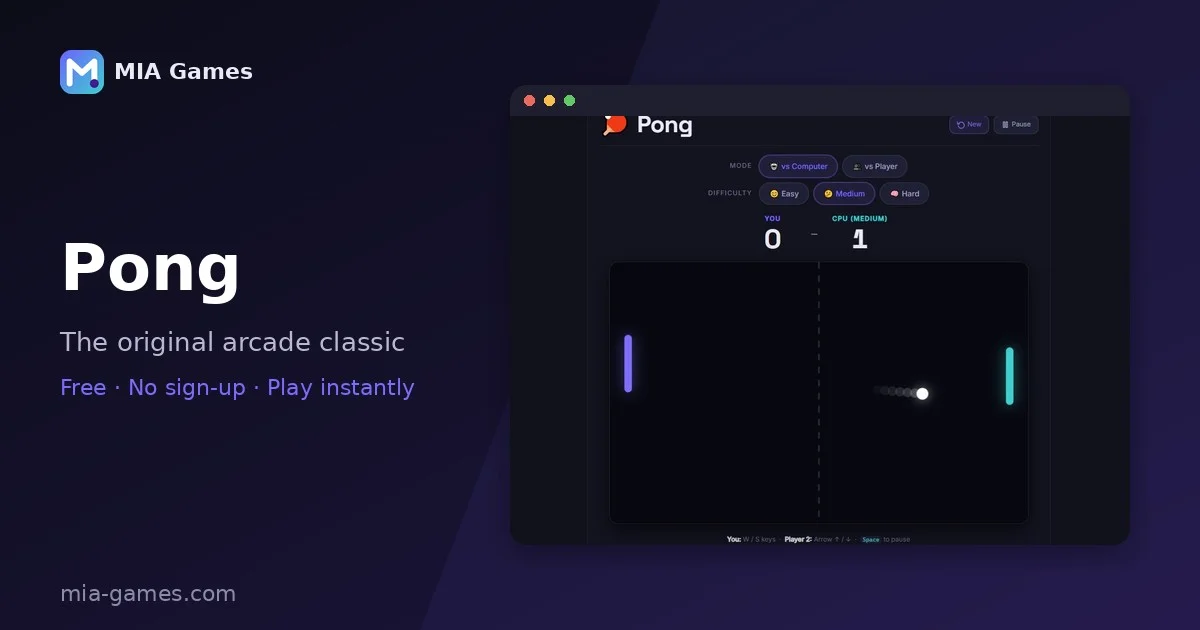
At MIA Games, we've seen thousands of players enjoy our Pong game — not just for fun, but for the mental benefits it provides. In this article, we'll explore the science behind why Pong is so effective at training your brain and body to work together more efficiently.
💡 Key Insight: Hand-eye coordination isn't just about sports. It's a fundamental skill that affects everything from typing on a keyboard to driving a car. Pong trains this skill in a low-stakes, highly engaging way.
A Brief History of Pong
Before we dive into the science, let's appreciate the game's remarkable history. Pong was created in 1972 by Allan Alcorn, a young engineer at Atari. It was originally designed as a training exercise — nothing more. But when the first arcade machine was placed in a bar called Andy Capp's Tavern in Sunnyvale, California, something extraordinary happened. The machine broke within two weeks — not from damage, but from overuse. The coin box was overflowing with quarters.
Pong became a phenomenon. It was the first video game to achieve mainstream success, establishing the template for competitive, two-player gaming. The game was so popular that it spawned countless imitators and laid the foundation for the entire video game industry. Today, Pong lives on in countless browser versions — including ours at MIA Games — proving that great game design is truly timeless.
What Is Hand-Eye Coordination?
Hand-eye coordination is the ability to synchronise visual input with motor output. In simple terms, it's how well your eyes can guide your hands to perform a specific task. This skill relies on the seamless communication between your visual cortex (where visual information is processed) and your motor cortex (which controls movement).
Good hand-eye coordination is essential for countless everyday activities: catching a ball, typing on a keyboard, driving a car, playing a musical instrument, and even cutting vegetables. Poor hand-eye coordination can make these tasks difficult and frustrating.
The Science Behind Pong
Pong is essentially a visual-motor tracking task. You watch the ball move across the screen, predict where it will go, and move your paddle to intercept it. This process involves several cognitive functions working together:
- Visual tracking: Your eyes follow the ball's trajectory.
- Prediction: Your brain calculates the ball's future position based on its speed and angle.
- Decision-making: You decide where to position your paddle.
- Motor execution: Your hand moves the paddle to the chosen position.
Real research on action-based games backs this up more than you might expect. A well-known study by neuroscientists Daphne Bavelier and C. Shawn Green (published in Nature, 2003) found that people who regularly played fast-paced action games showed measurably better visual attention and faster, more accurate visual-motor responses than non-gamers. Follow-up research in this area has explored similar training in older adults, since maintaining sharp visual-motor coordination is an important part of healthy aging.
How Pong Trains Your Brain
1. Improves Reaction Time
Reaction time is the speed at which you respond to a stimulus. In Pong, the stimulus is the ball bouncing off the wall or your opponent's paddle. The faster your reaction time, the better you can defend your side and score points.
The same Bavelier and Green research found that action-game players consistently outperformed non-players on visual reaction time tasks — a well-replicated finding in the action-video-game literature since. The improvement isn't limited to gaming, either: faster visual reaction time genuinely transfers to real-world tasks, like noticing an obstacle while walking or reacting to a hazard on the road.
2. Enhances Predictive Ability
Great Pong players don't just react — they anticipate. They watch the ball's angle and speed and predict where it will end up. This predictive ability is a form of cognitive foresight that has real-world applications, from sports to reading social cues.
This kind of anticipation — tracking a moving object and predicting where it's headed — is a recognised skill in sports science, often called "coincidence-anticipation timing." It's the same skill a tennis player uses to judge where a serve will land, or a goalkeeper uses to anticipate a penalty kick. Games like Pong train this same predictive skill in a low-stakes, repeatable way, which is part of why paddle-and-ball games have long been used informally in sports training and vision therapy.
3. Builds Visual-Spatial Awareness
Pong requires you to track a moving object while maintaining awareness of the boundaries of the playing field. This dual-task training enhances visual-spatial awareness — the ability to understand the relationship between objects in space.
Visual-spatial awareness is crucial for everything from navigating a crowded room to reading a map. By playing Pong, you're exercising this skill in a fun, engaging way.
Key Benefits of Playing Pong
Faster Reaction Time
Respond quicker to visual stimuli in games and real life.
Better Prediction Skills
Anticipate moving objects and plan your responses ahead.
Enhanced Visual-Spatial Awareness
Improve your ability to track objects and navigate spaces.
Strengthened Neural Pathways
Build connections between visual and motor brain regions.
Reduced Cognitive Decline
Maintain brain plasticity and slow age-related decline.
Stress-Free Training
Improve coordination without pressure or performance anxiety.
Pong vs. Other Coordination Games
While many games offer cognitive benefits, Pong is uniquely effective for hand-eye coordination for several reasons:
- Simplicity: Pong has no complex rules or distractions. You can focus entirely on tracking the ball and moving your paddle.
- Speed: The ball moves quickly, forcing you to react fast. This rapid pace is essential for improving reaction time.
- Predictability: The ball's trajectory follows consistent physics. This allows you to learn patterns and improve your predictive ability.
- Two-player option: Playing against another person adds a social and competitive element that enhances engagement and motivation.
Compared to games like Reaction Time or Simon, Pong offers a more dynamic, continuous training experience. It's not just about pressing a button when you see a stimulus — it's about ongoing, real-time coordination between your eyes and hands.
Common Mistakes to Avoid
- Overreacting: Moving your paddle too far or too quickly often leads to missing the ball. Focus on small, precise movements.
- Not tracking the ball with your eyes: Some players watch the paddle instead of the ball. Always keep your eyes on the ball.
- Playing too defensively: While defence is important, attacking (moving forward to intercept the ball) improves your reaction time more effectively.
- Rushing: Speed comes with practice. Don't try to be too fast too soon — focus on accuracy first, then speed.
- Ignoring the opponent's paddle: Watching your opponent's paddle position can give you clues about where the ball will go.
How to Get the Most Out of Pong
If you want to maximise the hand-eye coordination benefits of Pong, follow these tips:
- Play regularly: Consistency is key. Aim for at least 10-15 minutes of Pong per day.
- Focus on tracking: Don't just watch the ball — follow it with your eyes. This trains your visual tracking ability.
- Increase speed: As you improve, try to react faster. Challenge yourself to intercept the ball closer to the net.
- Play against different opponents: If you play against AI, vary the difficulty level. If you play against humans, the unpredictability will challenge your skills.
- Combine with other games: Pair Pong with Reaction Time or Memory Match for a more comprehensive cognitive workout.
🎯 Pro Tip: Try playing Pong with your non-dominant hand. This challenges your brain to form new neural connections and can improve your overall coordination even faster.
Practice Plan for Improvement
- Week 1: Play 10 minutes daily. Focus on accuracy — keep the ball in play as long as possible.
- Week 2: Increase to 15 minutes. Start tracking the ball with your eyes consciously.
- Week 3: Add 5 minutes of non-dominant hand practice. This challenges your brain.
- Week 4: Challenge the AI on a higher difficulty. Measure your improvement.
Who Can Benefit from Pong?
The beauty of Pong is that it's beneficial for virtually everyone:
- Children: Develops hand-eye coordination during critical developmental years.
- Athletes: Enhances reaction time and predictive ability for sports.
- Older adults: Maintains cognitive function and slows age-related decline.
- Gamers: Improves performance in other fast-paced games.
- Anyone: Provides a fun, low-pressure way to train a fundamental skill.
Real-World Applications
The skills you develop playing Pong aren't confined to the screen. Improved hand-eye coordination translates to:
- Better driving: React quicker to hazards and anticipate traffic patterns.
- Improved sports performance: Catch balls, hit targets, and move with greater precision.
- Enhanced typing and mouse use: Navigate digital devices with greater speed and accuracy.
- Safer everyday activities: Avoid bumps and spills by reacting faster to your environment.
Frequently Asked Questions
Can Pong really improve my hand-eye coordination?
Yes. Research has shown that action-based games like Pong improve visual attention and visual-motor responses. The improvements transfer to real-world tasks like driving and sports.
How long should I play Pong each day?
Most experts recommend 10-15 minutes of daily practice for measurable improvement. Consistency matters more than session length.
Does playing Pong with one hand vs. two hands make a difference?
Playing with your non-dominant hand challenges your brain to form new neural connections and can accelerate improvement. It's a great way to increase the difficulty without changing the game.
Is Pong good for older adults?
Yes. Pong is a low-impact way to maintain cognitive function and hand-eye coordination in older adults. The simplicity of the game makes it accessible, and the cognitive benefits are well-documented.
Can I play Pong on my phone?
Yes. MIA Games Pong is fully responsive and works on any device with a browser. You can use touch controls on mobile or mouse controls on desktop.
Is Pong better for coordination than other games?
Pong is uniquely effective for hand-eye coordination because it combines visual tracking, prediction, and real-time motor response in a simple, distraction-free environment. Other games like Reaction Time are also effective but target different aspects of coordination.
Start Playing Pong Today
The science is clear: Pong is more than just a game — it's a powerful tool for cognitive and physical development. And the best part? It's incredibly fun to play.
Ready to improve your hand-eye coordination? Play Pong on MIA Games right now. Challenge the AI, compete with a friend, and watch your reaction time and coordination improve with every match.
Let the ball bounce, and let your brain grow!