📌 Key Takeaways
- Flow describes deep involvement in an activity that feels rewarding in itself.
- Clear goals, useful feedback, and a suitable level of challenge can support flow, but do not guarantee it.
- Classic games make these features easy to notice through simple rules and repeated decisions.
- Time can seem to pass quickly when attention is absorbed, although the experience varies between people and situations.
- Flow is not proof that a game is educational, beneficial, or worth playing for longer.
You start a quick game while waiting for something else. A few rounds later, you check the time and realise that much longer has passed than you expected. The game did not feel especially complicated. You were simply paying attention to the next move, the next pattern, or the next chance to improve.
Psychologists use the word flow to describe one kind of deep involvement. It is often associated with enjoyable activities that hold a person's attention and provide a sense of purpose while they are being done. Games can create conditions in which flow is possible, but they do not produce it automatically. Understanding the difference helps explain why a small puzzle can be absorbing one day and frustrating the next.
In brief: Flow is not simply “having fun” or losing track of time. It is a particular kind of focused involvement. Clear goals, feedback, and a challenge that feels manageable are common conditions that can help it develop.
What Psychologists Mean by Flow
The concept is closely associated with psychologist Mihaly Csikszentmihalyi. In his research, he explored why people sometimes become deeply involved in activities such as music, sport, art, and demanding work, even when those activities offer no obvious external reward. Participants described being so engaged that the activity itself became the main reason to continue.
Csikszentmihalyi used the term flow for this experience. He later developed the idea in Flow: The Psychology of Optimal Experience (1990). The term “autotelic” is also used in this area: it describes an activity that is rewarding in itself, rather than being done only to obtain a separate reward.
Flow is not a synonym for concentration alone. A person can concentrate intensely because a task is stressful or confusing. Flow generally includes a sense of involvement and control, with attention directed towards the activity rather than towards self-conscious thoughts or outside distractions.
Conditions and experiences often associated with flow
Researchers do not always group the features of flow in exactly the same way. A useful distinction is between conditions that may support the experience and feelings that can occur while someone is in it.
- Clear goals: You understand what you are trying to do, even if the larger task takes time.
- Useful feedback: The activity shows how your actions affect the result, allowing you to adjust.
- Challenge and skill: The task asks for effort but still feels within reach of your abilities.
- Concentration: Your attention stays mainly on the activity.
- A sense of control: You feel that your decisions matter, even though success is not guaranteed.
- Reduced self-consciousness: You are less occupied with how you appear or how you are judging yourself.
- Changed sense of time: Time may seem to pass unusually quickly or, in some situations, slowly.
- Enjoyment in the activity: Continuing feels worthwhile for its own sake.
These are not a checklist that every player must experience in full. Flow is studied across different activities and populations, and researchers use different ways to measure it. It is more accurate to think of these features as a framework for understanding an experience than as a guaranteed recipe.
The Challenge–Skill Balance
One familiar explanation of flow focuses on the relationship between the difficulty of a task and the person's current ability. If a game is far too easy, it may become repetitive. If it is far too difficult, the player may feel confused or discouraged. A task that offers a meaningful challenge without feeling impossible can be more engaging.
This is often illustrated as a “flow channel”: challenge and skill are shown on two axes, with flow associated with a region where both are relatively high and reasonably balanced. The diagram is useful, but it should not be read as a precise formula. A player’s confidence, mood, familiarity with the rules, and the type of task can all affect how challenging the same game feels.
Consider a game of Snake. At the beginning, the player has room to move and time to plan. As the snake grows and the available space becomes harder to navigate, decisions may require more attention. For a player who is learning, this can create an interesting challenge. For someone unfamiliar with the controls, the same increase in speed may simply feel overwhelming.
Skill also changes the experience. A puzzle that once required careful thought may become routine after many attempts. Unless the game offers new goals or a different level of difficulty, the player may no longer find it engaging. Flow therefore depends on the interaction between the player and the activity—not on the game alone.
How Classic Games Can Support Flow
Many classic games are easy to understand at the surface level: the player has a goal, makes a move, sees what happened, and decides what to do next. That repeated loop can make the relationship between action and feedback especially clear. It does not mean that every session will be a flow experience, but it gives us a practical way to examine game design.
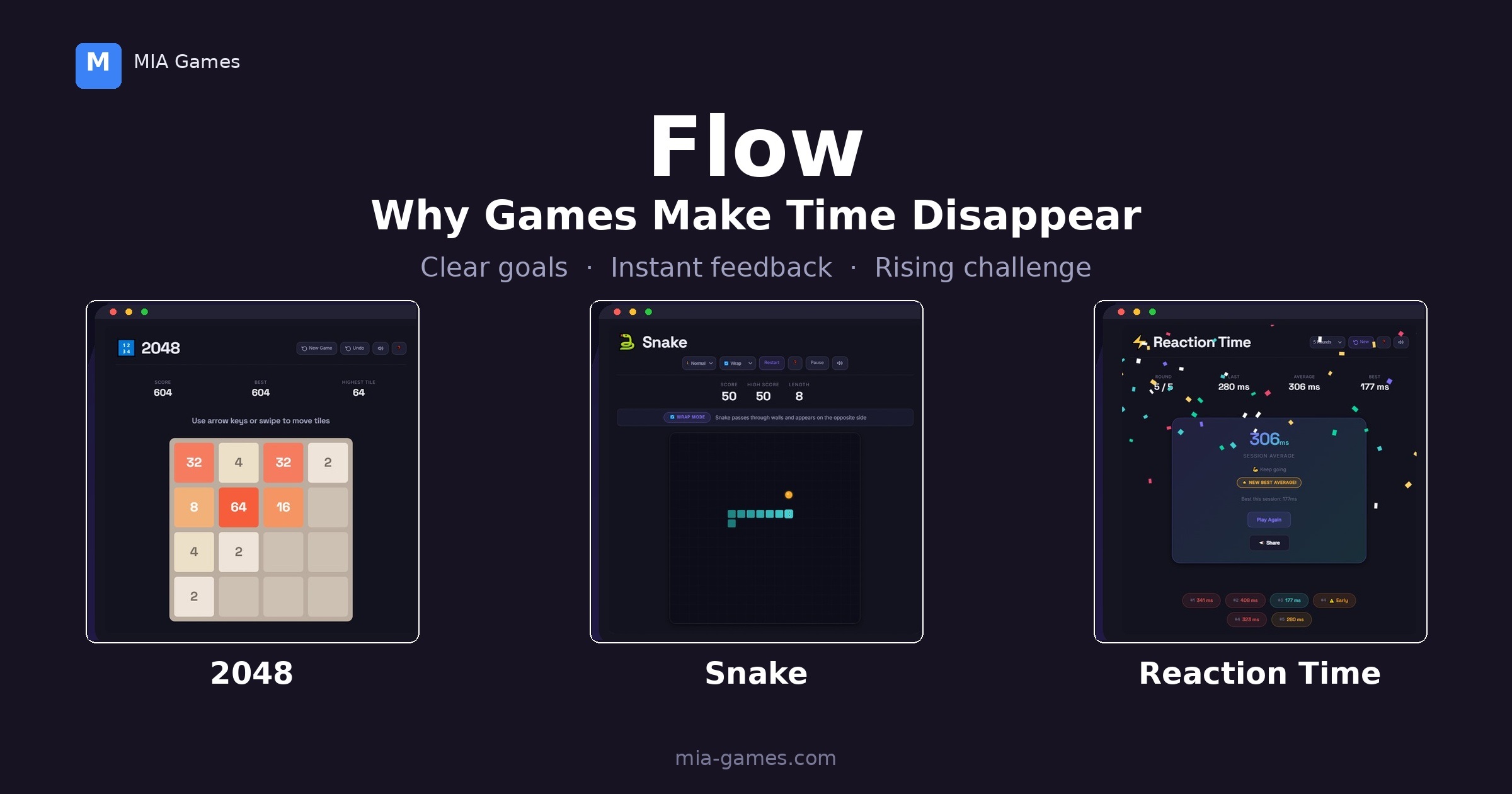
2048: Planning one move at a time
In 2048, the basic objective is to combine matching numbered tiles and work towards the 2048 tile. Each swipe changes the board, so the result of a decision is visible immediately. The player must think ahead while also responding to an increasingly crowded grid. A useful move can create room; a careless one can limit future options. The game’s appeal comes partly from this cycle of planning, feedback, and adjustment.
There is no guarantee that a player will reach 2048 or enter flow. Random tile placement and the state of the board can make some positions more difficult than others. The challenge is to make the best decision with the information available. For a related look at short puzzle sessions, see our article on how a five-minute game of 2048 can fit into a break.
Snake: A changing task with limited space
Snake begins with a simple instruction: guide the snake, collect food, and avoid collisions. Each item collected makes the snake longer, changing the space available for the next move. The rules remain easy to explain, but the decisions become more demanding as the run continues.
This makes Snake a helpful example of changing difficulty. The challenge does not rise in exactly the same way for every player: some may enjoy the faster pace, while others may find it stressful. You can also read the history of Snake or explore our Snake high-score tips.
Simon: Remembering a growing sequence
Simon asks the player to watch a sequence of lights or sounds and repeat it in the correct order. Each successful round adds another step. The feedback is clear: the sequence is either repeated correctly or it is not. Because the task relies on memory and attention, the player can often identify exactly where a mistake happened.
The growing sequence can provide a manageable progression for some players. Others may reach a point where the sequence becomes difficult to remember. That difference is important: a feature that makes a game engaging for one person may make it frustrating for another.
Reaction Time: A clear result, but a narrow task
Reaction Time strips the task down to a simple response. The player waits for a signal and clicks as quickly as possible. A result in milliseconds gives immediate feedback and makes it easy to compare attempts.
However, a quick result does not necessarily mean that the player is experiencing flow. Repeating a short test may be absorbing for a while, but it is also a narrow measure of performance in that particular task. Reaction times can vary with alertness, device input, distractions, and other conditions. Our article on reaction-time training explains what these scores can and cannot tell you.
Memory Match: Learning the layout through play
In Memory Match, players turn over cards and try to find matching pairs. Each turn provides feedback, while the locations of previously revealed cards become useful information for later choices. As players remember more of the board, they may develop a strategy and feel more confident about their next move.
The game illustrates how feedback and accumulated knowledge can make a task feel more manageable. It is not a formal test of memory, and performance in one round should not be treated as a measure of a person's general memory ability.
What Game Designers Have Learned from Flow
Flow theory has influenced discussions of game design because it gives designers a vocabulary for examining player experience. In 2005, Penelope Sweetser and Peta Wyeth proposed the GameFlow model, which brought together eight elements associated with enjoyment in games: concentration, challenge, player skills, control, clear goals, feedback, immersion, and social interaction.
The model is useful as a way to review a game's design. For example, a designer can ask whether players understand the objective, whether the feedback is clear, and whether the difficulty gives players room to develop their skills. It is not a guarantee that a game will be enjoyable for everyone. The original paper presented GameFlow as a model for evaluating player enjoyment and discussed an initial evaluation using two real-time strategy games.
GameFlow also helps explain why a game does not need complicated graphics or a long story to be engaging. A small puzzle can offer clear decisions and understandable feedback. Presentation matters, but the relationship between the player's actions and the game's response matters too.
Why Time Can Seem to Disappear
There is no single clock inside the brain that records our experience of time in a simple, uninterrupted way. How long an activity seems to last can depend on attention, memory, emotion, and whether we are judging time while an event is happening or looking back on it afterwards.
Attention is one part of the explanation. When you are actively monitoring time, you may notice each minute passing. When your attention is occupied by a game, you may check the clock less often. The passage of time can therefore feel different while you are playing than it does when you look back at the session.
Researchers Dan Zakay and Richard A. Block discussed the role of attention in time-estimation processes in a 1996 review. Their work is relevant because it distinguishes between judging duration while an event is taking place and estimating it afterwards. It is more careful to say that attention can influence time judgements than to claim that flow simply switches off the brain's timekeeping system.
There is another useful distinction: time experienced during an activity and time remembered afterwards are not necessarily the same. A session may feel short while it is happening, yet seem longer when you recall how many rounds, decisions, or events it contained. This is one reason that “time flew” should be treated as a description of experience, not a precise measurement of what happened in the brain.
Does Flow Help People Learn?
Flow is often discussed in education because a learner who is engaged may be more willing to persist with a challenging task. Research on game-based learning has examined links among challenge, engagement, flow, and learning outcomes. The findings are interesting, but they do not mean that any enjoyable game automatically teaches useful skills.
For example, Hamari and colleagues published a 2016 study examining engagement, flow, immersion, and learning in game-based learning environments. They reported that engagement was positively associated with learning, while immersion did not show the same significant effect in their analysis. Their findings underline an important distinction: being absorbed in a game and learning from it are related questions, but they are not identical.
A 2021 systematic review and meta-analysis by Harris and colleagues examined the relationship between flow states and performance across research settings. The authors reported an association, but an association alone cannot establish the direction of cause. Better performance may support a feeling of flow, flow may accompany conditions that support performance, or other factors may influence both.
A 2025 study by Jordi Carenys looked at competition in a game-based financial-accounting activity involving 179 undergraduate business students at a Spanish university. The study reported higher flow and learning gains in the competitive condition. This is a useful example of research in a specific educational setting; it should not be treated as proof that competition improves learning for every age group, subject, or game.
The practical lesson is modest but valuable: games can provide structure, feedback, and motivation that may support learning when the activity is designed around clear educational goals. To know whether learning has taken place, we still need to look at what the player can understand or do afterwards—not only how long they stayed engaged.
Where the Flow Explanation Has Limits
Flow is a helpful concept, but it is not a complete explanation for every enjoyable gaming session. One of its best-known ideas—the balance between challenge and skill—has been tested directly, with results that complicate the simple version of the theory.
In a preregistered 2023 experiment, Joe Cutting and colleagues used an AI-controlled system to adjust game difficulty around players' measured performance. The study included 311 participants in its analysed sample. The researchers did not find that the intended difficulty–skill balance produced significant differences in enjoyment or behavioural engagement. This does not disprove flow theory as a whole, but it does caution against treating a perfectly matched difficulty level as a guaranteed route to enjoyment or flow.
It is also important not to assume that absorption is always beneficial. Research on slot-machine play has examined a phenomenon described as “dark flow”: a highly absorbing experience that can occur in a harmful context. Dixon and colleagues' 2018 paper explored relationships among dark flow, depression, and multiline slot-machine play. The point is not that ordinary puzzle games are equivalent to gambling. It is that intense involvement, by itself, does not tell us whether an activity is healthy or worthwhile.
A sensible approach is to pay attention to the activity as well as the feeling. Are you enjoying a short break, or are you repeatedly playing longer than you intended? Does the game leave you refreshed, or does it make it difficult to stop? Flow describes a type of experience; it does not make decisions about your time on your behalf.
How to Make Room for a More Focused Game Session
You cannot order yourself to enter flow, and no technique guarantees that it will happen. You can, however, make it easier to give a game your attention and choose a level of challenge that feels comfortable.
- Choose a game that asks for some effort. If the rules are familiar, try a new strategy or a slightly more demanding goal. If the game feels confusing, take time to learn the controls first.
- Understand the immediate objective. Focus on one useful next step rather than worrying about the final score from the beginning.
- Notice the feedback. After a move or attempt, look at what changed. Use that information to decide what to try next.
- Reduce interruptions if you want to concentrate. Closing unrelated tabs or silencing notifications can make it easier to stay with the task.
- Set a stopping point. Decide how long you want to play before you begin. A timer or a planned number of rounds can help keep a short break short.
- Change activities when the experience stops being enjoyable. If you feel bored, stuck, or frustrated, take a break or choose something else.
Try the Idea for Yourself
Pick one of the games below and notice what keeps your attention. Is the goal clear? Can you tell what happened after each move? Does the challenge feel interesting, or does it become frustrating? These questions are more useful than trying to force a particular feeling.
You might find that 2048 encourages you to plan ahead, Snake makes you respond to a changing space, Simon asks you to remember a sequence, Reaction Time gives you a measurable result, Memory Match rewards careful observation, or Classic Stack, asks you to judge the right moment to place each block as the tower grows. Each game creates a different kind of task, and your experience may change from one session to another.
Ready to Play?
Explore these six free games on MIA Games. Play at your own pace and take a break whenever you need one.
Play 2048 Play Snake Play Simon Play Reaction Time Play Memory Match Play Classic StackFinal Thought
The next time a quick game seems to pass in a flash, flow may be one useful way to understand the experience. A clear objective, responsive feedback, and a challenge that feels worth attempting can help hold your attention. But the experience is personal, and the research is more nuanced than a simple formula.
Games can be enjoyable ways to spend a break, practise a strategy, or challenge yourself. The best measure of a good session is not how much time disappears, but whether the activity was worthwhile—and whether you were able to stop when you meant to.
Sources & Further Reading
The following books and research papers provide the foundations for the ideas discussed in this article. Links lead to publisher pages, journal records, or freely available research pages where possible.
- Csikszentmihalyi, M. (1990). Flow: The Psychology of Optimal Experience. Harper & Row. Publisher website.
- Sweetser, P., & Wyeth, P. (2005). “GameFlow: A model for evaluating player enjoyment in games.” Computers in Entertainment, 3(3). https://doi.org/10.1145/1077246.1077253.
- Fong, C. J., Zaleski, D. J., & Leach, J. K. (2015). “The challenge–skill balance and antecedents of flow: A meta-analytic investigation.” The Journal of Positive Psychology, 10(5), 425–446. https://doi.org/10.1080/17439760.2014.967799.
- Zakay, D., & Block, R. A. (1996). “The role of attention in time estimation processes.” In Advances in Psychology, 115, 143–164. https://doi.org/10.1016/S0166-4115(96)80057-4.
- Hamari, J., Shernoff, D. J., Rowe, E., Coller, B., Asbell-Clarke, J., & Edwards, T. (2016). “Challenging games help students learn: An empirical study on engagement, flow and immersion in game-based learning.” Computers in Human Behavior, 54, 170–179. https://doi.org/10.1016/j.chb.2015.07.045.
- Harris, D. J., et al. (2021). “A systematic review and meta-analysis of the relationship between flow states and performance.” International Review of Sport and Exercise Psychology. https://doi.org/10.1080/1750984X.2021.1929402.
- Cutting, J., Deterding, S., Demediuk, S., & Sephton, N. (2023). “Difficulty–skill balance does not affect engagement and enjoyment: A pre-registered study using artificial intelligence-controlled difficulty.” Royal Society Open Science, 10(2), 220274. https://doi.org/10.1098/rsos.220274.
- Dixon, M. J., Stange, M., Larche, C. J., Graydon, C., Fugelsang, J. A., & Harrigan, K. A. (2018). “Dark Flow, Depression and Multiline Slot Machine Play.” Journal of Gambling Studies, 34, 73–84. https://doi.org/10.1007/s10899-017-9695-1.
- Carenys, J. (2025). “Competing to Learn: The Role of Competition in Students’ Flow, Cognitive Load, and Learning Gains in Game-Based Learning.” International Journal of Learning, Teaching and Educational Research, 24(5). https://doi.org/10.26803/ijlter.24.5.9.