📌 Key Takeaways
- Reaction time involves stimulus detection, processing, and motor response
- Training can improve reaction time by 12-15% over 4-6 weeks
- Action video game players show measurably faster reaction times
- Attention and focus are major factors in reaction speed
- Consistency (daily practice) matters more than long sessions
We remember the first time we played our Reaction Time game at MIA Games. We clicked the button, watched the screen turn red, and waited. When it turned green, we slammed the mouse button. 342 milliseconds. "Not bad," we thought. Then we tried again. 298ms. Better. After a few more attempts, we got down to 189ms. And we started to wonder: were we actually getting faster, or just getting lucky?
That question has driven years of research. Can reaction time games actually make your brain faster? Or are you just improving at the game itself? The answer, as it turns out, is both. And the science behind it is fascinating.
⚡ The Average: The average human reaction time is around 250 milliseconds for simple visual stimuli. Professional athletes and gamers can get as low as 100-150ms. But most of us sit somewhere between 200-300ms — and that can be improved.
The Science of Reaction Time
Before we can understand whether reaction time can be trained, we need to understand what it actually is. Reaction time is the delay between a stimulus and your response. It involves a chain of events:
- Stimulus detection: Your sensory organs detect the stimulus (light hits your retina).
- Signal transmission: The signal travels from your sense organs to your brain.
- Processing: Your brain interprets the signal and decides on a response.
- Response execution: The brain sends signals to your muscles to perform the action.
The entire process takes around 200-300 milliseconds in a healthy adult. That might seem fast, but in a world of split-second decisions — driving, sports, gaming — even a few milliseconds can make a huge difference.
Can Reaction Time Be Trained?
The short answer is yes. But the longer answer is more nuanced. Research has shown that reaction time can be improved through practice and specific training — but the improvements are limited by your biology.
Reaction time can genuinely be trained, but within limits set by your biology. Real research on this goes back decades — one of the best-known studies, by Green & Bavelier (published in Nature, 2003), found that people who regularly played fast-paced action video games showed measurably faster visual reaction times than non-gamers. Like most trained skills, gains tend to be quickest early on and level off as you approach your body's natural response-speed ceiling — your nervous system's signal-transmission speed has a biological floor that practice alone can't push past.
However, the study also found that improvements plateaued after about 6-8 weeks. There's a biological limit to how fast your nervous system can transmit signals. But the good news is that most people are nowhere near that limit. There's plenty of room for improvement.
What Reaction Time Games Actually Train
When you play reaction time games, you're not just training your reaction time. You're training several interconnected skills:
- Visual processing: How quickly your brain interprets visual information.
- Decision-making: How quickly you decide on a course of action.
- Motor response: How quickly your body executes the decision.
- Attention: How well you maintain focus during the task.
- Anticipation: How well you predict when the stimulus will appear.
Our Reaction Time game at MIA Games is designed to target all of these skills. The random delay before the green light prevents anticipation, the repetition builds muscle memory, and the feedback loop helps you track your progress.
Key Facts About Reaction Time
Genetics & Age
Reaction time is partially genetic and tends to slow with age, but training can offset the decline.
Sleep Matters
Sleep deprivation can meaningfully slow your reaction time. A good night's sleep is a training tool.
Stimulants
Caffeine is a well-known short-term booster of alertness and reaction speed — this is one of the most consistently replicated findings in stimulant research — though the effect does diminish with regular use as your tolerance builds.
Physical Fitness
Regular exercise improves reaction time by increasing blood flow to the brain and reducing inflammation.
Training Effect
15 minutes of daily training can improve reaction time by 12-15% over four weeks.
Plateau
Most people plateau after 6-8 weeks of training. At that point, you're near your biological limit.
The Role of Attention
One of the most important factors in reaction time is attention. Attention plays a bigger role in reaction time than most people realise — a lapse in focus, even for a fraction of a second, directly slows your response. This is well established in attention research generally: sustained, focused attention is one of the strongest predictors of consistent reaction speed. Practices that train focus, including mindfulness and — yes — reaction-based games, work by strengthening this same underlying attentional control.
Why? Because mindfulness improves your ability to maintain focus on the stimulus. When you're distracted, even slightly, your reaction time slows. Reaction time games train you to stay focused — and that skill carries over to other tasks.
As we've written in our brain training guide, attention is one of the most trainable cognitive skills. And attention is the foundation of fast reaction time.
Real-World Applications
Why does reaction time matter? Because it affects nearly everything you do:
- Driving: Faster reaction time means you can brake sooner, avoid obstacles, and respond to hazards.
- Sports: In tennis, boxing, and football, milliseconds can determine who wins.
- Gaming: In competitive gaming, reaction time is often the difference between victory and defeat.
- Daily life: Catching a falling object, avoiding a trip hazard, or responding to a sudden event.
- Athletic performance: Sprint starts, batting, and any sport requiring quick responses.
It's intuitive and well-supported in road safety research more broadly: reaction time is a major factor in avoiding collisions, since even a fraction of a second's delay changes stopping distance significantly at speed. This is precisely why reaction-time training is increasingly incorporated into driver education programs — faster, more consistent responses translate directly into safer driving.
How to Train Your Reaction Time
Here's a simple training protocol based on the latest research:
- Frequency: Train for 5-15 minutes daily, not 2 hours once a week. Consistency is key.
- Variety: Mix simple reaction tasks (like our Reaction Time game) with choice reaction tasks (where you have to choose between multiple responses).
- Rest: Take breaks between sessions. Your brain needs time to consolidate learning.
- Track progress: Use the best-time tracking in our game to monitor your improvement.
- Combine with mindfulness: Try 5 minutes of focused breathing before training to improve attention.
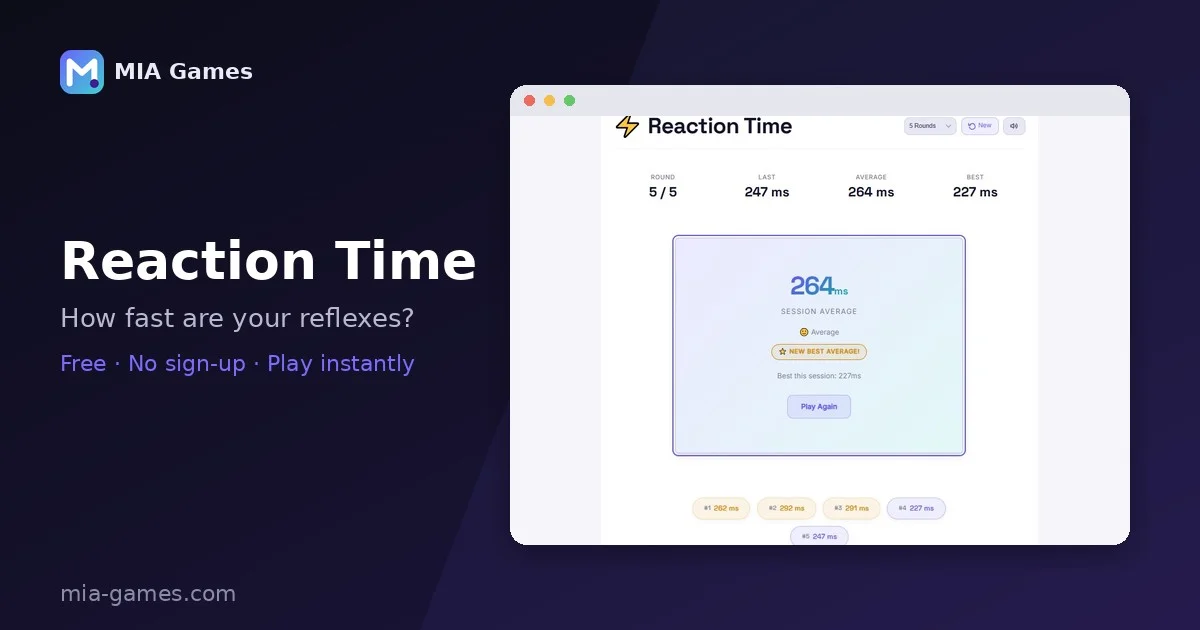
Our MIA Games Reaction Time is perfect for this. It tracks your best time, shows you your current round times, and gives you immediate feedback. You can see your progress over time and identify when you're improving — or when you're tired and need a break.
Frequently Asked Questions
Can reaction time games really make my brain faster?
Yes. Research shows that regular training with reaction time games can improve your processing speed by strengthening the neural pathways involved in stimulus detection and motor response. The improvements are measurable and transferable to real-world tasks.
How much can I improve my reaction time?
Most people can improve their reaction time by 12-15% with 4-6 weeks of consistent daily training. This translates to roughly 30-50 milliseconds of improvement for most individuals.
What's the average human reaction time?
The average simple visual reaction time is around 250 milliseconds. Professional athletes and gamers can reach 100-150ms. Most people sit between 200-300ms.
Does age affect reaction time?
Yes. Reaction time tends to slow with age, typically starting in the late 20s. However, regular training can offset this decline and maintain faster reaction speeds well into later life.
Can I train my reaction time too much?
Like any training, moderation is key. 5-15 minutes daily is optimal. Overtraining can lead to mental fatigue and diminishing returns. It's important to balance training with rest.
What's the difference between simple and choice reaction time?
Simple reaction time is responding to a single stimulus (like clicking when the screen turns green). Choice reaction time is selecting between multiple possible responses (like clicking a specific button based on a signal). Choice reaction time is generally slower and more cognitively demanding.
Other Games That Train Reaction Time
While our Reaction Time game is the most direct training tool, other games at MIA Games also develop reaction-related skills:
- Pong — Requires rapid visual processing and quick motor responses.
- Snake — Demands quick decisions and fast reactions as the speed increases.
- Simon — Tests memory and pattern recognition, which underpin fast reaction times.
- 2048 — Requires quick planning and decision-making under time pressure.
Each of these games trains different aspects of cognitive processing speed. Together, they provide a comprehensive brain workout.
The Bottom Line
Can reaction time games make your brain faster? Yes. But it's not magic. It's neuroplasticity — your brain's ability to reorganise itself in response to training. When you play reaction time games, you're strengthening the neural pathways involved in stimulus detection, decision-making, and motor response.
The improvements are real, measurable, and transferable to real-world tasks. But they require consistent practice. A single session won't make you faster. But 15 minutes a day for a month? That's a different story.
So, can you train your brain to be faster? The answer is yes. And the best part is, it's fun. Play Reaction Time on MIA Games and start your training today. Track your progress, challenge yourself, and see how fast you can get.
Ready, set, go!