📌 Key Takeaways
- Simon trains short-term memory, pattern recognition, and processing speed
- Research links sequential memory training to improved working memory
- The progressive difficulty creates a "just one more try" dopamine loop
- Different difficulty levels suit all ages and skill levels
- Consistent practice leads to measurable improvement in memory skills
Few games leave an impression quite like the first time you play Simon. It was 1980, and my cousin had just gotten the electronic game for his birthday. Four coloured buttons. A sequence of lights and sounds. A simple rule: watch, listen, repeat. And then — beep — the challenge got harder. Many of us first encountered Simon as children — and we were hooked.
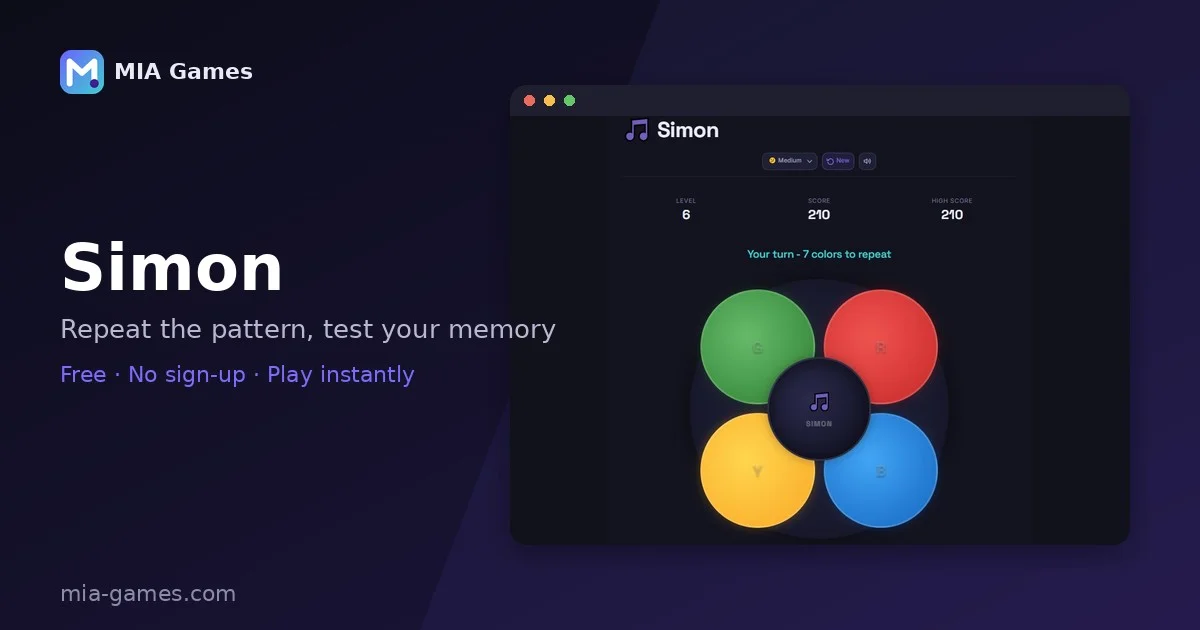
Fast forward forty-something years, and Simon is still one of the most captivating memory games ever created. At MIA Games, we've brought this classic challenge to the browser with our Simon Memory Game. And after watching thousands of players try to beat the sequence, we've come to appreciate just how powerful this simple game really is.
🎵 The Challenge: Simon tests your short-term memory, pattern recognition, and cognitive processing speed. The sequence starts with just one colour — and grows until you can't keep up.
What Makes Simon So Addictive?
The genius of Simon is its progressive difficulty. The game starts simple — one colour, one sound — and gradually increases the challenge. Each successful round adds another step to the sequence. You're always just one mistake away from losing, but you're always convinced you can do just a little bit better.
This "just one more try" feeling is driven by dopamine — the neurotransmitter associated with reward and motivation. Every time you successfully complete a sequence, your brain rewards you with a small dopamine hit. And when you fail, the "near miss" effect — when you were so close — motivates you to try again.
As we've written in our article on gaming psychology, this reward loop is the same mechanism that makes all great games addictive. But with Simon, it's pure, distilled, and incredibly effective.
What Simon Actually Trains
Short-Term Memory
Trains your ability to hold and recall sequences of information in the moment.
Visual Memory
Strengthens your capacity to remember visual patterns and colour sequences.
Auditory Memory
Improves your ability to recall sounds and associate them with patterns.
Processing Speed
Challenges your brain to process information quickly and respond accurately.
Sustained Attention
Requires focused concentration and resistance to distraction.
Pattern Recognition
Builds your ability to identify and remember sequential patterns.
The Science of Pattern Recognition
Pattern recognition is one of the most fundamental cognitive skills we possess. It's how we learn language, recognise faces, and navigate the world. Simon is essentially a pattern recognition boot camp — and the research supports its effectiveness.
Simon is essentially a real-world version of the "n-back" task, one of the most-studied paradigms in memory research — a sequence keeps extending, and you have to hold and recall an increasingly long chain of stimuli.
A landmark 2008 study by Jaeggi et al., published in PNAS (Proceedings of the National Academy of Sciences), found that training on this exact kind of sequential memory task improved working memory performance, with effects that in some cases extended to broader reasoning ability. It's worth being balanced here, though: later research — including a 2014 meta-analysis in Psychonomic Bulletin & Review — found the effect on broader intelligence was real but modest, and that the clearest, most reliable benefit is to the specific skill being trained. That's still a genuinely valuable form of mental exercise — just not a magic bullet for general brain power.
📊 What This Means: Every round of Simon is a live rep of the same memory mechanism scientists use to study working memory in the lab — holding a growing sequence in mind and reproducing it accurately under time pressure.
The History of Simon
The Simon game was invented in 1978 by Ralph Baer and Howard Morrison — Baer is also known as "the Father of the Video Game" for creating the first home video game console. Simon was directly inspired by an Atari arcade game called "Touch Me," which Baer and Morrison saw at a trade show in 1976 and felt they could execute far better. Fittingly, Simon's own internal working title during development was "Follow Me" — and the final name was chosen after the classic children's game "Simon Says" (though the creators have admitted they also liked the alliteration).
Originally released by Milton Bradley, Simon became an instant hit. It was one of the first electronic memory games, and its distinctive design — four large coloured buttons in a circular layout — became iconic. Over the years, Simon has been released in countless versions, from handheld devices to mobile apps to browser games like ours.
As we've written in our history of browser games, Simon represents an important milestone in gaming history. It proved that a game could be both simple and deeply engaging — and that memory challenges had broad appeal.
Simon vs. Other Memory Games
How does Simon compare to other memory games on MIA Games? Here's a quick breakdown:
- Memory Match: Tests spatial memory and visual recall of static images. Simon tests sequential memory and pattern recognition.
- Hangman: Builds vocabulary and word recognition. Simon builds pattern and sequence recognition.
- Sudoku: Challenges logical reasoning. Simon challenges cognitive processing speed.
Each game offers unique cognitive benefits. But Simon is uniquely effective at training rapid pattern recognition and sequential memory — skills that are essential in everything from learning to programming to everyday problem-solving.
Frequently Asked Questions
What skills does the Simon game train?
Simon trains short-term memory, visual memory, auditory memory, pattern recognition, cognitive processing speed, and sustained attention. It's a comprehensive memory workout.
Is Simon good for brain training?
Yes. Research on sequential memory tasks like Simon shows measurable improvements in working memory. While the transfer to broader intelligence is modest, the specific memory benefits are well-established.
How many difficulty levels does MIA Games Simon have?
Our Simon Memory Game has three difficulty levels: Easy (4 colours), Medium (6 colours), and Hard (8 colours). Each level adds more colours to the sequence, increasing the challenge.
What age is Simon suitable for?
Simon is suitable for all ages. Young children can start with the Easy level, while adults can challenge themselves on Hard. It's a great game for family game night or solo practice.
How often should I play Simon for memory benefits?
Consistency is more important than session length. 10-15 minutes of daily practice is ideal for building memory skills. Regular practice leads to noticeable improvement over time.
Can Simon help with cognitive decline in older adults?
Research suggests that pattern recognition and memory games can help slow cognitive decline in older adults. Simon's combination of visual, auditory, and sequential memory training makes it a comprehensive brain workout for older players.
How to Master Simon
After watching thousands of players on our MIA Games Simon, we've identified a few strategies that help players go further:
- Chunk the sequence: Instead of remembering each colour individually, group them into chunks of 2-3 colours. This is the same technique used by chess masters and memory champions.
- Use verbal rehearsal: Say the colours out loud as they flash. "Red, green, blue, yellow..." This engages your auditory memory alongside your visual memory.
- Associate colours with words: Link each colour to a word or image — Red = Fire, Green = Grass, Blue = Ocean, Yellow = Sun. This creates a mental hook.
- Focus on the rhythm: Simon's sequences have a rhythm. Pay attention to the timing — it can help you predict what comes next.
- Practice regularly: Consistency beats intensity. A few minutes each day is better than an hour once a week.
🎯 Pro Tip: Start with the Easy difficulty (4 buttons) and progress to Medium (6 buttons) and Hard (8 buttons). Each level adds more colours to the sequence, challenging your memory in different ways.
Who Benefits from Simon?
Children
Simon is excellent for developing working memory in children. It's also a great tool for teaching patience, focus, and the value of practice. Young children often start with the Easy level and work their way up, building confidence as they progress.
Adults
For adults, Simon offers a quick mental workout during a busy day. It's a "micro-exercise" for your brain — a few minutes of focused concentration that can help reset your attention.
Older Adults
Research has shown that pattern recognition games like Simon can help slow cognitive decline in older adults. The combination of visual, auditory, and sequential memory training makes it a comprehensive brain workout.
Beyond Simon: Other Memory Games
If you enjoy Simon, you might also like these other memory-focused games at MIA Games:
- Memory Match — For visual recall and spatial memory.
- Hangman — For vocabulary and word pattern recognition.
- Word Search — For visual scanning and pattern recognition.
- Sudoku — For logical reasoning and working memory.
As we've written in our memory improvement guide, the most effective approach is to vary the games you play to exercise different cognitive functions.
The Joy of the Challenge
There's something uniquely satisfying about Simon. The flashing lights, the beeping sounds, the growing sequence — it's a pure, distilled test of your cognitive abilities. And when you finally beat that sequence you've been struggling with, the feeling of accomplishment is real.
Simon reminds us that memory isn't just about storing information — it's about recognising patterns, processing sequences, and responding quickly. It's about training our brains to be faster, sharper, and more agile.
Ready to Take the Challenge?
Whether you're a child just learning to focus, an adult looking for a quick mental reset, or an older adult wanting to keep your mind sharp, Simon Memory Game on MIA Games is the perfect challenge.
With three difficulty levels — Easy (4 colours), Medium (6 colours), and Hard (8 colours) — you'll always have a challenge that matches your skill level. And the best part? It's completely free.
Can you beat the ultimate pattern challenge? There's only one way to find out.