📌 Key Takeaways
- Snake is an action game in which the player steers a growing snake and tries to avoid collisions.
- 2048 is a turn-based puzzle: matching tiles combine, while new tiles appear after moves.
- Snake rewards awareness of nearby space and careful steering; 2048 benefits from keeping larger tiles organised.
- Both games can be replayed to try to improve a personal best, but a high score is not the only reason to play.
- The better choice depends on whether a player prefers quick movement or a slower puzzle.
A familiar game can be enjoyable for a simple reason: you can start quickly, learn as you go, and decide whether you want another round. Snake and 2048 offer two different kinds of challenge. One asks you to steer carefully while the snake grows; the other asks you to combine numbered tiles without running out of space.
You can play Snake and 2048 free in your browser on MIA Games. This comparison looks at the basic rules, the decisions each game involves, and a few practical ways to approach them. It is intended as a guide to the games, not as a claim that playing them produces particular educational or cognitive benefits.
The main difference is the pace: Snake is an action game, while 2048 gives you time to consider each move. Here is what to expect from both.
In brief: Snake may appeal to players who enjoy movement and quick decisions. 2048 may suit players who prefer a puzzle they can approach one move at a time. Trying both is a straightforward way to see which style you enjoy.
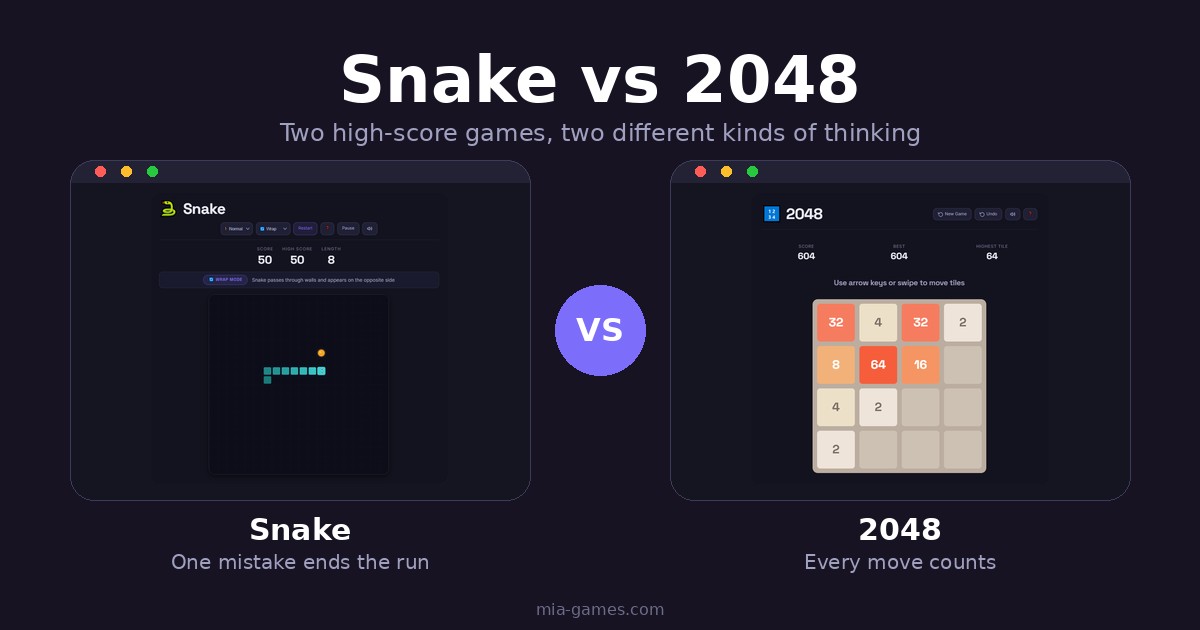
Snake: The Fast Survivor
The basic idea of Snake is easy to understand: guide the snake towards food and avoid running into a wall or its own body. As it eats, the snake grows, leaving less open space for the next turn. A run ends when a collision occurs. The exact speed and rules can vary between versions of the game.
The modern Snake game has roots in earlier arcade games. One important predecessor was Blockade, released by Gremlin Industries in 1976. In that game, players moved around the screen while leaving trails that opponents had to avoid. The trail-and-collision idea became a familiar part of later Snake-style games.
Snake became especially familiar to many people through Nokia phones. Nokia's version was included on the Nokia 6110 in 1997 and was developed by Taneli Armanto. A later version, Snake II, appeared on the Nokia 3310. Published estimates of how many devices included Snake vary, so this article avoids giving a single total. Our history of the Snake game looks at its development in more detail.
What playing Snake involves: steering accurately, noticing the space available, and thinking about where the snake will move next. Chasing food is only part of the decision. It also helps to consider whether the route will leave enough room to turn safely, especially as the snake gets longer.
2048: The Calm Planner
2048 is played on a 4×4 grid. When two tiles with the same number meet, they combine into a tile with their total value. After a valid move, a new tile appears in an empty square. The aim is to create a tile valued at 2048, while keeping the board from filling up. There is no countdown timer, so players can take time to consider their moves.
Gabriele Cirulli released 2048 in March 2014. He described it as a version of an idea explored in earlier tile-merging games, including 1024 and another game also called 2048. The game's simple format helped it spread quickly online, and Cirulli made the source code available publicly. For more background, see our article on the history of 2048.
One commonly used approach is to keep the largest tile in a chosen corner and arrange the other tiles in descending order nearby. This can make the board easier to manage, although new tiles appear in open spaces and may disrupt the pattern. Our guide to 2048 strategy explains the approach in more detail.
What playing 2048 involves: looking at the whole board, considering how a move will shift several tiles, and deciding whether a merge is worth the space it uses. A move that creates a large tile is not always the most useful one if it leaves the board difficult to manage.
Side-by-Side Comparison
The table gives a practical overview of the differences. Details such as speed and scoring can vary between versions.
| Snake | 2048 | |
|---|---|---|
| Starting point | Simple controls and a short set of rules | Simple swipe or arrow-key controls; tile strategy takes practice |
| Core decisions | Steer safely and choose a route towards food | Choose moves that combine tiles while preserving open spaces |
| How a run ends | The snake collides with a wall or its own body | The board has no available moves |
| Pace | Real-time movement; speed depends on the version | Turn-based; the player chooses when to move |
| Space | Open space becomes more limited as the snake grows | The board stays a fixed 4×4 grid |
| Useful approach | Leave room to turn and avoid trapping yourself | Keep larger tiles organised and avoid unnecessary moves |
| Typical feel | Active and quick-moving | Measured and puzzle-focused |
| May suit players who enjoy | Action and steering challenges | Number puzzles and planning |
Which Game for Which Player?
If you enjoy games that involve movement and quick steering, you may prefer Snake. You guide the snake continuously, adjust your route as it grows, and try to avoid collisions. Short attempts make it easy to return to the game and practise different routes. Our Snake high-score tips offer some practical ideas for planning your path.
If you prefer a puzzle with time to consider each move, 2048 may be a better fit. The board is small, but each move can affect several tiles. Keeping larger numbers in a consistent area and leaving useful spaces open can help you stay organised. There is no single strategy that guarantees a 2048 tile, because new tiles appear in empty squares.
You do not have to choose just one. Snake and 2048 are different enough that you may enjoy them for different reasons: one focuses on steering, while the other focuses on arranging tiles. If you have also read our Sudoku vs. 2048 comparison, this article looks at a different question: which style of play do you find more enjoyable?
Frequently Asked Questions
Which game is harder, Snake or 2048?
They present different challenges, so the answer depends on the player. Snake requires continuous steering and quick adjustments. 2048 gives you more time, but it can be difficult to keep the board organised as it fills. Which feels harder will depend on whether you find real-time movement or planning tile moves more challenging.
Can kids play both games?
Many children can understand Snake's basic goal quickly, but steering and avoiding collisions may take practice. 2048 involves matching numbers and thinking about how each move changes the board. A parent or caregiver can help a younger child understand the rules. Suitability depends on the child's age, experience, and comfort with the controls.
How do I get a high score in Snake?
Try not to chase food into a tight space. Look ahead before turning and choose routes that leave room for the snake to move. If the snake is getting longer, make a deliberate turn rather than changing direction at the last moment.
How do I get a high score in 2048?
Choose a corner for your largest tile and try to keep it there. Build smaller tiles in a useful order alongside it, and avoid moves that scatter the larger values across the board. This is a strategy to practise rather than a guarantee of reaching 2048.
Do I need to download anything to play?
No download or account is needed to play these versions on MIA Games. The games run in your browser. Your best score is stored on your device by the game, so it may not carry over if you switch browsers or devices or clear local browser data.
I read your Sudoku vs. 2048 article. Is this the same comparison?
They cover different comparisons. The Sudoku article looks at Sudoku and 2048, while this one considers Snake and 2048, focusing on their rules, pace, and play styles.
About This Comparison
This comparison describes the rules and typical play experience of Snake and 2048, then offers practical suggestions based on those mechanics. Descriptions such as “quick decisions” or “planning” refer to the actions a player takes during a game. They should not be read as evidence that either game improves intelligence, school performance, or other abilities.
The historical background is drawn from the references below, including general game-history summaries and related MIA Games articles. The practical suggestions are editorial guidance, not formal educational or clinical advice. Versions of both games can differ, so specific controls, speed changes, and score-saving behaviour may depend on the version being played.
References & Further Reading
- Wikipedia — Snake (video game genre): Background on early Snake-style games and the genre's history.
- Wikipedia — 2048 (video game): Background on the game's release and development.
- MIA Games — Untold Story of the Snake Game: MIA Games' overview of the Nokia versions and the game's history.
- MIA Games — History of 2048: MIA Games' background on the origins of 2048.
- MIA Games — Snake Game Secrets: High Score Tips: Practical suggestions for planning routes in Snake.
- MIA Games — Guide to 2048 Strategy: A walkthrough of common tile-positioning strategies.
The Verdict
So — Snake or 2048?
There is no universal winner. Snake offers a more active experience built around steering and avoiding collisions. 2048 is a tile puzzle in which each move changes the layout of the board. If you want a quick action game, try Snake; if you would rather take your time with a number puzzle, try 2048. Your preference is the best guide.
The choice comes down to the kind of challenge you enjoy. Snake asks you to guide a growing snake through limited space. 2048 asks you to combine tiles while keeping the board manageable. Both are easy to try in a browser, and you can return whenever you feel like another round.
More Games at MIA Games
If you would like to try something different next, explore Memory Match, work through the number puzzles in Sudoku, or test your timing with Classic Stack. These games are also available to play in your browser on MIA Games.