📌 Key Takeaways
- Word Search trains visual scanning, pattern recognition, and working memory
- Regular puzzle engagement is linked to slower cognitive decline in older adults
- Word Search offers unique cognitive benefits beyond crossword puzzles
- The game is accessible to all ages and skill levels
- Consistency and variety are key to maximising cognitive benefits
We used to think Word Search was just a lazy afternoon activity — something you did on the back of a newspaper while waiting for your coffee to cool. It was a game for kids, for retirees, for people who wanted to pass the time without actually thinking. We were wrong. Dead wrong.
After spending months building and playing our Word Search game at MIA Games, we've come to a surprising realisation: Word Search is one of the most effective brain workouts you can do in 10 minutes. It's not just a game. It's a cognitive training tool disguised as a simple word puzzle.
🧠 The Science: Word puzzles have real, peer-reviewed backing. A 2022 randomized controlled trial by researchers at Columbia University and Duke University, published in NEJM Evidence, compared crossword puzzle training against computerized brain-training games in adults with mild cognitive impairment. Over a 78-week trial, the crossword puzzle group showed greater improvement on standardized cognitive testing than the computer-game group.
The Cognitive Mechanics of Word Search
At first glance, Word Search looks trivial. You're just finding words in a grid of letters. But beneath that simple surface lies a complex interplay of cognitive skills:
- Visual scanning: Your eyes move systematically across the grid, processing dozens of letters per second.
- Pattern recognition: Your brain is constantly comparing the letters you see with the word you're looking for.
- Working memory: You need to hold the target word in your mind while scanning the grid.
- Mental flexibility: Words can be horizontal, vertical, or diagonal — in any direction. Your brain needs to switch between these orientations constantly.
- Selective attention: You're filtering out irrelevant letters while focusing on the ones that matter.
What Word Search Actually Trains
Visual Scanning
Trains your eyes to move efficiently and systematically across visual fields.
Pattern Recognition
Strengthens your ability to identify familiar patterns quickly and accurately.
Working Memory
Improves your ability to hold and manipulate information in your mind.
Cognitive Flexibility
Enhances your ability to switch between different mental tasks and orientations.
Vocabulary Building
Exposes you to new words and reinforces spelling and word recognition.
Focused Attention
Develops sustained concentration and resistance to distraction.
The Science Behind the Benefits
The cognitive benefits of Word Search aren't just anecdotal — though it's worth being precise about what the science actually shows. Word Search itself hasn't been the subject of dedicated clinical trials, but it draws on the same core skills — vocabulary recall, sustained visual attention, and pattern recognition — that have been studied rigorously in closely related word puzzles.
In the Columbia/Duke trial mentioned above, participants training with crossword puzzles outperformed a computerized cognitive-games group on the ADAS-Cog scale, a standard measure of cognitive function, at both 13 weeks and 78 weeks. The study's authors described home-based puzzle training as a promising, scalable, low-cost tool for supporting cognitive health in older adults.
Beyond puzzles specifically, a landmark 21-year study published in the New England Journal of Medicine (Verghese et al., 2003) found that people who regularly engaged in cognitively stimulating leisure activities had a measurably lower risk of developing dementia later in life — one of the most-cited findings linking everyday mental engagement to long-term brain health.
📊 What This Means: While Word Search hasn't been studied in isolation, it engages the same cognitive systems — memory, attention, and visual scanning — that peer-reviewed research consistently links to better outcomes with regular practice.
Why Word Search is Different from Other Word Games
You might be thinking: "Isn't this the same as crossword puzzles?" Not quite. While crosswords are great for vocabulary and general knowledge, Word Search offers unique cognitive benefits:
- Visual-spatial processing: Word Search requires you to process visual information spatially, not just linguistically.
- Dynamic attention: You're constantly shifting your focus between the word list and the grid.
- Multidirectional thinking: Unlike crosswords, Word Search requires you to think in eight directions simultaneously.
- Speed training: The timer in our MIA Games Word Search adds a speed element that crosswords don't have.
As we've written in our brain training guide, the most effective cognitive exercises are the ones that challenge multiple skills at once. Word Search does exactly that.
Word Search for Different Ages
For Children
Word Search is an excellent tool for developing early literacy skills. It reinforces letter recognition, spelling, and vocabulary in a fun, low-pressure environment. The visual nature of the game appeals to young learners who might find traditional flashcards boring.
For Adults
For adults, Word Search offers a quick mental reset during a busy day. It's a mindfulness exercise disguised as a game — it forces you to focus on something simple and enjoyable, giving your brain a break from complex problem-solving.
For Older Adults
The research on Word Search and cognitive aging is particularly compelling. Studies have shown that regular word puzzle engagement is associated with slower cognitive decline in older adults. It's a gentle, accessible way to keep the brain active.
Frequently Asked Questions
Is Word Search really good for your brain?
Yes. Word Search engages multiple cognitive skills simultaneously — visual scanning, pattern recognition, working memory, and selective attention. While it hasn't been studied in isolation, it draws on the same systems that research links to slower cognitive decline.
What's the difference between Word Search and crossword puzzles?
Word Search focuses on visual-spatial processing and rapid pattern recognition, while crosswords emphasize vocabulary, general knowledge, and verbal reasoning. Both are valuable, but they exercise different cognitive skills.
How long should I play Word Search for brain benefits?
Most experts recommend 10-15 minutes of daily puzzle engagement for cognitive benefits. Consistency matters more than session length.
Can Word Search help prevent dementia?
While no single activity can prevent dementia, a landmark 21-year study in the New England Journal of Medicine found that regular engagement in cognitively stimulating leisure activities was associated with a lower risk of dementia later in life.
What grid size should I start with?
Start with 8×8 if you're new to the game. Move to 10×10 and then 12×12 as you improve. Larger grids require more visual scanning and sustained attention.
Is Word Search good for children's learning?
Yes. Word Search reinforces letter recognition, spelling, and vocabulary in a fun, engaging way. It's a popular educational tool in primary school classrooms.
How to Get the Most Out of Word Search
Here are my top tips for maximising the cognitive benefits of Word Search:
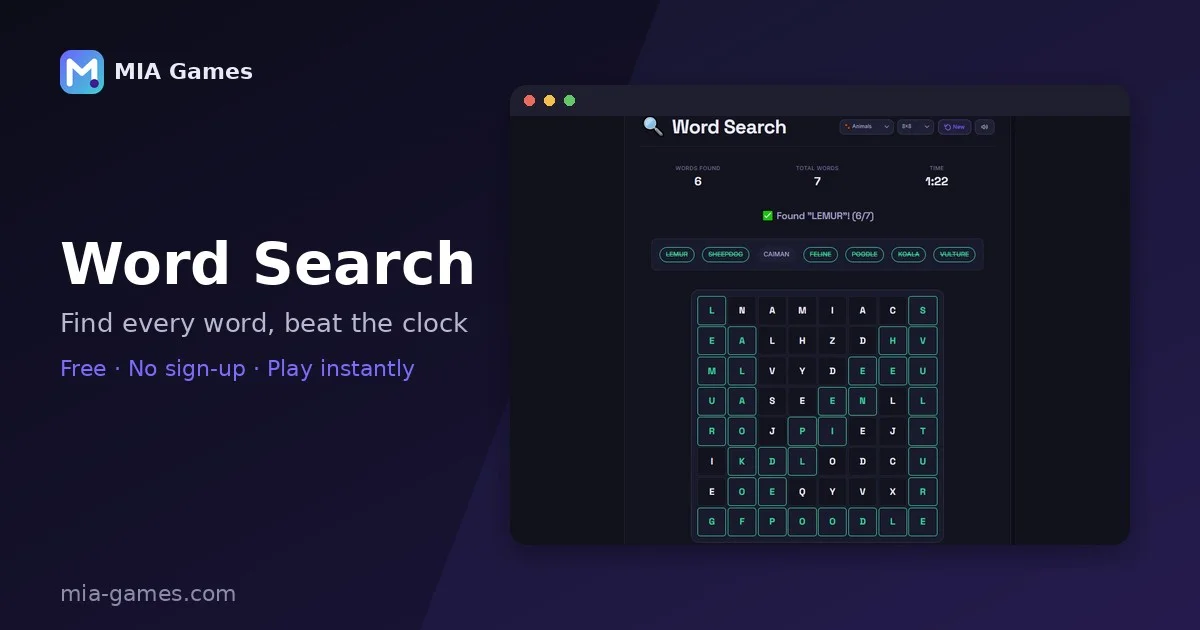
- Switch categories regularly: Our MIA Games Word Search offers six categories — Animals, Countries, Sports, Technology, Food, and Nature. Rotating between them keeps your brain flexible.
- Increase the grid size: Start with 8×8, then move to 10×10, then 12×12. The larger the grid, the more visual scanning is required.
- Track your time: The timer isn't just for show. It adds a speed element that challenges your processing speed.
- Don't use a systematic scan every time: Sometimes scan randomly. Sometimes go row by row. Variety keeps your brain adapting.
- Play regularly: Consistency is key. A few minutes each day is better than an hour once a week.
Beyond Word Search: Other Cognitive Games
While Word Search is excellent for visual processing and vocabulary, it's just one part of a complete brain training routine. Here are some other games at MIA Games that target different cognitive skills:
- Sudoku — For logical reasoning and working memory.
- Memory Match — For short-term memory and concentration.
- Hangman — For vocabulary and pattern recognition.
- Simon — For auditory and visual memory.
- Minesweeper — For logical deduction and spatial reasoning.
As we've written in our memory improvement guide, the best approach is to vary the games you play to exercise different cognitive functions.
The Joy of Simple Puzzles
There's something deeply satisfying about finding a hidden word. That moment when your eyes lock onto the pattern and the letters click into place — it's a small victory, but it's real. And when you've found all the words, there's a sense of accomplishment that's hard to replicate.
Word Search reminds us that learning and brain training don't have to be hard work. They can be fun. They can be playful. They can be something you look forward to, not something you dread.
Ready to Give Your Brain a Workout?
Whether you're a parent looking for a fun way to build your child's vocabulary, an adult seeking a quick mental reset, or an older adult wanting to keep your mind sharp, Word Search on MIA Games is the perfect place to start.
With six categories, three grid sizes, and a timer to challenge your speed, you'll never run out of puzzles to solve. And the best part? It's completely free.
Start searching today — and give your brain the workout it deserves!