📌 Key Takeaways
- Pong is an ongoing rally game: you follow the ball, position your paddle, and try to return each shot.
- A reaction-time test is a short, single-response task: wait for a visual signal, then respond as quickly as you can.
- Reaction-time results depend on the person, the task, and the device. Treat online scores as personal comparisons, not clinical measurements.
- Practice may make you more familiar with a particular game or test, but that does not prove your reflexes have improved in every situation.
- Choose Pong for a game of timing and rallies, or Reaction Time when you want to try a simple speed test. You can enjoy both for different reasons.
Ever get drawn into a Pong rally and find yourself leaning into every return? Or open a reaction-time test just to see how quickly you can tap when the screen changes? They both involve quick responses, but the experience is quite different. Pong asks you to follow a moving ball and keep a rally going. Reaction Time gives you a signal and asks for one quick response.
You can try both in your browser on MIA Games: Pong and Reaction Time. In this comparison, we look at how each game works, what you are doing while you play, and which one might suit you better. The aim is to explain the differences without suggesting that either game can transform your reflexes or measure your overall ability.
One is about keeping up with a moving game; the other is about responding to a single cue. Here is what to expect from each.
💡 The short version: Choose Pong if you enjoy rallies, timing, and trying to outplay an opponent. Choose Reaction Time if you want a quick test that gives you a result in milliseconds. Neither is the better choice for everyone; it depends on what you feel like playing.
Pong: The Rally Master
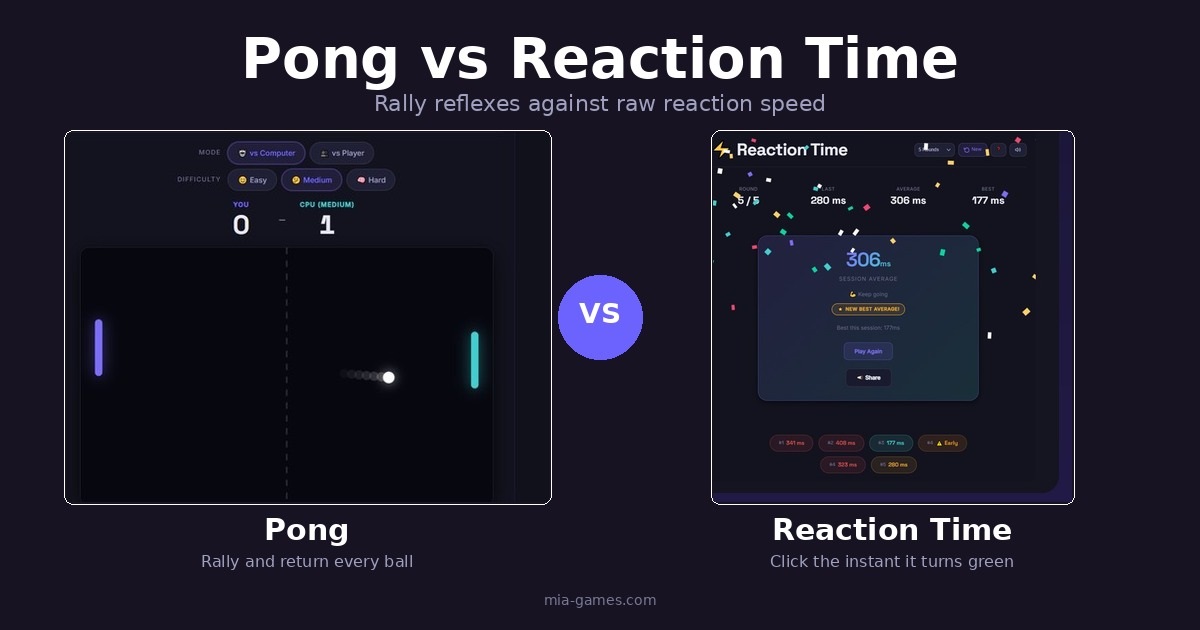
Pong has a simple idea: keep the ball in play. You move a paddle up and down to meet a ball that travels across the screen. Miss it and your opponent scores. The exact scoring target and ball behaviour can vary between versions, but the basic challenge is easy to understand: follow the ball, get your paddle into position, and try to return the shot.
Pong first appeared in arcades in 1972. Atari engineer Allan Alcorn created the game as an early programming exercise after co-founder Nolan Bushnell asked him to make a simple table-tennis game. The prototype was tested at a bar in Sunnyvale, California, where it quickly attracted players. Pong became an important early arcade hit and helped bring video games to a much wider audience. For more background, see our article on the evolution of Pong.
During a Pong match, you follow the ball, judge where it is heading, and move your paddle into position. You are responding repeatedly rather than making one isolated tap. Watching the ball’s path and anticipating its next movement can help you make better decisions during the game, although that is not the same as proving a general improvement in reflexes. Our article on Pong and hand-eye coordination explores the movements involved in more detail.
Reaction Time: The Pure Sprint
The Reaction Time game is more straightforward. Wait while the screen shows the waiting state; when it changes to green, tap or click as quickly as you can. The result is displayed in milliseconds (ms), a unit equal to one thousandth of a second. In this version, a set of five rounds is used to calculate an average. There is no rally to follow and no opponent to beat—just a short response test.
Simple reaction time has been studied in psychology for well over a century. Results vary with the person being tested, the type and timing of the signal, the response required, and the equipment used. In a 2015 study of 1,469 adults aged 18 to 65, Woods and colleagues reported a mean visual simple-reaction-time result of 231 milliseconds; after correcting for hardware delays, the figure was 213 milliseconds. That was a controlled research setup, not a universal target for every browser test. A home computer or phone can introduce its own timing differences, so an online score should be treated as an estimate rather than a laboratory measurement. If a result looks unusually fast, anticipation or a premature tap may also be involved.
A few attempts can help you become familiar with the test and its timing. Your results may also vary from round to round depending on attention, tiredness, and how you use the device. A lower score on one attempt does not necessarily mean your general reflexes have changed. If you want to explore the topic further, our reaction-time article discusses practice and testing in more detail.
Side-by-Side Comparison
The main difference is what you do from moment to moment. Pong involves repeated movement and decisions during a rally; the reaction-time game records how quickly you respond to a visual cue.
| Pong | Reaction Time | |
|---|---|---|
| What you do | Follow the ball and move the paddle throughout a rally | Wait for a visual cue, then respond once |
| Main challenge | Positioning, timing, and keeping the ball in play | Responding promptly to a changing signal |
| Opponent | A computer-controlled paddle or another player, depending on the version | Your own previous results |
| Session | A match can last several minutes, depending on play | A short series of quick attempts |
| Result | Match score and how the rally unfolds | Response time shown in milliseconds |
| What changes with practice | You can become more familiar with the ball's movement and game controls | You can become more familiar with the test and its timing |
| May appeal to | Players who enjoy rallies, competition, and timing | Players who enjoy short tests and comparing their own results |
Which Game for Which Player?
If you enjoy a game that develops over a series of returns, try Pong. You have to keep track of the ball and decide where to move your paddle. A close rally can be satisfying, especially when you manage to return a difficult shot or recover after falling behind. If you want some practical pointers, our Pong hand-eye coordination article looks at the movements involved.
If you are curious about your response time, try the Reaction Time test. It is quick to play and gives you a result you can compare with your own later attempts. For a fairer comparison, use the same device and input method each time, and remember that browser results are affected by hardware and software timing.
There is no reason to choose only one. Play Pong when you want a longer game with an opponent, then try the reaction-time test when you want a quick change of pace. They offer different challenges, so the one you prefer may simply depend on your mood.
Frequently Asked Questions
What is a good reaction time?
There is no single score that is right for everyone or every test. Research results depend on the task and the equipment used. One controlled 2015 study reported a mean of 231 ms for visual simple reaction time, but that figure should not be treated as a universal browser-game benchmark. For your own comparisons, use the same device and test conditions.
Does playing Pong improve your reflexes?
Pong gives you repeated practice at following a moving ball, positioning a paddle, and timing your returns. Those are skills used within the game. That does not, by itself, show that playing Pong improves reaction speed in unrelated everyday activities.
Can kids play both games?
Both games have simple rules, but whether they are suitable for a child depends on the child and the setting. Pong involves moving a paddle to return a ball; the reaction-time test asks the player to respond when the screen changes. Younger players may need a little help getting started.
Why is my score slower on my phone than on my computer?
Different screens, refresh rates, browsers, and input methods can affect the time recorded by an online test. Touch input and a mouse may not produce identical results, and the exact delay varies by setup. For a more useful personal comparison, use the same device, browser, and input method each time.
Do I need fast internet to play?
Both games are designed to run in your browser, so you do not need a high-speed connection for ordinary play. A stable connection is helpful when loading the page, but the reaction-time result is also influenced by your device and browser.
Which game should I play to warm up before a match?
Either can be a short warm-up, depending on what you want to do. A few Pong rallies let you get used to tracking the ball and moving the paddle. The reaction-time test gives you a quick response-time result. Neither should be treated as a proven way to improve performance in a separate sport or activity.
A Note on the Sources
This comparison combines basic descriptions of the two games with practical observations about how they are played. When we describe Pong as involving tracking and repeated responses, we are talking about the actions required during a match. When we describe Reaction Time as a response test, we mean the time recorded between a visual cue and a player's input. These descriptions should not be read as claims that either game improves general intelligence, reflexes, or performance outside the game.
For Pong's history, we refer to the Smithsonian's National Museum of American History and the Computer History Museum. For reaction-time measurements, we refer to a peer-reviewed study by Woods and colleagues. The study's results came from controlled testing and should not be directly equated with scores from every browser or device. Suggestions about which game a player might enjoy are editorial guidance, not medical or scientific advice.
Sources & Further Reading
- Smithsonian National Museum of American History: Pong, Atari, and the Origins of the Home Video Game: Background on Atari, Allan Alcorn, and Pong's early arcade history.
- Computer History Museum: Pong: Historical account of the Pong prototype and its early reception.
- Woods et al. (2015): Factors Influencing the Latency of Simple Reaction Time: Peer-reviewed research on visual simple reaction time and the effect of computer hardware and software delays.
- MIA Games: From Arcade to Browser: The Evolution of Pong: Additional background on Pong's history and later versions.
- MIA Games: Reaction Time Training: Brain Speed: Related reading on reaction-time tests and practice.
- MIA Games: How Pong Improves Hand-Eye Coordination: Related discussion of the movements and timing involved in Pong.
The Verdict
So, which one should you try first?
There is no overall winner because the games ask you to do different things. Pong is a game of repeated returns, positioning, and competition. Reaction Time is a short test built around responding to a visual signal. Choose the one that sounds more enjoyable today—or try both and see which one you come back to.
The main difference is simple: Pong keeps you involved in a rally, while the reaction-time test gives you a quick result to compare with your own attempts. Neither needs to be more than a bit of fun. Sometimes that is reason enough to play one more round.
More Games at MIA Games
If you feel like trying something different afterwards, take a look at Memory Match, work through a logic challenge in Sudoku, or test your timing with Classic Stack. MIA Games has more free browser games to explore, with no download required.
Ready to Play?
Feel like giving them a try? Both games are free to play in your browser.
Play Pong Play Reaction Time