📌 Key Takeaways
- Word Search is the calmer starting point: the words are given, there is no fail state, and a child can work at their own pace.
- Hangman is the more demanding follow-up: it asks a child to spell, guess letters in order, and use what they already know about words.
- Word Search mainly practises careful scanning and attention to detail. Hangman mainly practises spelling, vocabulary, and deduction.
- For most families, the best order is Word Search first, then Hangman when the child can spell simple words and wants a guessing challenge.
- Neither game needs exaggerated promises. Both are worth playing because they are fun, simple, and easy to fit into a short break.
Every parent knows the moment. Your child loves words, but you are not sure which game to hand them first. Two classics come up again and again: Word Search and Hangman. Both are word games. Both can be played with nothing more than paper and a pencil. But they ask a child to do very different things.
At MIA Games, we offer both Word Search and Hangman free in the browser. This comparison focuses on the games themselves: how they work, what they directly ask a child to practise, and which one fits which age. It is a practical guide, not a developmental or educational assessment.
Let us break it down — what each game teaches, when kids are ready, and how to know when it is time to move up.
💡 The practical answer: Start with Word Search for a young or unsure reader. Move to Hangman when the child can spell simple words and enjoys guessing. Use the child's interest and comfort, not a single birthday, as the guide.
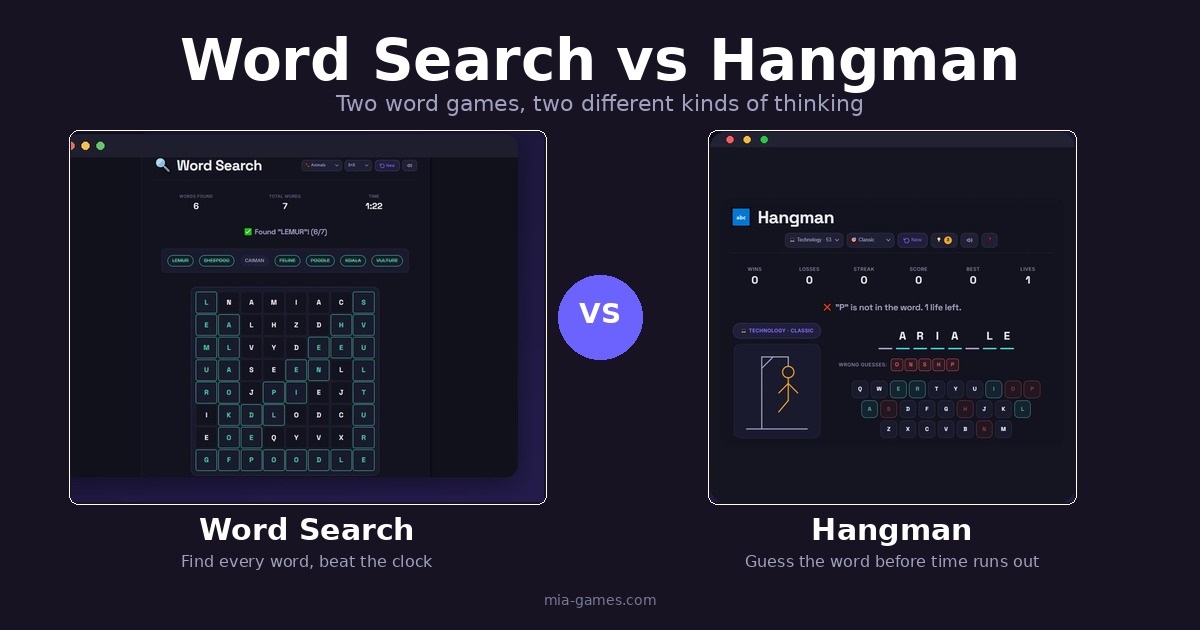
Word Search: The Calm Finder
Word Search is one of the simplest games to explain. A grid of letters hides a list of words. The player scans the grid, finds each word, and circles it. Words can run left to right, right to left, up, down, or diagonally. A game ends when every word on the list is found. There is no opponent, no timer in the classic version, and no moment when the game suddenly ends in failure. A child can stop, come back later, and pick up where they left off.
One well-documented milestone in the modern English-language word search is Norman E. Gibat’s puzzle, published in the Selenby Digest, a small advertising flyer in Norman, Oklahoma, on 1 March 1968. The puzzle hid names of Oklahoma towns in a letter grid, with words running in several directions. Accounts of its early circulation report that teachers requested copies for classroom use. This helps explain how the format reached more readers, although it does not by itself establish a measured educational benefit.
There is an important limit to the claim: Gibat's 1968 puzzle is often credited as an early published English-language example, but it is difficult to establish that it was the first word-search puzzle in any language. Similar formats are associated with Spanish puzzle-maker Pedro Ocón de Oro, and the history is not fully settled. It is more accurate to describe 1968 as a documented milestone than to claim a definitive global invention date.
What kids practise: scanning a grid carefully, telling similar letters apart, holding a target word in mind while searching, and staying patient when a word does not appear at once. Because the words are given, a child does not need to know how to spell them first. This can make a simple Word Search accessible to some early readers: the word list supplies the target, so the task is locating it rather than recalling its spelling from memory. A child still needs enough letter recognition to use the grid, and puzzle difficulty matters.
Hangman: The Letter Detective
Hangman works the other way round. One player thinks of a word and draws a blank for each letter. The other player guesses one letter at a time. A correct letter is filled into every place it appears. A wrong letter brings the player one step closer to losing, traditionally by adding one part of a stick figure. Guess the whole word before the figure is complete, and you win. Run out of guesses first, and the word wins.
Hangman's origins are much less clear than Word Search's. No single inventor or year is known. Tony Augarde's The Oxford Guide to Word Games describes Hangman's origins as uncertain and suggests the game may date to the Victorian period. Alice Gomme's Traditional Games (1894) records a related word-guessing game called "Birds, Beasts and Fishes", which does not use the familiar gallows drawing. This is useful evidence of an earlier guessing-game tradition, but it does not prove that the modern game of Hangman was invented in 1894. The exact origin and development of the familiar version remain unclear.
That distinction matters for parents. The guessing itself is the game. The drawing is only a way of counting wrong guesses. Families can replace the drawing with a neutral countdown, such as removing leaves from a tree or filling a simple progress bar. That keeps the letter-guessing rules while changing the theme for children who dislike the traditional image. These are optional house rules, not a universal teaching practice.
What kids practise: spelling, letter frequency, and deduction. A player may begin with common letters such as E or A, then use the revealed pattern to decide which letter to try next. The best guess depends on the word list and language, so no fixed letter order guarantees success. Each answer narrows the possibilities: a revealed letter pattern rules some words out and points to others. Unlike Word Search, Hangman only works if the child already knows, or can work out, the word being guessed. That usually makes Hangman harder to begin with for a child who is still learning basic spelling; some children may nevertheless enjoy trying it with help and familiar words.
Side-by-Side Comparison
Here is how the two games stack up for parents deciding where to start:
| Word Search | Hangman | |
|---|---|---|
| Starting point | Around 5–6 for short, familiar words; stays fun well beyond that with larger grids | Around 7–8, once a child can spell simple words; earlier with adult help and very short words |
| Core skill | Visual scanning and attention to detail | Spelling, vocabulary, and letter-by-letter deduction |
| Vocabulary needed | None to start — the words are given on the list | Must know, or be able to work out, the hidden word |
| Solo play | Natural — it is a solo puzzle by design | Traditionally needs a word-setter; the browser version supplies the word, so it works solo too |
| Typical feel | Calm, no fail state, easy to pause and return to | Tense in a good way — every wrong guess costs a chance |
| What it directly practises | Scanning, pattern matching, patience | Spelling, letter frequency, guessing from partial clues |
| Practical fit | Good for quiet time, pre-readers, and children who dislike losing | Good when a child wants a challenge and enjoys guessing games |
Which Game for Which Age?
For younger children and early readers, Word Search may be the easier starting point. A child is a good candidate when they can recognise letters and enjoy finding things, even if they cannot spell yet. Use short word lists, familiar themes such as animals or colours, and small grids. Words that run only left to right and top to bottom are the gentlest start.
Introduce Hangman when basic spelling is underway. Look for a child who can spell simple words such as CAT, DOG, and SUN, and who enjoys guessing. Start with short, concrete words, give a category clue such as "animal" or "food", and play together at first so a wrong guess feels like a clue, not a failure.
Older children: let interest guide the choice. Some children will keep enjoying large, tricky word searches with diagonal and backwards words. Others will prefer the deduction of Hangman, especially with longer words and themed lists. If they become curious about the history of either game, our Word Search benefits article and our Hangman benefits article go deeper, and our kids games guide places both games among our 13 free browser games.
Frequently Asked Questions
At what age can a child start word searches?
Some children may enjoy simple word searches around age 5 or 6, especially with short, familiar words in a small grid. This is a practical suggestion, not a developmental cutoff. Start with words that run left to right, then add up, down, and diagonal words as the child gets more confident.
Is Hangman good for spelling?
Hangman directly practises spelling: a child must think about which letters belong in a word, in what order, and which letters are most likely. It works best once a child can already spell some simple words, so the game practises spelling rather than teaching it from zero.
Which game is better for a 5-year-old?
Word Search may be the easier fit for a 5-year-old who recognises letters, because the words are provided and the puzzle does not have a conventional losing state. Hangman can still work with very short, familiar words and help from an adult, but it asks more of a young speller.
Can you play both games solo?
Word Search is naturally a solo game. Hangman traditionally needs one person to choose the word, but the browser version on MIA Games supplies the word, so a child can play Hangman alone too.
What should my child play after word searches get too easy?
Try larger grids, diagonal and backwards words, and themed word lists. If the child is ready for a different challenge, Hangman is one possible next step: it uses the same love of words, but adds guessing, deduction, and spelling practice.
Is the hanging picture a problem for young children?
It can be for some children. A family can swap the drawing for a neutral image or countdown if that feels more comfortable for the child. The word-guessing part of the game stays exactly the same.
How Reliable Is This Comparison?
This article combines factual descriptions of the games with MIA Games' practical editorial guidance for families. The descriptions of scanning, letter recognition, spelling, and guessing refer to actions used during play; they should not be read as evidence that either game improves general intelligence, school performance, or long-term cognitive outcomes. Those broader claims would require separate, relevant research.
For the historical points, the sources below include a history of Gibat's 1968 puzzle and bibliographic records for Alice Gomme's 1894 collection and Tony Augarde's reference book on word games. These sources support a cautious account, not a definitive claim about the first word search ever or a single inventor of Hangman. Age suggestions in this article are practical starting points, not clinical or educational assessments.
Sources & Further Reading
- History of Word Search Puzzles — From 1968 to Today: A secondary history of Norman Gibat’s Selenby Digest puzzle, the 1968 date, and uncertainty around claims of a single first inventor.
- Alice Bertha Gomme, The Traditional Games of England, Scotland, and Ireland (1894): Digitised primary source for Gomme’s collection of traditional games; useful historical context for the related guessing game.
- Tony Augarde, The Oxford Guide to Word Games (Oxford University Press): Bibliographic record for a reference work discussing the history and rules of traditional word games, including Hangman.
- Open Library catalogue — The Traditional Games of England, Scotland, and Ireland: Catalogue record confirming the 1894 publication details of Gomme’s collection.
- MIA Games — Word Search Brain Workout Benefits: Additional site article about the Word Search game.
- MIA Games — Hangman Word Game Benefits: Additional site article about Hangman.
The Verdict
So, which word game is best for kids — Word Search or Hangman?
The honest answer is: there is no universal winner. Word Search can feel more approachable because the target words are supplied and a round does not normally end in a loss. Hangman asks the player to infer a word from partial information, which may suit a child who is already comfortable with simple spelling. Trying Word Search first and Hangman later is one reasonable route, but interest and readiness matter more than a fixed sequence.
If you take one thing from this article, let it be this: choose the game that creates the right level of challenge. Word Search centres on locating given words in a grid. Hangman centres on guessing letters and using the pattern to narrow down a word. Both can be enjoyable without making broad promises about educational outcomes.
More Word Games at MIA Games
Once your child has tried both games, there is a whole shelf of word and puzzle games waiting. Test pattern skills with Memory Match, work up to the logic puzzles in Sudoku, or try a quick number challenge in 2048. Every game is free, runs in the browser, and needs no download.
Ready to Play?
Put theory into practice — play both games free right now.
Play Word Search Play Hangman